
Superheat vs Subcooling: A Field Guide for HVAC Techs
- 13 May, 2026
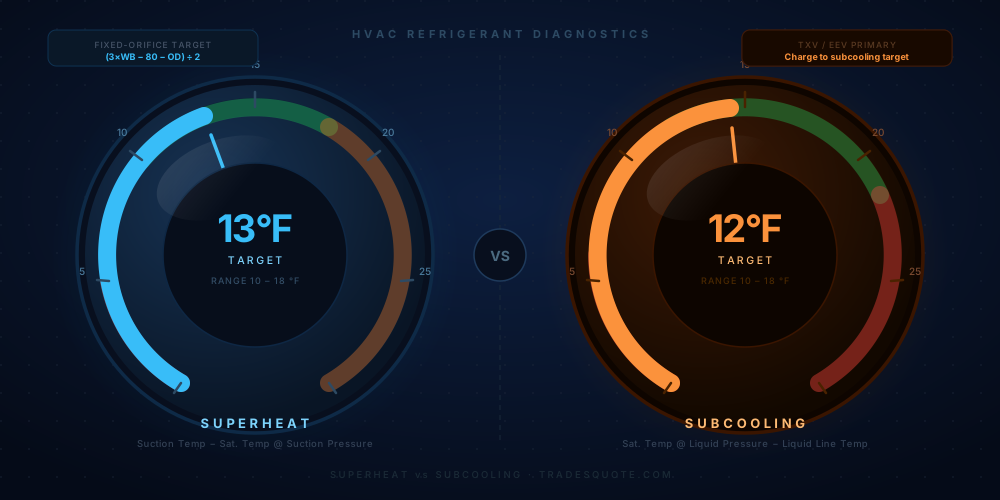
Superheat tells you what the refrigerant is doing at the evaporator outlet; subcooling tells you what it is doing at the condenser outlet - and together they are the two most reliable diagnostic numbers you have for refrigerant charge. They are also the measurements behind telling an overcharged system from an undercharged one.
What Is Superheat
Superheat is the number of degrees the refrigerant vapor is above its saturation temperature at the suction pressure. A refrigerant boiling at 40°F saturation that exits the evaporator as 50°F vapor has 10°F of superheat.
Formula:
Superheat = Suction Line Temperature − Saturation Temperature at Suction PressureSuperheat confirms the refrigerant has fully vaporized before it reaches the compressor. Zero superheat means liquid is returning to the compressor, which causes mechanical damage. Too much superheat means the evaporator is starved.
Target Superheat by System Type
| System Type | Normal Range | Notes |
|---|---|---|
| Fixed-orifice (piston/cap tube) | 10–18°F | Use Target Superheat formula |
| TXV / EEV | 8–12°F at evap outlet | TXV self-regulates; verify at suction service valve |
Target Superheat formula for fixed-orifice systems:
Target Superheat = ((3 × Indoor Wet Bulb °F) − 80 − Outdoor Dry Bulb °F) / 2Example: Indoor WB = 67°F, Outdoor DB = 95°F
((3 × 67) − 80 − 95) / 2 = (201 − 80 − 95) / 2 = 26 / 2 = 13°FA measured superheat within 3°F of target is acceptable. Anything outside that range warrants investigation before adding or removing refrigerant.
What Is Subcooling
Subcooling is the number of degrees the liquid refrigerant is below its saturation temperature at the liquid line (high-side) pressure. Liquid leaving the condenser at 115°F saturation but measured at 105°F has 10°F of subcooling.
Formula:
Subcooling = Saturation Temperature at Liquid Pressure − Liquid Line TemperatureSubcooling confirms a solid column of liquid is reaching the metering device. Flash gas at the TXV inlet causes erratic superheat and reduced capacity.
Target Subcooling by System Type
| System Type | Normal Range | Notes |
|---|---|---|
| TXV / EEV | 10–18°F | Measured at condenser outlet / liquid service valve |
| Fixed-orifice | 5–10°F | Less critical; superheat is the primary charge indicator |
TXV systems are charged to subcooling. Fixed-orifice systems are charged to superheat. Mixing up which measurement to use is one of the most common field errors.
Where superheat and subcooling are measured
How to Measure Superheat and Subcooling
- Connect manifold gauges to the suction and liquid service valves.
- Let the system stabilize under load for 10–15 minutes before recording readings. Readings taken during pull-down are meaningless.
- Record suction pressure. Use a PT chart or refrigerant app to convert that pressure to saturation temperature.
- Clamp a digital temperature probe on the suction line 6 inches from the service valve, in the shade, with proper insulation over the probe.
- Subtract saturation temperature from line temperature - that is your superheat.
- Record liquid (high-side) pressure. Convert to saturation temperature.
- Clamp the temperature probe on the liquid line at the condenser outlet.
- Subtract liquid line temperature from saturation temperature - that is your subcooling.
Use the same refrigerant on the PT chart as what is in the system. R-410A, R-22, and R-32 have different saturation curves.
How to measure superheat and subcooling
What High and Low Readings Mean
High Superheat
Measured superheat is more than 3–5°F above target.
- Undercharged system - most common cause
- Restricted metering device (piston partially blocked, TXV stuck closed)
- Low evaporator airflow (dirty filter, failed blower, closed registers)
- Refrigerant restriction in the liquid line (kinked line, bad filter-drier)
Do not add refrigerant before checking airflow. A dirty evaporator coil can produce high superheat readings identical to a 1-lb undercharge - confirm airflow first with a static pressure test and a Delta T reading before you touch the charge.
Low Superheat
Measured superheat is more than 3–5°F below target, or below 5°F.
- Overcharged system
- TXV stuck open or oversized
- High indoor latent load (unusually humid conditions)
- Flooded start if the system was just turned on
Low superheat below 5°F risks liquid slugging the compressor. Do not ignore it.
High Subcooling
Measured subcooling is above 18°F.
- Overcharged system - liquid is backing up into the condenser
- Liquid line restriction downstream of measurement point (filter-drier, solenoid valve, kinked line)
Check the filter-drier by feeling for a temperature split across it. A cold inlet and warm outlet confirms a blocked drier.
Low Subcooling
Measured subcooling is below 5°F.
- Undercharged system
- Excessive heat gain in the liquid line (long uninsulated runs in a hot attic)
- Condenser coil fouled, causing high condensing temperature
What superheat and subcooling readings mean
Which Measurement to Use
Use superheat as the primary charge indicator on fixed-orifice systems. The metering device cannot self-regulate, so refrigerant charge directly controls how much liquid feeds the evaporator.
Use subcooling as the primary charge indicator on TXV and EEV systems. The valve maintains suction superheat automatically within its range, so suction superheat alone will not tell you if the system is overcharged by 2 lbs. Subcooling reflects the total refrigerant inventory in the system.
On TXV systems, check both. Subcooling confirms charge; superheat confirms the valve is functioning correctly.
Superheat and Subcooling Calculator
A superheat and subcooling calculator (also called a superheat subcooling calculator, subcool and superheat calculator, or superheat and subcool calculator) converts gauge pressures and line temperatures into superheat and subcooling values using the refrigerant’s PT chart. Enter suction pressure, suction line temp, liquid pressure, and liquid line temp - the calculator handles saturation lookup and subtraction.
Field workflow: stabilize the system under load, record all four readings, then run the superheat and subcooling calculator to compare against target ranges before adding or removing refrigerant.
Use the Free Calculators
Superheat Calculator - superheat from suction pressure and line temperature.
Subcooling Calculator - subcooling from liquid pressure and line temperature.
FAQ
What is normal superheat for an R-410A system?
For a fixed-orifice R-410A system, use the Target Superheat formula: ((3 × Indoor WB) − 80 − Outdoor DB) / 2. Under typical summer conditions (67°F WB indoor, 95°F outdoor), that works out to 13°F. Acceptable measured range is 10–16°F. For a TXV system with R-410A, target 8–12°F at the evaporator outlet.
What is normal subcooling for a TXV system?
10–18°F at the condenser outlet or liquid service valve. Most manufacturers specify 10–15°F. Check the equipment nameplate or service manual for the specific unit - some systems list a target subcooling value directly on the data plate.
How do I know if an AC is overcharged?
On a TXV system, subcooling above 18°F with normal or low superheat is the clearest indicator of overcharge. On a fixed-orifice system, superheat well below target (under 5°F) combined with high suction pressure points to overcharge. High discharge pressure and high amperage draw are supporting evidence, but subcooling and superheat are the definitive measurements.
Can I use subcooling to charge a fixed-orifice system?
Technically yes, but it is unreliable. Fixed-orifice systems have wider subcooling swings with normal charge variation than TXV systems do. Use superheat as the primary indicator and cross-check subcooling only as a sanity check.
Why does superheat change when outdoor temperature changes?
Because saturation temperature at suction pressure changes with heat load, and outdoor ambient affects how hard the condenser works, which in turn affects suction pressure. That is why the Target Superheat formula includes outdoor dry bulb temperature - the target shifts with conditions. A system that reads 18°F superheat at 85°F ambient and 13°F at 100°F ambient may be perfectly charged both times.