
Furnace Sizing Guide: What Size Furnace for My House?
- 27 May, 2026
The right furnace size for a 2,000 sq ft house in a cold climate (Zone 5) is roughly 90,000–100,000 BTU output - but that number changes significantly based on where you live and how well your home is insulated.
This guide walks through the standard sizing rules, the AFUE adjustment that most homeowners miss, a full BTU table by climate zone, and a real worked example so you can walk into a contractor conversation with the right number already in hand.
The BTU Per Square Foot Rule by Climate Zone
HVAC engineers size furnaces using a heat loss calculation (Manual J), but the BTU-per-square-foot shortcut gets you close enough to verify a contractor’s quote or narrow down your options. This is the heating-side counterpart to cooling capacity - if you also need to size an air conditioner, see how many BTU you need for AC.
The three tiers that matter:
- Zones 1–2 (mild climates): 30 BTU per square foot. Think Florida, southern Texas, coastal California.
- Zones 3–4 (moderate climates): 45 BTU per square foot. Think Virginia, Missouri, Oregon, the Pacific Northwest.
- Zones 5–6 (cold climates): 60 BTU per square foot. Think Minnesota, Wisconsin, upstate New York, most of Canada.
If your home is older with minimal insulation, add 10–15% to these figures. If it was built after 2000 with good insulation and low-E windows, you can often subtract 10%.
Furnace BTU per square foot by climate zone
BTU Table: Square Footage by Climate Zone
| Home Size (sq ft) | Zone 1-2 (30 BTU/sqft) | Zone 3-4 (45 BTU/sqft) | Zone 5-6 (60 BTU/sqft) |
|---|---|---|---|
| 1,000 | 30,000 BTU | 45,000 BTU | 60,000 BTU |
| 1,200 | 36,000 BTU | 54,000 BTU | 72,000 BTU |
| 1,500 | 45,000 BTU | 67,500 BTU | 90,000 BTU |
| 1,800 | 54,000 BTU | 81,000 BTU | 108,000 BTU |
| 2,000 | 60,000 BTU | 90,000 BTU | 120,000 BTU |
| 2,200 | 66,000 BTU | 99,000 BTU | 132,000 BTU |
| 2,500 | 75,000 BTU | 112,500 BTU | 150,000 BTU |
| 3,000 | 90,000 BTU | 135,000 BTU | 180,000 BTU |
These figures are output BTU - the actual heat delivered to your living space. Furnace nameplates show input BTU, which is higher. That brings us to the step most homeowners skip.
The AFUE Adjustment: Input vs. Output BTU
AFUE (Annual Fuel Utilization Efficiency) is the percentage of fuel energy that becomes usable heat. A 96% AFUE furnace turns 96 cents of every dollar of gas into heat. The other 4 cents goes out the flue.
To find the input BTU nameplate you need to buy:
Input BTU = Output BTU / AFUE
Example: You need 80,000 BTU of output and you’re buying a 96% AFUE furnace.
80,000 / 0.96 = 83,333 input BTU
Furnaces come in standard nameplate sizes: 60k, 80k, 100k, 120k. In this case you’d choose between an 80k and a 100k input unit. With an 80% AFUE furnace, the same 80,000 BTU output need becomes:
80,000 / 0.80 = 100,000 input BTU
That’s a full nameplate size difference driven entirely by efficiency. Always do this conversion before comparing prices.
AFUE input vs output BTU
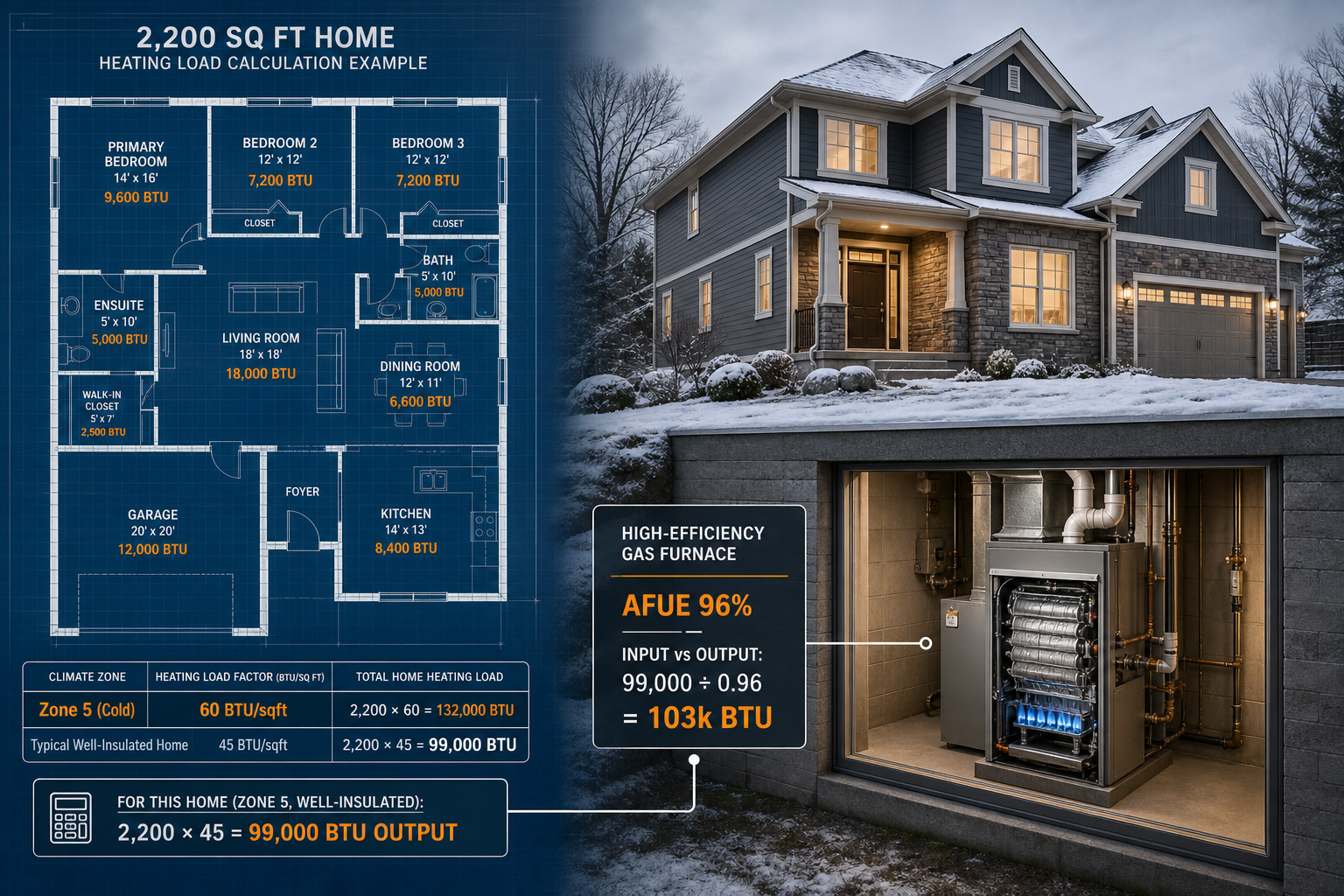
Worked Example: 2,200 sq ft House in Denver (Zone 5)
Denver sits in Climate Zone 5. Using the 60 BTU/sqft rule with a slight reduction for a well-insulated modern home, the right multiplier is 45 BTU/sqft (Denver’s altitude and dry climate mean heat loss is somewhat lower than a humid cold climate like Chicago).
- Square footage: 2,200
- Multiplier: 45 BTU/sqft (Zone 5, well-insulated)
- Output needed: 2,200 x 45 = 99,000 BTU
Now apply the AFUE adjustment for a 96% furnace:
- 99,000 / 0.96 = 103,125 input BTU
The nearest standard nameplate sizes are 100k and 120k. A 100k input unit delivering 96,000 BTU output is only 3% short - acceptable. A 120k unit is 20% oversized, which causes the problems described below. Buy the 100k.
Why Contractors Oversize by 25–50%
Oversizing is the most common furnace mistake, and it usually comes from contractors who add safety margins on top of safety margins.
An oversized furnace short-cycles: it reaches the thermostat setpoint quickly, shuts off, then restarts minutes later. Each startup draws a surge of gas and stresses the heat exchanger. The result is:
- Cold spots in rooms far from the furnace (the blower runs too briefly to distribute heat evenly)
- Higher utility bills from frequent on/off cycling versus steady operation
- Accelerated wear on the heat exchanger and igniter
- More humidity swings because the blower doesn’t run long enough to condition the air
The fix is not always a smaller furnace - it’s an accurate load calculation. If a contractor quotes you a 120k unit for a 2,200 sq ft Denver home without showing you a Manual J calculation, ask for one. Our comparison of Manual J vs. rules of thumb explains why the per-square-foot figure is only a sanity check and the load calc is what should size the equipment.
Oversized furnace consequences
Two-Stage vs. Single-Stage Furnaces
A single-stage furnace runs at 100% capacity every time it fires. A two-stage furnace runs at approximately 65% capacity for most cycles and ramps to 100% only on the coldest days.
The practical difference: in a properly sized two-stage furnace, roughly 80% of heating cycles run at the lower stage. That means:
- Longer, quieter runs that distribute heat more evenly
- Reduced temperature swings at the thermostat
- Slightly lower utility bills (though savings are modest - 3–5% over a comparable single-stage)
Two-stage makes the most sense when you have a large home or rooms that are hard to heat evenly. For a smaller, well-insulated home, the price premium may not be worth it. Once you have settled on a size, our furnace replacement cost breakdown shows what that nameplate translates to in installed dollars. And if you live somewhere with hard winters, it is worth weighing a furnace against a cold-climate heat pump before you buy.
Use the Free Calculator
Furnace BTU Calculator - get your exact answer in seconds.
FAQ
What size furnace do I need for a 1,500 sq ft house?
It depends on your climate zone. In a mild climate (Zones 1–2), a 1,500 sq ft house needs about 45,000 BTU output. In a moderate climate (Zones 3–4), about 67,500 BTU. In a cold climate (Zones 5–6), about 90,000 BTU. Apply the AFUE conversion to find the right input nameplate size.
Is a bigger furnace always better?
No. Oversizing is more harmful than undersizing in most situations. An oversized furnace short-cycles, creates cold spots, and wears out faster. The goal is a furnace that runs in longer, steady cycles - not one that blasts heat and shuts off.
What does AFUE mean and why does it matter for sizing?
AFUE stands for Annual Fuel Utilization Efficiency. It measures what percentage of the fuel burned becomes usable heat. A 96% AFUE furnace delivers 96,000 BTU of heat for every 100,000 BTU of gas consumed. It matters for sizing because furnace nameplates show input BTU, not output BTU. If you need 90,000 BTU of heat and you’re buying a 96% AFUE unit, you need a nameplate that delivers at least 90,000 / 0.96 = 93,750 input BTU - which means buying a 100k unit, not an 80k unit.
How do I find my climate zone?
The US Department of Energy publishes a climate zone map. As a quick reference: Florida and southern Texas are Zone 1–2, the mid-Atlantic and Pacific Northwest are Zone 3–4, and the upper Midwest, New England, and Mountain states are Zone 5–6. Most of Canada falls in Zone 6–8.
Should I get a Manual J calculation?
Yes, if you’re spending $3,000–$8,000 on a new furnace. A Manual J calculation accounts for window area, insulation R-values, ceiling height, infiltration rate, and local design temperatures. The BTU-per-square-foot rule is a sanity check - Manual J is what your contractor should be using to size the equipment.