
What Size Heat Pump Do I Need? A Guide for Cold Climates
- 03 Jun, 2026
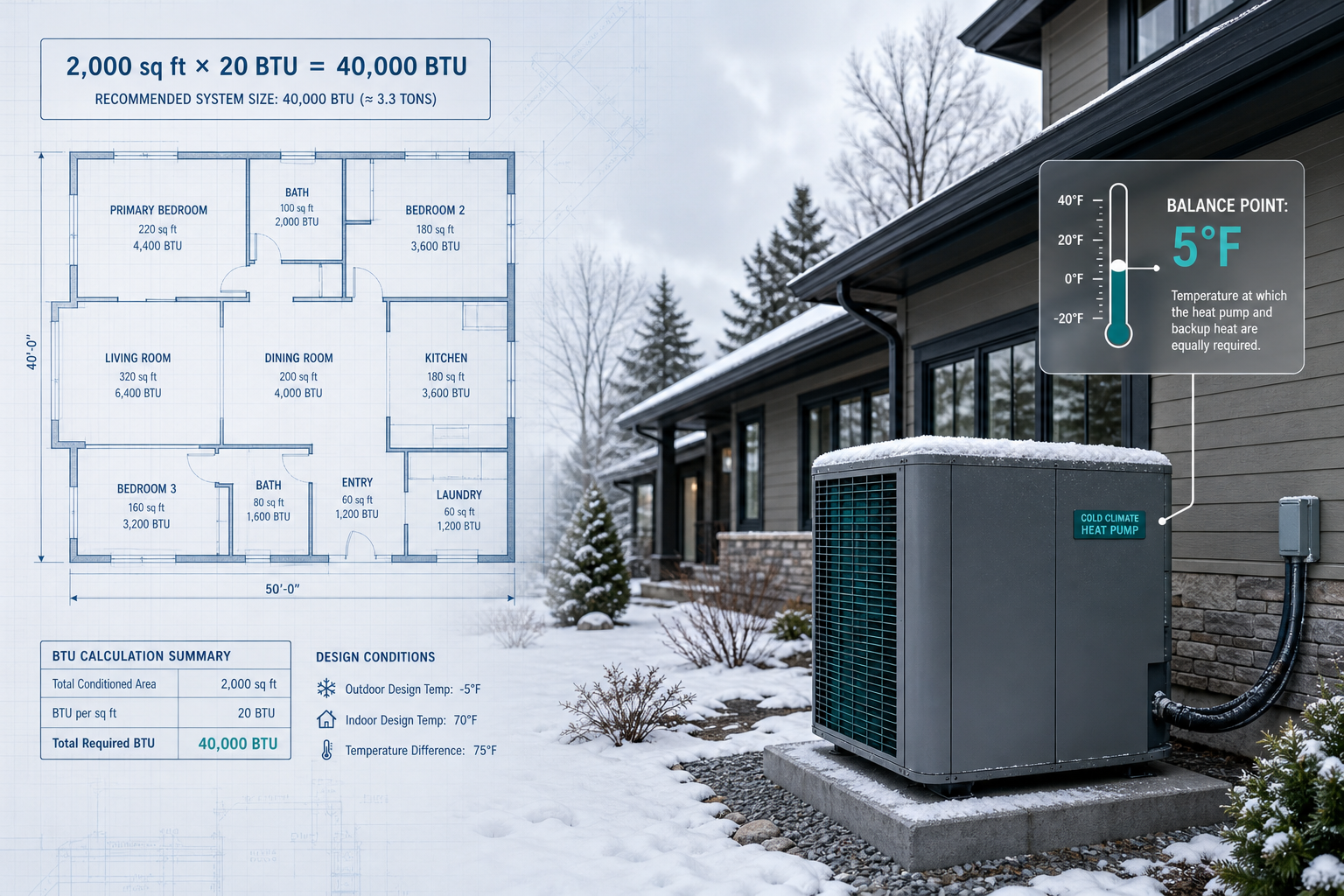
Most homeowners need a heat pump sized at 20 BTU per square foot of conditioned space - but in cold climates, that rule only gets you halfway to the right answer.
Heat pumps are sized to the cooling load first. Then you run a balance-point analysis to determine whether that unit can handle your heating load, or whether you need a cold-climate model and backup heat. This guide walks through both steps with real numbers.
Size to Cooling, Not Heating
Unlike a furnace, a heat pump does two jobs: cooling in summer and heating in winter. The standard sizing rule starts with cooling capacity:
20 BTU per square foot is the baseline for a conditioned, reasonably insulated home in a moderate climate.
A 2,000 sq ft home needs roughly 40,000 BTU, which is a 3.5-ton unit (1 ton = 12,000 BTU). This is the same starting point used for any air conditioner - our how many BTU do I need guide covers the cooling-load math and adjustment factors in full.
Adjustments that increase this number:
- High ceilings (above 9 ft)
- Poor insulation or older windows
- High solar exposure or dark roofing
- More than average occupants or internal heat loads
Adjustments that decrease it:
- Excellent insulation and air sealing
- Heavy tree shading
- Cooler climates (Zone 5-6)
If you oversize to meet the heating load in a cold climate, you will have a unit far too large for summer cooling. An oversized heat pump short-cycles, fails to dehumidify properly, and wears out faster.
The Balance Point: Where Cold Climate Sizing Gets Complicated
The balance point is the outdoor temperature at which your heat pump’s heating output exactly equals your home’s heat loss. Below that temperature, the heat pump cannot keep up on its own.
Standard heat pumps: balance point around 30-40°F. Below that, you need supplemental heat.
Cold-climate heat pumps (rated to -13°F or lower): balance point around 5-15°F. These units use variable-speed compressors and refrigerants optimized for low ambient temperatures.
The colder your climate, the more the balance point matters. In Zone 3, a standard unit with electric resistance backup is a reasonable choice. In Zone 6, a standard unit will be running on backup heat for months at a time, which is expensive if that backup is electric resistance.
Heat pump balance point
Climate Zone Guide
Use this table to match your climate zone to the right equipment strategy.
| Climate Zone | Example Cities | Recommended Strategy |
|---|---|---|
| Zone 1-2 | Miami, Houston | Standard heat pump, no backup needed |
| Zone 3-4 | Charlotte, Kansas City | Standard heat pump with backup heat |
| Zone 5 | Chicago, Denver | Cold-climate unit preferred; backup recommended |
| Zone 6 | Minneapolis, Burlington VT | Cold-climate unit required; backup heat essential |
| Zone 7 | Fairbanks, northern Maine | Cold-climate unit plus robust backup system |
Find your zone using the Department of Energy’s climate zone map, or look up your city’s design heating temperature (the 99th percentile coldest outdoor temperature used for load calculations).
Heat pump strategy by climate zone
Dual-Fuel vs. All-Electric
Once you know you need backup heat, you have two options:
Dual-fuel system: A heat pump paired with a gas or propane furnace. The heat pump handles most of the heating season efficiently. The furnace fires only on the coldest days. This is often the most cost-effective choice where natural gas is available, because gas is cheaper per BTU than electric resistance on the coldest days.
All-electric system: A cold-climate heat pump paired with electric resistance backup strips. No gas line required. Total operating cost depends on your local electricity rate, but modern cold-climate units reduce the hours the backup strips run significantly compared to a standard unit.
The right choice depends on your gas availability, local utility rates, and how deep your winters go. In Zone 6 with expensive electricity, dual-fuel typically wins on annual operating cost. For a full side-by-side of the two heating sources, see our heat pump vs. gas furnace cost comparison, and if you are sizing the furnace half of a dual-fuel setup, the furnace sizing guide covers the BTU math by climate zone.
Dual-fuel vs all-electric backup
Worked Example: 2,000 Sq Ft Home in Minneapolis (Zone 6)
- Cooling load: 2,000 sq ft x 20 BTU/sq ft = 40,000 BTU = 3.5 tons
- Design heating temperature: -13°F (Minneapolis 99th percentile)
- Equipment choice: Cold-climate heat pump rated to -13°F
- Capacity at design temp: Modern cold-climate units deliver roughly 60% of rated heating capacity at -13°F. A 40,000 BTU rated unit delivers about 24,000 BTU at -13°F.
- Heat loss at design temp: A well-insulated 2,000 sq ft home in Minneapolis typically loses 40,000-50,000 BTU/hr at -13°F.
- Gap: Backup heat covers the shortfall on the coldest days. The heat pump runs efficiently down to around 0°F and reduces backup usage to a small fraction of heating hours.
Sizing this home to a 5-ton unit to “meet the heating load” would result in a unit far too large for summer, with 60,000 BTU of cooling capacity for a 40,000 BTU load. That is a significant oversizing problem. Before you commit to a size, confirm the cooling load with a proper load calculation - our look at Manual J vs. the rule of thumb explains why the per-square-foot estimate is only a starting point.
Use the Free Calculator
Heat Pump Sizing Calculator - get your exact answer in seconds.
FAQ
What size heat pump do I need for a 2,000 sq ft house?
Start with 40,000 BTU (3.5 tons) as your baseline. Adjust up for poor insulation, high ceilings, or strong sun exposure. Adjust down for tight construction and heavy shading. Always confirm with a Manual J load calculation before purchasing equipment.
Do heat pumps work below 0 degrees?
Standard heat pumps lose most of their heating capacity below 20-25°F and become ineffective below 0°F. Cold-climate heat pumps (also called hyper-heat or ultra-low ambient units) are tested and rated at -13°F and can maintain meaningful heating output below 0°F. If you live in Zone 5 or colder, specify a cold-climate model.
Should I size a heat pump to the heating load or the cooling load?
Size to the cooling load. Oversizing to meet the heating load causes short-cycling, poor dehumidification, and premature wear in summer. If the cooling-sized unit cannot meet the heating load on the coldest days, the correct solution is a cold-climate model and a properly sized backup heat source - not a larger heat pump.