
How Much Does a New HVAC System Cost in 2026?
- 26 Jun, 2026
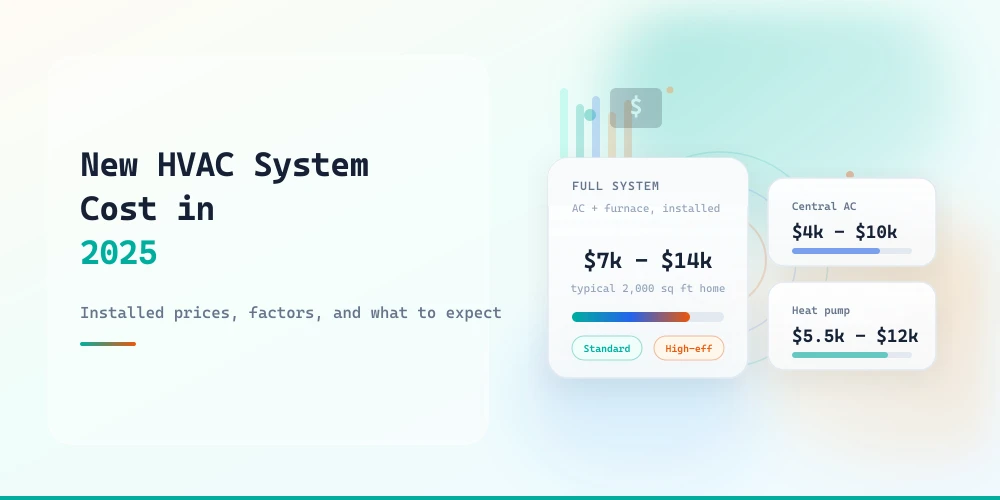
A new HVAC system costs $7,500 to $15,000 installed for a typical US home with a central air conditioner and gas furnace in 2026. That range covers a 2,000 sq ft home with good existing ductwork and average labor costs. Equipment and labor prices have edged up over the past year, so a job that ran $7,000 in 2024 commonly lands closer to $7,500–$8,000 today. Your number can fall below or above the range depending on equipment tier, duct condition, and where you live.
2026 HVAC Price Ranges by System Type
The table below reflects installed costs - equipment plus labor - for a standard 2,000 sq ft home with usable existing ductwork. Prices are national averages.
| System Type | Efficiency | Installed Cost Range |
|---|---|---|
| Central AC only | Standard (14–16 SEER2) | $4,500 – $7,000 |
| Central AC only | High efficiency (18+ SEER2) | $7,000 – $10,500 |
| Gas furnace only | 80% AFUE | $2,800 – $4,800 |
| Gas furnace only | 96% AFUE | $4,000 – $6,500 |
| Full system (AC + furnace) | Standard | $7,500 – $12,000 |
| Full system (AC + furnace) | High efficiency | $11,000 – $17,000 |
| Air source heat pump | Standard cold-weather rating | $6,000 – $9,500 |
| Cold climate heat pump | Rated to -15°F | $7,500 – $13,000 |
| Mini-split, single zone | 18,000–24,000 BTU | $3,000 – $5,000 |
These ranges assume a like-for-like replacement on a 2- to 3-ton system. A larger home needing 4 or 5 tons adds $1,000–$3,000 to most categories.
2026 HVAC price ranges by system type
What Drives the Cost Up
Old or inadequate ductwork is the single biggest variable. If your ducts need to be replaced or significantly modified, add $2,000 to $6,500 to any of the figures above. Duct replacement on a two-story home with tight attic access regularly runs $4,500–$6,500 on its own - see Ductwork Replacement Cost.
Difficult access and installation conditions add labor hours fast. A furnace in a crawlspace, an air handler in a second-floor closet, or refrigerant line runs over 50 feet will push a quote $500–$1,500 higher than a straightforward basement swap.
Geographic labor markets matter more than most homeowners expect. Labor rates in the Northeast and California run 25–35% above the national average. A $9,500 full-system job in Kansas City is a $13,000 job in Boston with identical equipment.
Upgrading electrical service for a heat pump or high-efficiency system can add $500–$1,500 if a new dedicated circuit or panel upgrade is needed.
Permits and inspections are typically $150–$500 but are required in most jurisdictions and should be included in any legitimate quote.
What Drives the Cost Down
A simple like-for-like swap - same fuel type, same location, ducts in good condition - keeps labor hours low and is the scenario behind the lower ends of the ranges above.
Good existing ductwork eliminates the largest wildcard. If your ducts are less than 15 years old, properly sized, and sealed, you are in the best position to hit the lower end of any range.
Off-season scheduling (September–November and February–March) gives contractors flexibility and often yields 5–10% discounts. Demand is lower and installers are easier to schedule.
Getting three quotes is the most reliable cost control available to homeowners. On an $11,000 job, competitive bids routinely produce $1,000–$2,000 in savings without changing the equipment spec.
What drives HVAC cost up or down
Tax Credits Available in 2026
The Inflation Reduction Act extended energy efficiency tax credits through 2032. These are non-refundable federal income tax credits, not rebates, and remain available in 2026.
- Air source heat pumps: Up to $2,000 per year (30% of installed cost, capped at $2,000)
- High-efficiency central AC: Up to $600 (30% of cost for units meeting CEE Tier requirements)
- High-efficiency gas furnace: Up to $600 (96% AFUE or higher, meeting program requirements)
Many states and utilities stack additional rebates on top of federal credits. The ENERGY STAR Rebate Finder and your utility’s website are the best places to check local programs. A $10,000 heat pump installation can net $2,000–$4,000 back between federal credits and utility rebates in high-incentive states. Because these programs change year to year, confirm current eligibility before counting on a credit.
Tax credits for HVAC in 2026
A Note on Low Bids Under $4,500
A full central air and furnace replacement quoted under $4,500 should raise questions. At that price point, the contractor is either using no-name equipment with limited parts availability, skipping permits, or planning to cut labor corners on refrigerant charging and duct connections. Both create problems within 2–5 years. The cheapest legitimate full-system replacement from a licensed contractor with permits runs $7,000–$8,000 in low-cost labor markets.
This does not apply to single-component replacements. A furnace-only swap or a single-zone mini-split install can legitimately come in under $4,500.
Use the Free Calculator
Replacement Cost Calculator - get your exact answer in seconds.
For individual pieces, see Central Air Installation Cost, Furnace Replacement Cost, and the combined Furnace and AC Replacement Cost guide.
FAQ
What is a fair price for HVAC replacement?
For a full system (AC plus furnace) in a 2,000 sq ft home with usable existing ductwork, $7,500–$12,000 is a fair range for standard-efficiency equipment in most US markets in 2026. High-efficiency equipment or difficult installations push the fair range to $11,000–$17,000. If you are in a high-cost labor market like California or New England, add 25–35%.
How much does it cost to install a 3-ton AC unit?
A 3-ton central AC unit (36,000 BTU) costs $5,000–$8,000 installed in 2026, depending on efficiency tier and labor market. Standard SEER2 units run $5,000–$6,500. High-efficiency units (18+ SEER2) run $6,500–$9,000. These figures assume the furnace or air handler is staying in place and the ductwork is reusable.
Does HVAC replacement include ductwork?
Not by default. Standard HVAC replacement quotes cover the outdoor condenser, indoor air handler or furnace, refrigerant line set connection, and labor for the equipment swap. Duct inspection is typically included, but duct repair or replacement is quoted separately. Always ask your contractor to state explicitly what is and is not covered.
Can I negotiate an HVAC quote?
Yes, and it is worth doing. Contractors have margin in both equipment markup and labor. Getting three written quotes is the best negotiating position. You can also ask for the equipment model number and compare it yourself - knowing what a unit costs at distribution tells you something about a quote that charges far more for “the unit.” Off-season timing, bundling multiple units, and prepaying promptly are also legitimate ways to negotiate.