
Return Air Duct Sizing: How to Size the Return Side
- 26 Jun, 2026
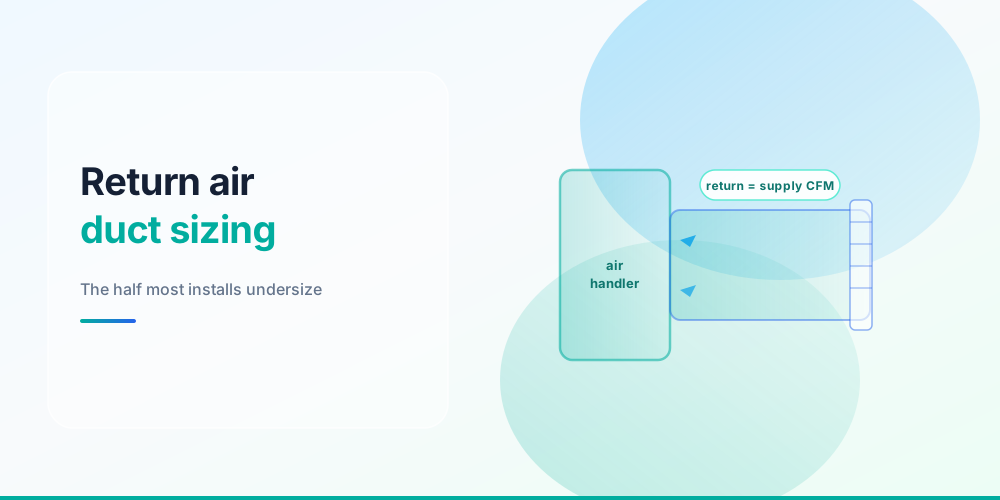
Return air ducts are the half of the duct system most installs get wrong. Supplies get all the attention because you can feel air coming out of them, but the blower can only push out what it can pull back - and an undersized return quietly strangles the whole system. If you’ve ever met an AC that’s properly charged, has clean coils, and still can’t cool, an undersized return is one of the usual suspects.
This guide covers how to size the return side. For the supply side and the CFM-to-size lookup that both share, see the Duct Size Chart and the HVAC Duct Sizing Guide.
Why Return Sizing Matters
Air is a loop. Every cubic foot the blower delivers through the supplies has to come back through the returns. Choke that return path and the blower can’t pull enough air, which drives static pressure up and airflow down across the whole system:
The undersized-return chain reaction
High static pressure from a starved return is the root cause behind a surprising share of comfort complaints, iced coils, and burned-out blower motors. If you’re chasing a high static-pressure reading, the return side is the first place to look - see HVAC Static Pressure.
The Core Rule: Return Must Match Supply
The single most important rule of return sizing: total return airflow should equal total supply airflow. Since a system moves roughly 400 CFM per ton, a 3-ton system moving ~1,200 CFM of supply air needs return ducting capable of pulling ~1,200 CFM back. The return isn’t an afterthought sized “big enough” - it’s sized to a number, and that number is your total supply CFM.
Three rules for sizing returns
Return Duct Size by CFM
Returns are sized at a lower velocity than supplies. You notice return noise more (it’s closer to living spaces and the air is moving toward you), so returns are run slower to stay quiet - which means a return duct is one size larger than a supply carrying the same airflow:
Return duct size by airflow
| Return airflow | Approx. round size |
|---|---|
| 100 CFM | 7 in |
| 200 CFM | 9 in |
| 400 CFM | 12 in |
| 700 CFM | 14 in |
| 1,000 CFM | 16 in |
| 1,200 CFM | 18 in |
These are starting figures at a typical residential friction rate; the exact size comes from a Manual D calculation. Note how a 1,200 CFM return wants an 18-inch round (or a large rectangular equivalent) - far bigger than people expect, which is exactly why returns get undersized.
One Central Return or Several?
Two valid approaches, depending on the house:
- A central return (one or two large grilles) is simplest and cheapest, and works when interior doors are usually open. The risk: when bedroom doors close, those rooms have no return path and go pressure-imbalanced - they get stuffy and hard to condition.
- Return per room (or transfer grilles/jumper ducts) solves the closed-door problem by giving each room a path back. It costs more in ducting but delivers far better room-to-room balance.
If you use a central return, add transfer grilles or jumper ducts to bedrooms so closed doors don’t starve them. A door undercut alone is rarely enough return path.
Don’t Forget the Filter Grille
A return filter grille is a common hidden choke point. The filter adds resistance, so the grille must be sized for a low face velocity - around 300 feet per minute for a filter grille - or the filter itself becomes the restriction, spiking static pressure and whistling. That’s why a return filter grille looks oversized compared to the duct behind it: the large face keeps velocity through the media low.
Worked example
A 3-ton system moves ~1,200 CFM. The return path must carry all 1,200 CFM: that’s an 18-inch round trunk (or equivalent rectangular), and a filter grille sized for ~300 fpm face velocity needs roughly four square feet of net free area - e.g. a 20×30 filter grille. Split across two returns, each carries ~600 CFM and can step down accordingly.
Common Mistakes
- One small return for the whole house - the classic. It can’t match supply CFM, and static pressure pays the price.
- Sizing the return like a supply - returns run slower and need to be larger.
- Undersized filter grille - the filter chokes airflow even when the duct is fine.
- No return path for closed bedrooms - central return with no transfer grilles leaves rooms imbalanced.
Calculate Return Air Duct Size
To calculate return air duct size, start with total system CFM (about 400 CFM per ton), then size the return duct at a lower velocity than supply - typically one size larger for the same airflow. A return air duct sizing calculator does this automatically: enter CFM, friction rate, and duct shape to get round or rectangular dimensions with velocity checked.
Quick method: 3-ton system → ~1,200 CFM return → 18-inch round trunk (or equivalent rectangular) at residential friction rates.
Size Your Returns
Duct Size Calculator - return air duct sizing calculator: enter return CFM and get duct size with velocity checked.
The Duct Size Calculator sizes return ducts the same way it sizes supplies - feed it the airflow and friction rate. Find the required CFM first with the CFM Calculator (400 CFM per ton), and see the Duct Size Chart for the supply side.
FAQ
How do I size a return air duct?
Size the return to carry the system’s total airflow - about 400 CFM per ton - at a lower velocity than the supply ducts. That makes a return one size larger than a supply for the same CFM. A 3-ton system needs return ducting good for ~1,200 CFM, roughly an 18-inch round or a large rectangular equivalent.
Should the return be the same size as the supply?
The total return airflow should equal the total supply airflow, but because returns are run at lower velocity, an individual return duct is typically one size larger than a supply carrying the same CFM. The airflow matches; the duct is bigger.
How many CFM can a return duct carry?
At a lower return-side velocity, a 12-inch round return carries about 400 CFM, a 14-inch about 700, a 16-inch about 1,000, and an 18-inch about 1,200 CFM. These are starting figures - a Manual D calculation gives the exact size for your friction rate.
What size return for a 3-ton system?
A 3-ton system moves about 1,200 CFM, so the return path must carry 1,200 CFM - roughly an 18-inch round trunk or equivalent, with a filter grille around 20×30 to keep filter face velocity near 300 fpm. Splitting it into two returns lets each be smaller.
Why is my return too small a problem?
An undersized return starves the blower, which drives static pressure up and airflow down. The result is uneven temperatures, longer run times, higher bills, frozen coils, and premature blower or compressor failure - even when the equipment itself is fine.