
Mini-Split vs Central Air: Which Is Right for Your Home?
- 31 Mar, 2026
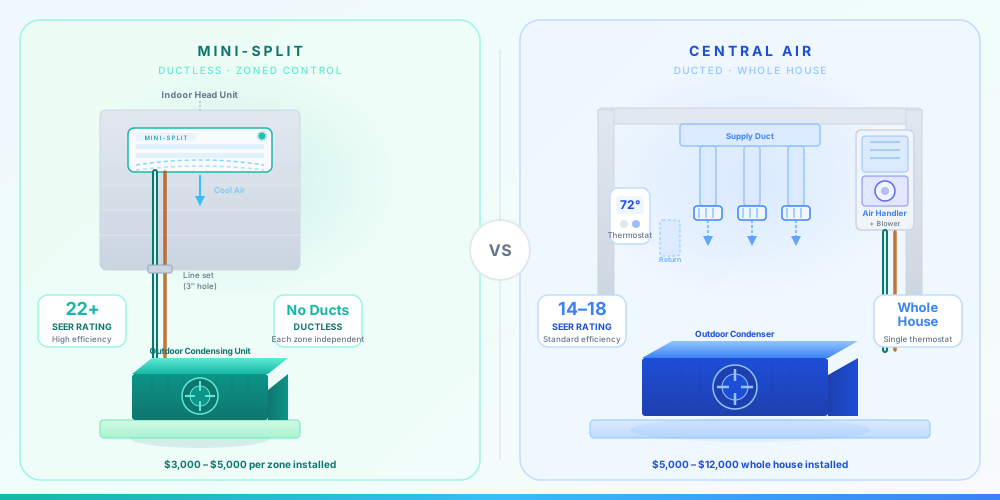
Mini-splits cost more upfront but run more efficiently than central air - and whether that trade-off makes sense depends on your home’s existing ductwork, how many rooms you’re cooling, and how long you plan to stay.
Head-to-Head Comparison
| Factor | Mini-Split | Central Air |
|---|---|---|
| Upfront cost (installed) | $3,000–$5,000 per zone | $5,000–$12,000 whole house |
| Typical SEER rating | 18–25+ | 13–18 |
| Ductwork required | No | Yes |
| Zoned control | Yes - each head independent | No (single thermostat standard) |
| Installation disruption | Low (3-inch wall penetration) | High (duct installation or modification) |
| Air filtration | Basic washable filter | Can support MERV 11–13 media filters |
| Heating capability | Yes - heat pump down to 5–15°F outdoor | Requires separate furnace |
Mini-split vs central air at a glance
When a Mini-Split Wins
Room additions and sunrooms. Extending ductwork to a new room typically costs $1,500–$3,000 and often requires upsizing the air handler. A single-zone mini-split at $3,000–$4,500 installed sidesteps that entirely.
Garages and detached structures. No duct run needed. One line set through the wall, and you have full heating and cooling.
Historic homes without existing ducts. Installing new ductwork in a two-story Victorian or a mid-century ranch with a crawlspace can run $8,000–$15,000. A three-zone mini-split system covering the main living areas often comes in cheaper and causes no structural modification.
Single-room cooling. If one bedroom runs hot and the rest of the house is fine, a single mini-split head solves the problem without touching the central system.
Homes with old, leaky ductwork. If your ducts are degraded, you are losing conditioned air before it reaches the rooms. Replacement ductwork is expensive. A mini-split removes the problem entirely.
When Central Air Wins
New construction with planned ductwork. When ducts are designed into the build, the cost per square foot drops sharply. A central system at $5,000–$8,000 covering 2,000 square feet beats the equivalent five-zone mini-split installation at $12,000–$18,000. See our full central air installation cost breakdown for what drives that price.
Whole-house air filtration matters. Central systems can run air through high-MERV or HEPA-style filters, UV-C germicidal lamps, and ERV/HRV ventilation equipment. Mini-splits filter only the air in their zone through a basic mesh filter.
Existing, well-sealed ductwork. If your ducts are in good condition and your blower door test shows low leakage, a central system replacement is usually the right call. You already paid for the infrastructure.
Single-thermostat simplicity. For homeowners who want one control point and no per-room management, central air is simpler to operate.
Which system fits your home?
The Efficiency Gap Is Larger Than SEER Numbers Suggest
A 3-ton SEER 14 central air conditioner and a comparable SEER 22 mini-split system look like a straightforward comparison - the mini-split uses about 36% less electricity per unit of cooling. Run the math at 1,500 hours per year and $0.14/kWh:
- SEER 14 central: 3 tons = 36,000 BTU/hr. At SEER 14: 36,000 / 14 = 2,571 watts. Over 1,500 hours: 3,857 kWh. Cost: $540/year.
- SEER 22 mini-split: 36,000 / 22 = 1,636 watts. Over 1,500 hours: 2,455 kWh. Cost: $344/year.
- Annual savings: $196/year on the compressor alone.
But the duct loss factor pushes this further. Studies from Lawrence Berkeley National Laboratory and ASHRAE field data consistently show that residential duct systems lose 20–30% of conditioned air through leakage, conduction through unconditioned spaces, and poor duct sealing. A central system that delivers 70–80% of its rated output to the living space effectively has a real-world SEER closer to 10–11, not 14.
Mini-splits have no ducts. Every BTU the compressor produces ends up in the room. The real-world efficiency gap is often closer to $280–$340 per year on a whole-house comparison, not $196. For the full picture on the central side, our guide to how much it costs to run central AC walks through the monthly and annual operating numbers.
Duct losses widen the efficiency gap
Multi-Zone Mini-Split Systems
A multi-zone mini-split uses one outdoor condensing unit connected to up to five indoor air handlers (called heads or cassettes). Each head has its own remote or thermostat. You can cool the bedroom to 68°F while leaving the living room at 74°F, or turn off zones that are unoccupied entirely.
Sizing a multi-zone system requires matching the total indoor head capacity to the outdoor unit. Oversizing individual heads is a common installation mistake - it causes short cycling, humidity problems, and premature compressor wear. Each zone should be sized by room load, not by round numbers. To get each head right, work through what size mini-split you need, which sizes capacity per room, or start from the BTU per room basics.
Mini-Split Limitations
Wall aesthetics. High-wall cassettes are visible on the interior wall. Ceiling cassettes and floor-mounted units are available but add cost. Some homeowners find the appearance intrusive; others do not notice after a week.
Monthly filter cleaning. Mini-split filters are washable mesh panels that need rinsing every 3–4 weeks in normal use. Central systems with a 4-inch media filter need changing every 6–12 months. The maintenance frequency is higher with mini-splits.
Large open plans with high static pressure. Mini-split air handlers are designed for room-level distribution, not long duct runs. A 2,500-square-foot open-plan home with high ceilings may need multiple heads to cover the space adequately, or may be better served by a properly designed central system with zoning dampers.
Use the Free Calculator
Mini-Split Sizing Calculator - get your exact answer in seconds.
FAQ
Is a mini-split cheaper to run than central air?
Yes, in most installations. A SEER 22 mini-split uses 36–40% less electricity than a SEER 14 central system at rated conditions. The gap widens when you account for duct losses in central systems, which typically waste 20–30% of conditioned air. Expect savings of $200–$350 per year for a whole-house comparison in a climate with 1,400–1,800 cooling hours annually.
Do mini-splits work as well as central air?
For comfort and temperature control, mini-splits typically perform better. Each zone maintains its own setpoint independently, and the inverter-driven compressor modulates output rather than cycling on and off. This produces more stable temperatures and better dehumidification at part load. The limitation is air distribution - a central system moves air through the whole house with one blower, while a mini-split only conditions the room where the head is mounted.
Can a mini-split cool a whole house?
Yes, with a multi-zone system. One outdoor unit can serve up to five indoor heads. A 3,000-square-foot house with four bedrooms and an open main floor might use a 4- or 5-zone system. The total installed cost for a whole-house multi-zone mini-split is higher than a comparable central system in new construction, but it eliminates duct installation costs in existing homes and provides better per-room control.
How long does a mini-split last?
A quality mini-split from a major manufacturer (Mitsubishi, Daikin, Fujitsu, LG) typically lasts 15–20 years with proper maintenance. Central air condensers last 12–18 years on average, though the air handler and ductwork may need separate servicing. The inverter compressor in a mini-split runs at lower stress levels than a single-speed central compressor, which contributes to longer service life.