
HVAC Duct Sizing: Manual D vs Rules of Thumb
- 24 Mar, 2026
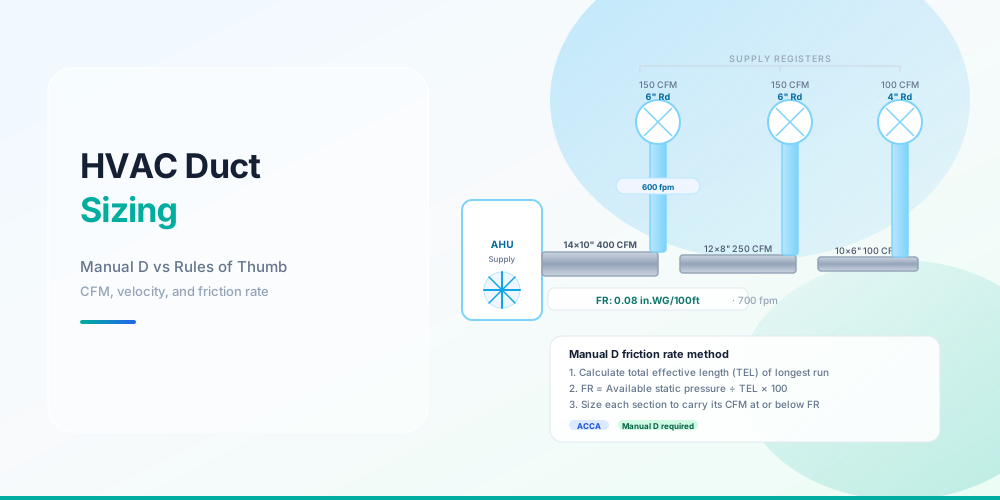
HVAC duct sizing determines how much air each room receives - get it wrong and no amount of equipment capacity fixes uneven temperatures, high static pressure, or noise complaints.
There are two ways to size ducts: the Manual D engineering method and simplified rules of thumb. Rules of thumb work for straightforward residential systems. Manual D is required for load-calculated designs, any system with complex geometry, or anywhere comfort callbacks are not acceptable.
Rules of Thumb for Duct Sizing
Rules of thumb start with CFM - the volume of air each room or branch needs to maintain comfort. (If you need to establish those airflow targets first, start with what CFM is and how to calculate it.) For a whole-system view, the rough benchmark is 400 CFM per ton of equipment capacity.
Velocity limits keep noise and friction in check:
- Main trunk (supply): 700–900 feet per minute (fpm)
- Branch runouts: 600 fpm or less
- Return duct: 500–700 fpm
To use velocity to find duct diameter: divide CFM by velocity (fpm) to get area in square feet, then convert to inches and round up to the next standard duct size (6”, 7”, 8”, 10”, 12”, 14”).
Example: A branch carrying 200 CFM at 600 fpm needs 0.333 sq ft = 48 sq in = 7.8” - round up to 8”. To skip the arithmetic, the duct size chart by CFM lists the round size for common airflow values at a glance.
Rules of thumb produce a starting point. They do not account for fitting losses, flex duct resistance, or equipment static pressure limits. Use them to sketch a layout, then verify with friction rate math.
Duct sizing rules of thumb
Manual D Method
Manual D (ACCA Manual D) is the ANSI-recognized standard for residential duct design. It works backward from available static pressure to a target friction rate, then uses friction charts to select duct diameters.
Step 1: Available Static Pressure
Start with the equipment’s Total External Static Pressure (TESP) rating - this is printed on the equipment data plate, typically 0.5 in.w.c. for residential systems.
Subtract the pressure drops of fixed components:
- Coil (evaporator): typically 0.10 in.w.c.
- Filter: typically 0.08–0.10 in.w.c.
- Any other accessories (UV lights, ERVs, humidifiers): per manufacturer specs
What remains is the available static pressure for the duct system.
Step 2: Total Effective Length
Total Effective Length (TEL) is the length of the longest supply run from the air handler to the furthest register, plus fitting equivalents.
Fittings add resistance equivalent to additional feet of straight duct. Common equivalents:
| Fitting | Equivalent Feet (sheet metal) |
|---|---|
| 90-degree elbow (long radius) | 15 ft |
| 90-degree elbow (short radius) | 25 ft |
| Tee, supply branch | 20–30 ft |
| Transition, abrupt | 15 ft |
| Register boot | 25–35 ft |
Add straight duct footage plus all fitting equivalents from the air handler to the end register. Do the same for the return side and add both paths together for TEL.
Step 3: Design Friction Rate
Design friction rate (FR) is the pressure available per 100 feet of effective duct length:
FR = (Available Static Pressure / TEL) x 100
This gives you in.w.c. per 100 ft - the unit used on friction charts.
With your friction rate, look up each duct diameter on a friction chart (Moody-based, ACCA Manual D Appendix). Select the smallest diameter that carries the required CFM at or below your friction rate.
Manual D design flow
Worked Example: 3-Ton System
Given:
- 3-ton system, 1,200 CFM total
- Equipment TESP: 0.50 in.w.c.
- Evaporator coil loss: 0.10 in.w.c.
- Filter loss: 0.08 in.w.c.
- Total effective length (longest run, supply + return): 200 ft
Step 1 - Available static: 0.50 - 0.10 - 0.08 = 0.32 in.w.c.
Step 2 - Friction rate: (0.32 / 200) x 100 = 0.16 in.w.c. per 100 ft
Step 3 - Duct selection at FR = 0.16:
- 10” round trunk: carries approximately 700 CFM
- 12” round trunk: carries approximately 1,000 CFM
- 14” round trunk: carries approximately 1,400 CFM
For this 1,200 CFM system, a 14” main trunk keeps friction at or below 0.16. Branches are sized the same way using their individual CFM loads and the same friction rate.
Flex Duct Penalty
Flexible duct has a corrugated inner liner that creates turbulence sheet metal does not. The resistance penalty is 15–25% higher than equivalent sheet metal.
Practical rules for flex:
- Size up one diameter compared to sheet metal for the same CFM. If sheet metal calls for 8”, use 9” or 10” flex.
- Derate flex capacity by approximately 25% when sizing from sheet metal tables.
- Fully extend flex - every inch of slack adds bends that compound resistance. A 6-foot flex run with two unnecessary 90-degree sags can behave like 20+ equivalent feet.
- Limit flex duct runs to 6 feet where possible. Do not use flex for main trunks in systems over 2 tons.
Common Sizing Mistakes
Undersized return duct. The most common cause of high static pressure on residential systems is an undersized return. A single 14”x14” grille and a 14” round duct cannot serve a 4-ton air handler at 1,600 CFM without excessive velocity. Size the return at least as generously as the supply side - see the dedicated return air duct sizing guide for grille and duct selection, and confirm the result with a static pressure test once installed.
Oversized supply trunk. A 20”x12” main trunk on a 2-ton system drops velocity below 400 fpm. Low velocity causes air stratification - the system runs but the room never mixes. Trunk velocity below 500 fpm is usually a sign of oversizing.
Flex duct with too many bends. A flex branch with three bends between the plenum and the register can easily exceed 50 equivalent feet of resistance. Use hard duct to within 6 feet of the register boot, then transition to a short flex connection.
Not accounting for fittings. Ignoring fitting equivalents in TEL calculations produces an optimistic friction rate. The duct system arrives on-site and static pressure is 0.10 in.w.c. over budget, forcing the equipment to run at higher speed, higher noise, and shortened motor life.
Common duct sizing mistakes
Use the Free Calculator
Duct Size Calculator - get your exact answer in seconds.
Also see the Duct Friction Rate Calculator to work through the Manual D friction rate calculation for any system.
FAQ
What size duct do I need for 400 CFM?
At 600 fpm branch velocity, 400 CFM requires 0.667 sq ft = 96 sq in = 11” round duct. In practice, a 10” duct at 733 fpm is acceptable for a branch run under 10 feet; use 12” for longer runs or if velocity limits are strict. For flex duct, go to 12”.
How do I calculate duct size?
Divide CFM by your target velocity in fpm to get area in square feet. Multiply by 144 to convert to square inches. Take the square root and multiply by 2/pi to get equivalent round diameter, then round up to the next standard size. Alternatively, use the friction rate method from Manual D: find your available static pressure, divide by total effective length, multiply by 100, then look up duct diameter on a friction chart.
What is Manual D?
Manual D is the ACCA (Air Conditioning Contractors of America) residential duct design standard, also recognized by ANSI. It defines a step-by-step procedure for calculating available static pressure, total effective length, and design friction rate, then selecting duct sizes from standardized friction charts. Many jurisdictions require Manual D calculations for permitted HVAC work.
Can I use flex duct for the main trunk?
Flex duct on a main trunk is technically possible but poor practice on systems over 1.5–2 tons. The high corrugation resistance requires a significantly larger diameter to carry the same CFM as sheet metal, and the probability of sags and undersupport increases over long runs. For systems 3 tons and up, use sheet metal for the main trunk and transition to flex only for final branch runouts.