
What Size Electrical Service Do I Need? 100 A to 400 A
- 03 Aug, 2026
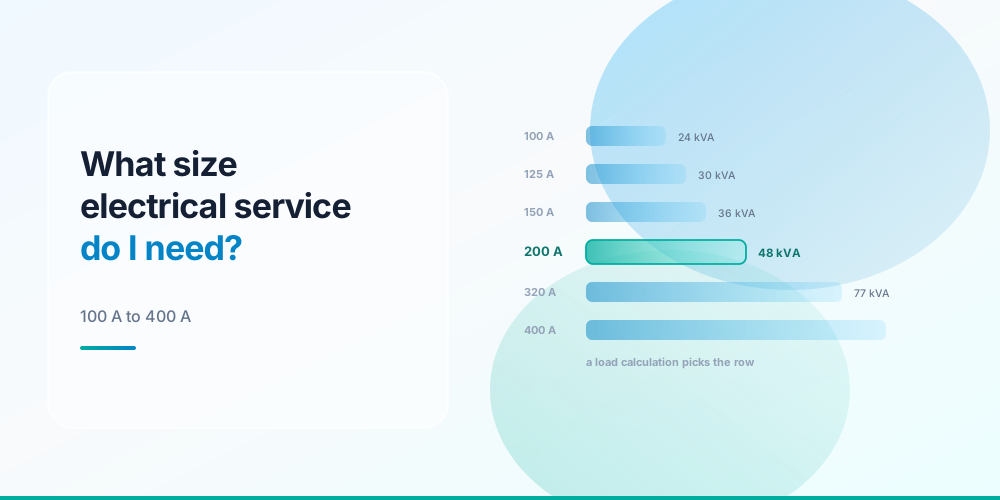
Services come in standard sizes, and the one you need is decided by a load calculation - but knowing what each rating actually covers saves a lot of time before you run the numbers. This is the orientation: every standard rating, what it suits, and the three ratings people constantly confuse with each other.
The Standard Ratings
Service ratings and what they cover
| Service | Capacity at 240 V | Typically suits |
|---|---|---|
| 60 A | 14 kVA | Legacy only - not permitted for a new dwelling |
| 100 A | 24 kVA | Gas heat, gas range, gas water heater |
| 125 A | 30 kVA | Where the calculation lands just over 100 |
| 150 A | 36 kVA | Mixed fuel with one large electric load |
| 200 A | 48 kVA | The modern default - all-electric with EV headroom |
| 225 A | 54 kVA | All-electric with both a heat pump and EV charging |
| 320 A | 77 kVA | Large home; sold as a 400 A class meter |
| 400 A | 96 kVA | Two panels, dual EV, electric resistance heat |
100 amps is the floor. 230.79(C) requires the service disconnecting means for a one-family dwelling to be rated not less than 100 amperes, 3-wire. That’s why you’ll still find 60-amp services on older houses but can never install one new - and it’s a large part of why 60-amp services get upgraded whether or not the load calculation demands it.
200 amps is the default, not the maximum. It’s what most new construction gets because it covers an all-electric house with room to spare, and the incremental cost over 150 A is small. That doesn’t make it automatic: a house with gas heat, a gas range and gas hot water may calculate at 70 amps, and a 100-amp service is a perfectly good install.
Let the Calculation Decide
Square footage doesn’t determine service size - appliances do. A 3,500 ft² house with gas heat, gas cooking and gas hot water can calculate lower than a 1,400 ft² all-electric condo.
The 220.82 optional method is the usual route: 3 VA per ft² for general lighting, 1,500 VA for each small-appliance and laundry circuit, nameplate VA for every fastened appliance, then the first 10 kVA at 100% and the rest at 40%, plus the larger of heating or cooling. Divide by 240 and round up to the next standard rating.
The full walkthrough, plus the standard Part III method and why the two disagree, is in Residential Load Calculation. For the specific 100-versus-200 decision, 100 Amp vs 200 Amp Service.
One important note for existing houses: 220.87 lets you use the utility’s measured peak demand over 12 months × 125% instead of a paper calculation. On an older home that regularly proves the existing service is adequate - see Do I Need a Panel Upgrade.
Three Ratings, Not One
Service rating vs main breaker vs busbar
These get used interchangeably and they are not the same thing:
The service rating is what the service-entrance conductors and the utility’s supply can carry. It’s set by conductor sizing under 230.42 and, for a dwelling, Table 310.12 - which permits the 83% allowance, so a 200-amp service takes 2/0 copper or 4/0 aluminum rather than the larger conductors straight ampacity would demand. That’s covered in 200 Amp Service Wire Size.
The main breaker is the service disconnect protecting those conductors. It’s the number stamped on the handle, and it’s what most people mean by “I have a 200-amp panel.”
The panel busbar rating is what the panelboard’s internal bus can carry, printed on the label inside the door. It is frequently larger than the main breaker - a panel with a 225 A busbar and a 200 A main is common, and that headroom is what makes solar interconnection under the 705.12 busbar rules possible.
The consequence: upgrading one of these upgrades nothing. A new 200-amp panelboard fed by the original 100-amp service conductors is still a 100-amp service. All three have to move together, which is why a service upgrade is a bigger job than a panel swap.
Why a 320 A Meter Is a “400 A Service”
320 A and 400 A are the same service
This trips up nearly everyone the first time. A meter socket sold as 320 A and one sold as 400 A class are the same equipment. 320 A is the continuous rating; 400 A is the class rating for intermittent duty - and 400 × 0.8 = 320.
In practice such a service is almost always split into two 200-amp panels rather than feeding one 400-amp panel. The gear is cheaper, and running two sets of 4/0 aluminum is far easier than one set of 600 kcmil.
Worth it for a large all-electric home, two EVs, electric resistance heat, or a house with a shop plus a pool and hot tub. Below that, a 200-amp service with a load-management system (Article 750) is usually the better spend - it lets a large load like an EV charger back off when the house is busy, often avoiding an upgrade entirely.
Don’t Forget the Utility
The NEC governs your side of the meter; the utility governs theirs, and their rules are not the code’s. Before committing to a size, confirm:
- Whether the transformer serving you can support the upgrade, and who pays if it can’t
- The utility’s requirements for meter location, height, and clearances - these vary and are non-negotiable
- Whether the service must be overhead or underground, and who trenches
- Lead times for the disconnect and reconnect, which frequently drive the project schedule
Utility requirements are the most common cause of a service upgrade going sideways after the quote is signed.
Common Mistakes
- Sizing by square footage. Appliances decide, not area.
- Installing 200 A reflexively. Sometimes right, but it should follow the calculation.
- Replacing the panel and calling it a service upgrade. The conductors and meter set the service rating.
- Confusing the busbar rating with the main breaker. Read the label, not the handle.
- Reading a 320 A meter as smaller than a 400 A service. Same equipment.
- Skipping 220.87 on an existing house. Measured demand often removes the need to upgrade.
- Ignoring the utility until after the quote. Transformer capacity and meter rules can change everything.
- Forgetting the grounding electrode system. An upgrade brings it up to current code, which is real scope.
Size the Service
Service Size Calculator - takes a calculated or measured load and returns the standard service rating, with the 220.87 route available as an input.
The Service Size Calculator is the tool for this question, and it will accept either a 220.82 calculated figure or a 220.87 measured one. Produce the calculated figure with the Load Calculator, size the conductors with the Service & Feeder Wire Size Calculator, and price the work with the Panel Upgrade Cost Calculator.
Sources & standards: NEC (NFPA 70) 2023 - 220.82, 220.87, 230.42, 230.79(C), Table 310.12, 408.36, 705.12, Article 750. Utility requirements vary independently of the NEC; local amendments override the model code, and the AHJ has final say.
FAQ
What size electrical service do I need for my house?
Run a 220.82 load calculation and round up to the next standard rating. Most all-electric houses land between 125 A and 200 A; a house with gas heat, cooking and hot water often calculates under 100 A. 230.79(C) sets 100 A as the minimum for a one-family dwelling regardless of how low the calculation comes out.
Is 150 amp service enough?
For a house with mixed fuel and one significant electric load, often yes - 150 A is 36 kVA. It becomes tight once you add both a heat pump and EV charging. The calculation decides; if you’re between 150 and 200, the incremental cost of 200 A at installation time is usually small enough to be worth it.
What is the minimum service size for a house?
100 amperes, 3-wire, under 230.79(C), for a one-family dwelling. Smaller services exist on older homes and are allowed to remain, but a new or replacement service disconnect can’t be rated below 100 A.
Why is a 400 amp service called 320 amps?
They’re the same equipment described two ways. 320 A is the continuous duty rating and 400 A is the intermittent class rating - 400 × 0.8 = 320. Such a service is normally split into two 200-amp panels rather than one 400-amp panel, since the gear costs less and the conductors are far easier to handle.
Is the panel rating the same as the service rating?
No. The panel busbar rating is what the panelboard’s bus can carry and is often higher than the main breaker; the service rating is what the service-entrance conductors and utility supply can carry. A 200-amp panel fed by 100-amp conductors is a 100-amp service - the smallest of the three ratings governs.
Do I need a 400 amp service for two EVs?
Usually not. Two EVs add substantial load, but a 200-amp service with a load-management system under Article 750 can share capacity between them and back off when the house is busy - frequently at a fraction of an upgrade’s cost. A 400 A service makes more sense when resistance heat, a shop, or a pool is in the mix too.