
Where GFCI Protection Is Required (NEC 210.8, With the 2023 Changes)
- 04 Aug, 2026
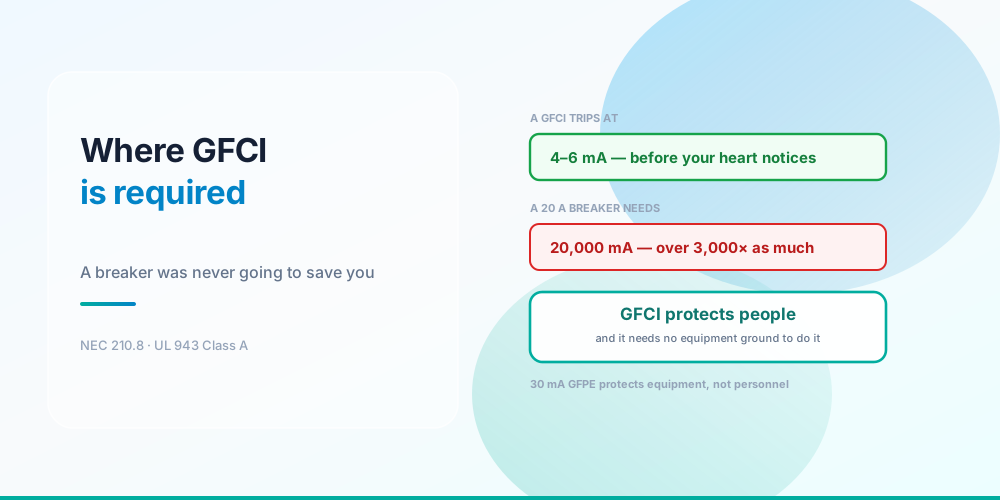
Start with the number that explains why this device exists at all.
A Class A GFCI trips at 4–6 milliamps. A 20 A breaker needs 20,000 milliamps - and only then after its time-current curve allows. The heart can fibrillate somewhere around 50 mA, and at 10 mA your hand muscles lock so you can’t let go.
Overcurrent protection was never going to help with any of that. It protects the conductor. The GFCI is the only device in the panel that protects the person, and it does it by noticing a few thousandths of an amp going somewhere it shouldn’t.
The Scale of It
Why a breaker was never going to protect you
| Level | Current |
|---|---|
| Perception - a tingle | ~1 mA |
| GFCI Class A trips (UL 943) | 4–6 mA |
| ”Let-go” threshold - muscles lock | ~10 mA |
| GFPE for equipment | 30 mA |
| Ventricular fibrillation risk | ~50 mA |
| 20 A breaker | 20,000 mA |
Two things fall out of this table that people get wrong.
A GFCI needs no equipment ground. It compares the current leaving on the hot with the current returning on the neutral, and trips on the difference. Where those don’t match, current is going somewhere else - through a person, through water, through a pipe. There’s no ground reference in that measurement, which is why 406.4(D)(2) permits a GFCI marked “No Equipment Ground” as the replacement for an ungrounded receptacle. It’s the single most useful fact about the device.
30 mA GFPE is not personnel protection. Ground-fault protection of equipment operates at six times the Class A threshold - well above the let-go point and into the range where fibrillation becomes a risk. It protects wiring and equipment from arcing ground faults. Article 426 and 427 heating cable, and 620.62 elevator applications, use it legitimately; it is never a substitute for a Class A device where people are the concern.
Where It’s Required in a Dwelling
210.8(A), grouped by why each location is on the list
210.8(A) requires GFCI protection for all 125 V through 250 V receptacles supplied by single-phase branch circuits rated 150 V or less to ground, in these locations:
| Location | Note |
|---|---|
| Bathrooms | All receptacles |
| Garages and accessory buildings | At or below grade level, not intended as habitable rooms |
| Outdoors | See also 210.8(F) below |
| Crawl spaces | At or below grade |
| Basements | Unfinished portions and areas not intended as habitable rooms |
| Kitchens | Countertop surfaces and more |
| Within 6 ft of any sink | Measured along the cord’s path, not through walls |
| Bathtub and shower areas | Within 6 ft of the outside edge |
| Laundry areas | All receptacles |
| Indoor damp and wet locations | Per the Article 100 definitions |
| Boathouses | All receptacles |
The “within 6 ft of a sink” rule is broader than people realise and catches wet bars, utility sinks, laundry tubs and basement sinks. The measurement is the shortest path a cord would actually follow without passing through a wall, floor, ceiling, doorway or partition - so a receptacle on the other side of a wall from a sink is not within 6 feet even if the straight-line distance is 3 feet.
Article 680 covers pools, spas and hot tubs separately and more stringently, including bonding requirements that have nothing to do with GFCI. 590.6 requires GFCI on temporary construction power.
The Recent Expansions - and an Honest Caveat
Not every GFCI rule is settled where you work
This is where a lot of published guidance overstates its confidence, so here’s the careful version.
210.8(A)‘s core dwelling list is settled. It has been stable across several cycles. Design to it without checking.
210.8(D) - specific appliances. The 2020 cycle introduced a GFCI requirement for certain appliances, starting with dishwashers, and later cycles reach further into cooking and other equipment. This provision has been amended out or delayed in several jurisdictions, partly because early-generation appliances produced nuisance trips and partly on cost grounds. The requirement exists in the model code; whether it exists where you work is a different question.
210.8(F) - all outdoor outlets for dwellings. The 2020 cycle extended GFCI protection to outdoor outlets generally, not just receptacles - which caught air-conditioning condensers. That produced real nuisance-tripping problems with equipment not designed for it, and a substantial wave of state and local amendments and delays.
So: confirm with the AHJ before pricing or designing around 210.8(D) or 210.8(F). Which cycle applies where is the subject of NEC Adoption by State, and the broader set of recent changes is in NEC 2023 vs 2026.
There is also 210.8(E), requiring GFCI for receptacles installed to service heating, air conditioning and refrigeration equipment - the receptacle itself being required by 210.63, within 25 feet of the equipment.
Non-Dwelling Locations
210.8(B) covers other than dwelling units, and the list is longer than the dwelling one - bathrooms, kitchens, rooftops, outdoors, sinks, indoor wet locations, locker rooms with showers, garages and service bays, crawl spaces, unfinished areas of basements, and laundry areas.
Two differences worth knowing: the non-dwelling rules extend to rooftops (which the dwelling list doesn’t name), and 210.8(B) applies to a wider voltage and phase range in recent cycles, reaching three-phase and higher-voltage receptacles up to specified limits. Commercial kitchen work in particular is more heavily covered than residential.
Devices, Placement and Practicalities
Receptacle vs breaker. A GFCI receptacle protects itself and, wired through its LOAD terminals, everything downstream. A GFCI breaker protects the whole circuit including the wiring. The breaker costs more and is the right answer where the first outlet is inaccessible, where you want the wiring protected, or where you’d otherwise need several devices.
Dead-front GFCIs exist for where you want protection without a usable receptacle at that point.
Test monthly, and note that modern devices self-test. UL 943 has required self-testing since 2015; a device whose indicator shows a fault has failed and must be replaced. An older GFCI that won’t trip on its test button is not protecting anything.
Placement matters for cost. Putting the GFCI at the first box on the circuit protects everything downstream with one device. Putting it at the last box protects one receptacle and wastes the capability.
Do not put a refrigerator or a sump pump on a GFCI you can’t see unless the code requires it. A tripped GFCI in a garage means spoiled food or a flooded basement, and the failure is silent. Where the code does require it - and increasingly it does - that’s the answer, but it argues for a device or a breaker whose status is visible.
GFCI vs AFCI - and Where Both Are Required
They solve different problems and the distinction matters:
- GFCI compares hot against neutral and trips at 4–6 mA, protecting people from shock.
- AFCI does pattern recognition on the current waveform looking for arc signatures, protecting property from fire.
Many locations now require both, and dual-function AFCI/GFCI devices are the usual answer - a kitchen or laundry receptacle typically needs both under 210.8 and 210.12. The full comparison is in GFCI vs AFCI.
When It Trips and Nothing Is Wrong
Two mechanisms account for most complaints:
Cumulative leakage. Every appliance and every long cable run leaks a small current to ground by design - through filter capacitors, through insulation. Put enough devices on one GFCI-protected circuit and the total can approach 4–6 mA with nothing faulty anywhere. Long runs make it worse. Splitting the circuit fixes it.
A shared neutral. Two circuits sharing a neutral will trip a GFCI on either one, because the returning current doesn’t match the outgoing current on the protected circuit. This is the top wiring error behind GFCI complaints, and it trips AFCIs too. Diagnosis is in AFCI and GFCI Nuisance Tripping.
A tripping GFCI protecting a single appliance is usually finding something real. Treat it as evidence before assuming nuisance.
Common Mistakes
- Assuming a GFCI needs a ground. It doesn’t - that’s what makes 406.4(D)(2) work.
- Treating 30 mA GFPE as personnel protection. It’s six times the Class A threshold.
- Measuring the 6 ft to a sink in a straight line. It follows the cord’s path, not through walls.
- Forgetting laundry areas. They’re in 210.8(A).
- Assuming 210.8(D) and 210.8(F) apply where you work. These are among the most amended provisions in the code.
- Putting the GFCI at the end of the circuit. At the first box it protects everything downstream.
- Wiring downstream devices to the LINE terminals. They get no protection.
- Trusting an old GFCI that won’t trip on test. It has failed. Self-test has been required since 2015.
- Assuming GFCI covers arc faults. Different device, different job - often both are required.
- Chasing a nuisance trip without checking for a shared neutral. It’s the most common cause.
Plan the Circuits
Receptacle & Circuit Calculator - works out how many outlets a circuit supports under the dwelling and non-dwelling rules, which is the layout decision that determines how many protective devices you need and where they go.
See GFCI vs AFCI for what each device detects, Receptacle Spacing Rules for where the receptacles go in the first place, and Grounding vs Bonding for why a GFCI works without a ground.
Sources & standards: NEC (NFPA 70) 2023 - 210.8(A) through (F), 210.12, 210.63, 406.4(D)(2), 590.6, Article 426, Article 427, Article 680, 620.62; UL 943 for Class A GFCI trip thresholds and the self-test requirement. Human current-tolerance figures are widely published approximations and vary with path, duration and individual. The 210.8(D) and 210.8(F) provisions are amended or delayed in a number of jurisdictions - confirm locally. Local amendments override the model code and the AHJ has final say. Have electrical work designed and installed by a licensed electrician under permit.
FAQ
Where is GFCI protection required?
In dwellings, 210.8(A) requires it for receptacles in bathrooms, garages and accessory buildings, outdoors, crawl spaces, unfinished basements, kitchens, laundry areas, boathouses, bathtub and shower areas, indoor damp and wet locations, and anywhere within 6 feet of a sink. Pools and spas are covered separately by Article 680, and non-dwelling occupancies by 210.8(B), which is a longer list including rooftops.
At what current does a GFCI trip?
4 to 6 milliamps, per UL 943 for Class A devices. That’s below the roughly 10 mA “let-go” threshold at which hand muscles lock, and well below the ~50 mA where ventricular fibrillation becomes a risk. A 20 A breaker needs 20,000 mA, which is over three thousand times as much - which is why overcurrent protection does nothing for shock.
Does a GFCI need a ground wire?
No. It measures the difference between the current leaving on the hot and returning on the neutral, and trips when they don’t match. No ground reference is involved. This is why NEC 406.4(D)(2) permits replacing an ungrounded receptacle with a GFCI marked “No Equipment Ground” - it provides genuine shock protection without one, though it does not create an equipment ground for equipment that needs one.
Do I need GFCI within 6 feet of a sink?
Yes, under 210.8(A) in a dwelling - and the rule catches wet bars, utility sinks and laundry tubs, not just kitchens and bathrooms. The 6 feet is measured along the shortest path a cord would actually follow, without passing through a wall, floor, ceiling, doorway or partition, so a receptacle on the far side of a wall may be outside the requirement.
Is GFCI required for an outdoor air conditioner?
In the 2020 and later model code, 210.8(F) extends GFCI protection to outdoor outlets at dwellings, which includes condensers. However this provision caused real nuisance-tripping problems with equipment not designed for it, and it has been amended out or delayed in a number of jurisdictions. Confirm with your AHJ rather than assuming either answer.
What is the difference between GFCI and GFPE?
A Class A GFCI trips at 4–6 mA and protects people from shock. Ground-fault protection of equipment operates at around 30 mA - six times higher, above the let-go threshold - and protects wiring and equipment from damage caused by arcing ground faults. GFPE is legitimate for applications like heating cable and elevators; it is never personnel protection.
Should I use a GFCI receptacle or a GFCI breaker?
A receptacle at the first box on the circuit protects everything wired downstream from its LOAD terminals and is cheaper. A breaker protects the entire circuit including the wiring, and is the right choice where the first outlet is inaccessible, where you’d otherwise need multiple devices, or where you want the branch-circuit wiring protected. Dual-function AFCI/GFCI breakers cover both requirements at once.
Why does my GFCI keep tripping with nothing plugged in?
Most often a shared neutral - two circuits sharing a neutral means the current returning doesn’t match the current leaving, which is exactly what a GFCI trips on. The other common cause is cumulative leakage: every appliance and long cable run leaks a little current by design, and enough of them on one protected circuit can total 4–6 mA with nothing faulty. Splitting the circuit resolves both.