
AFCI and GFCI Nuisance Tripping: How to Actually Diagnose It
- 04 Aug, 2026
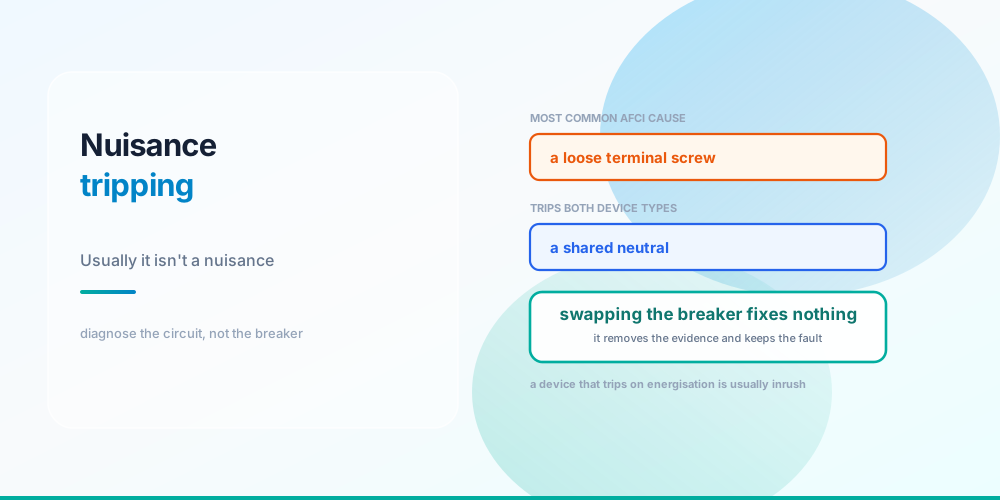
The phrase “nuisance tripping” does a lot of damage, because it decides the answer before anyone has looked.
The most common cause of an AFCI trip is a loose terminal screw. That’s series arcing at a real connection that’s really heating up, and the device found it - which is precisely what it was installed to do. The second most common cause is a shared neutral, which is a wiring error. The third is a neutral touching ground somewhere downstream, which is also a wiring error.
None of those is a nuisance. All three are fixed by working on the circuit, and none is fixed by swapping the breaker - that just removes the instrument that noticed.
Genuine nuisance trips exist. They’re mostly inrush and cumulative leakage, they have a distinctive signature, and they’re further down the list than the reputation suggests.
What It Usually Turns Out to Be
What it usually turns out to be
| Cause | Trips | Real fault? |
|---|---|---|
| Loose terminal screw | AFCI | Yes - series arcing |
| Shared neutral | both | Yes - wiring error |
| Neutral touching ground downstream | both | Yes - wiring error |
| Cumulative leakage | GFCI | No - split the circuit |
| Driver or motor inrush | both | No - energisation only |
| Damaged cable in the wall | AFCI | Yes - often a screw or staple |
| Brush-motor appliance | AFCI | No - arc signature by design |
Why the loose screw dominates. An AFCI does pattern recognition on the current waveform, looking for the signature of arcing. A terminal that isn’t tight enough makes and breaks contact under thermal cycling and vibration, producing exactly that signature - and producing real heat at a real connection. Backstabbed receptacles are the classic offender because the spring contact relaxes over years.
110.14(D) requires terminations to be torqued to the manufacturer’s specification with a calibrated tool. Almost nobody does it on copper, and this is the failure mode that argues for it.
The Shared Neutral
This is the single highest-value thing to check, because it’s common, it’s invisible, and it trips both device types for the same reason.
Both AFCIs and GFCIs contain a current transformer that compares the current leaving on the hot against the current returning on the neutral. If a second circuit borrows the same neutral, the protected circuit’s neutral carries the sum of both:
- Circuit A (protected) draws 8 A on its hot.
- Circuit B (not protected) draws 5 A, returning on the shared neutral.
- The device sees 8 A out and 13 A in - a 5 A imbalance.
That’s about a thousand times the trip threshold. The device fires instantly and it is right to.
Where shared neutrals come from:
Legitimate multiwire branch circuits. Two hots on opposite legs sharing a neutral is a proper MWBC, and it needs a two-pole AFCI (or a handle-tie plus a two-pole device) so both circuits are measured together. A single-pole AFCI on one leg of an MWBC will trip.
Old wiring where neutrals were tied together in a box - very common in houses wired before MWBCs were thought about carefully. Separating them is the fix.
Both halves of a split receptacle where the tab was broken for the hots but the neutral stayed shared.
Note that 210.4(B) requires all conductors of an MWBC to be disconnected simultaneously, so a handle tie or a common-trip two-pole device is required regardless of the AFCI question.
The Neutral-to-Ground Contact
Same mechanism, different cause: if the neutral touches ground anywhere downstream of the device, some return current diverts through the grounding system and the comparison fails.
Three places it happens:
A subpanel with the neutral bonded. The most common one, and it produces unpredictable trips across every protected circuit in that panel. Exactly one bond belongs in the system, at the service - see Grounding vs Bonding and Main Breaker vs Main Lug Panels.
A pinched or nicked neutral touching a metal box or the EGC.
A bootleg ground - a jumper from neutral to ground at a receptacle, installed to make a three-prong tester read correctly on an ungrounded circuit. It is dangerous as well as trip-inducing, and the legitimate fix for an ungrounded receptacle is a GFCI marked “No Equipment Ground” under 406.4(D)(2).
To test for it: disconnect the circuit’s neutral at the panel and check continuity between that neutral and ground. Any continuity with the circuit isolated means contact downstream.
Diagnose by When It Trips
Start with when it trips - it costs nothing and narrows it fast
| When it trips | What it points to |
|---|---|
| On energisation only | Inrush - LED drivers or a motor starting |
| Immediately, nothing plugged in | Wiring - shared neutral or neutral-to-ground |
| Under load, repeatably | One load, or one termination |
| Randomly over weeks | Intermittent connection - the real hazard case |
Read the trip code first
Most modern AFCI breakers blink a diagnostic code after a trip that distinguishes an arc fault from a ground fault from an overload - typically a pattern of flashes on the trip indicator, decoded in the manufacturer’s literature. Eaton, Square D, Siemens and others all do this in some form.
This is the most under-used diagnostic step in the trade. It’s free, it takes thirty seconds, and it tells you whether you’re looking for an arcing connection or a neutral fault before you open a single box.
The sequence
- Read the trip code. Free information.
- Unplug everything on the circuit and reset. If it still trips, the problem is wiring, and no amount of load-hunting will find it. If it holds, the problem is a load or a termination.
- Check for a shared neutral. Isolate the circuit’s neutral at the panel and test continuity to ground and to other neutrals.
- Add loads back one at a time, letting each run. When it trips, you have your appliance.
- If it survives every load, it’s a termination. Open every box on the circuit - receptacles, switches, splices, the panel - and check and torque each screw. Look for discoloured or backstabbed terminals.
- Insulation resistance test between conductors and to ground if nothing surfaces. This finds damaged cable inside walls, which is where the drywall-screw cases live.
A clamp meter on the neutral at the panel is worth having for step 3; a megohmmeter for step 6.
The Genuine Nuisance Cases
Cumulative leakage on GFCIs. Every appliance leaks a small current to ground by design - filter capacitors in switch-mode supplies, motor windings, heating elements. Individually it’s microamps to a milliamp. Put enough on one protected circuit and the total approaches 4–6 mA with nothing faulty. Long cable runs add to it. Splitting the circuit is the fix, and it’s a design problem rather than a defect.
Driver and motor inrush. LED drivers charge input capacitors at the instant of energisation, drawing tens of amps for milliseconds. Fixture manufacturers publish a maximum number of fixtures per 15 or 20 A circuit for this reason, commonly 30–50. This produces the classic “trips when I turn the lights on, fine afterwards” complaint. The count is in the spec sheet - see How Many Lights on One Circuit.
Brush motors. Vacuum cleaners, treadmills, older power tools and some furnace blowers produce arcing at the commutator by design. Early AFCI generations tripped on these considerably more than current ones; if a house has first-generation AFCIs and one specific vacuum trips one specific circuit, a modern replacement device may genuinely be the answer.
Certain older appliances and dimmers with poor filtering can also present as arc signatures.
What Not to Do
Don’t replace an AFCI with a standard breaker. 210.12 requires AFCI protection for branch circuits supplying outlets and devices in most dwelling living areas. Removing it is a code violation, it may void insurance, and it discards the only device that noticed a real fault.
Don’t swap the breaker as step one. Occasionally a device is genuinely defective, and it’s worth trying a known-good one after the circuit checks out - not before. Swapping first means that if the new one holds for a while you’ll conclude the problem is solved when the arcing connection is still there, getting hotter.
Don’t dismiss a trip because the circuit “works fine.” Series arcing at a loose terminal works fine right up until it doesn’t. The device is telling you about a connection you can’t see.
Don’t leave a mystery unresolved. Random trips over weeks are the pattern most associated with a genuine intermittent fault, which is exactly the failure mode AFCIs exist to catch.
Common Mistakes
- Assuming a trip is a nuisance. The top three causes are all real faults.
- Swapping the breaker first. It removes the evidence and leaves the fault.
- Not reading the trip code. Most modern AFCIs name the fault type in a blink pattern.
- Missing a shared neutral. It trips both device types and is invisible without testing.
- Single-pole AFCI on a multiwire branch circuit. Needs a two-pole device; 210.4(B) requires simultaneous disconnect anyway.
- Overlooking a bonded subpanel neutral. Causes unpredictable trips across the whole panel.
- Leaving a bootleg ground in place. Dangerous, and 406.4(D)(2) gives you a legitimate fix.
- Ignoring the fixture manufacturer’s per-circuit maximum. That’s the inrush limit behind energisation trips.
- Skipping the torque spec. 110.14(D) requires it, and loose terminations are the leading AFCI cause.
- Replacing an AFCI with a standard breaker. A 210.12 violation, and it throws away the diagnosis.
Related Calculations
Receptacle & Circuit Calculator - where cumulative leakage or driver inrush is the cause, the fix is splitting the circuit, and this works out how the outlets divide.
See GFCI vs AFCI for what each device detects and why, Where GFCI Protection Is Required for which circuits need which, and Grounding vs Bonding for the neutral-to-ground faults behind a large share of trips.
Sources & standards: NEC (NFPA 70) 2023 - 110.14(D), 210.4(B), 210.8, 210.12, 406.4(D)(2), 250.24(A)(5), 250.6; UL 943 for GFCI Class A thresholds and UL 1699 for AFCI performance. Trip-code indicator patterns are manufacturer-specific - consult the breaker’s literature. Diagnostic testing on energised equipment carries real risk; have this work done by a licensed electrician.
FAQ
Why does my AFCI breaker keep tripping?
Most often because it has found a genuine series arc at a loose or backstabbed terminal - that’s the commonest cause and it’s a real fault getting hot inside a box. The next most common causes are a shared neutral and a neutral touching ground downstream, both wiring errors. Genuine nuisance causes such as driver inrush or a brush-motor appliance are further down the list than the reputation suggests.
Can I replace an AFCI breaker with a regular one?
No. NEC 210.12 requires AFCI protection for branch circuits supplying outlets and devices in most dwelling living areas, so removing it is a code violation and may affect insurance. More practically, it discards the only device that noticed a fault which is still there. Diagnose the circuit instead.
Why does a shared neutral trip an AFCI or GFCI?
Because both devices compare the current leaving on the hot against the current returning on the neutral, and trip on the difference. If a second circuit borrows the neutral, the protected circuit’s neutral carries both - 8 A out and 13 A back, say, which is a 5 A imbalance and roughly a thousand times the trip threshold. A legitimate multiwire branch circuit needs a two-pole AFCI so both hots are measured together.
What does it mean when my AFCI breaker blinks?
Most modern AFCI breakers emit a diagnostic blink code after tripping that distinguishes an arc fault from a ground fault from an ordinary overload. The pattern is decoded in the manufacturer’s literature. It’s the cheapest and most under-used diagnostic step available - read it before opening any boxes, because it tells you whether to look for an arcing connection or a neutral fault.
Why does the breaker trip only when I turn the lights on?
LED driver inrush. Every driver charges its input capacitors at the instant of energisation, briefly drawing tens of amps even though the running load may be under an amp. Fixture manufacturers publish a maximum number of fixtures per 15 or 20 A circuit for exactly this - commonly 30 to 50. Splitting the fixtures across two circuits resolves it.
Can too many appliances trip a GFCI without a fault?
Yes - this is genuine cumulative leakage. Every appliance leaks a small current to ground by design through filter capacitors and insulation, and long cable runs add to it. Enough devices on one protected circuit can total 4 to 6 mA with nothing faulty anywhere, which is the Class A trip threshold. Splitting the circuit is the fix; it’s a design issue rather than a defect.
How do I find a loose connection causing arc faults?
Unplug everything and reset. If it still trips, it’s wiring. If it holds, add loads back one at a time - and if it survives all of them, the problem is a termination. Then open every box on the circuit, including the panel, and check and torque each screw to the manufacturer’s specification per 110.14(D). Look for discoloured terminals and for backstabbed receptacles, which relax over years.
Should I just try a new breaker?
Only after the circuit has checked out clean. Devices do occasionally fail, and a known-good replacement is a legitimate last test. Doing it first is the trap: if the new breaker holds for a few weeks you’ll conclude the problem is solved while the arcing connection is still in the wall, getting hotter.