
Cost to Install an Outlet or Add a Dedicated Circuit
- 04 Aug, 2026
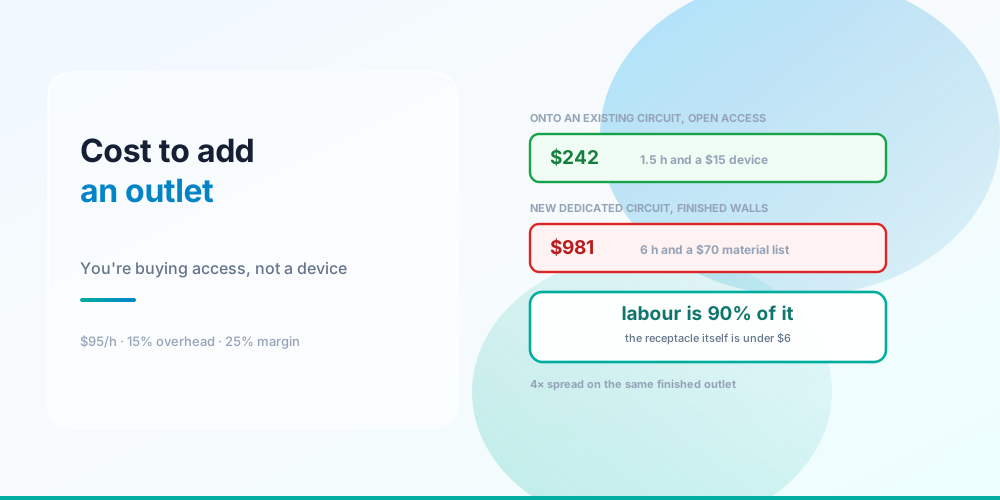
A tamper-resistant duplex receptacle costs about $6. The installed price ranges from $242 to $1,234 depending on almost nothing to do with the device.
That gap is the whole subject. Labour is 90% of the direct cost on the cheapest version of this job, and the variable that moves it is access - whether there’s a circuit nearby, whether the walls are open, how far it is to the panel, and whether the panel has a space free.
Which is why “how much for an outlet?” can’t be answered on the phone, and why an electrician who gives you a number without looking is either guessing high or about to be disappointed.
The Ladder
Seven scenarios at $95/h, 15% overhead, 25% margin
| Scope | Hours | Price |
|---|---|---|
| Receptacle on an existing circuit, open access | 1.5 h | $242 |
| Same, fishing a finished wall | 3 h | $468 |
| Exterior GFCI receptacle | 2.5 h | $433 |
| New 20 A circuit, open access | 4 h | $675 |
| New 20 A circuit, finished walls | 6 h | $981 |
| 240 V range or dryer outlet | 5 h | $912 |
| Kitchen small-appliance circuit, four outlets | 7 h | $1,234 |
A 4× spread on what the customer sees as the same finished outlet. These use $95/hour with 15% overhead and a 25% margin - the same arithmetic as the Estimate Calculator, so substitute your own rate and they scale directly.
Two rows deserve comment.
The exterior GFCI at $433 costs more than a plain interior outlet at the same hours because of the hardware: a weatherproof box, a listed in-use cover, and a GFCI device. It’s one of the few outlet jobs where material is a real fraction of the price.
The kitchen circuit at $1,234 is the most-quoted job in the list and the most under-quoted, because 210.52(B) requires two 20 A small-appliance circuits, and those circuits generally may not serve other outlets. People price one circuit and discover they needed two. See Receptacle Spacing Rules.
Where the Money Actually Goes
Where $242 goes
On the cheapest version of the job:
| Component | Amount |
|---|---|
| Labour, 1.5 h at $95 | $142.50 |
| The receptacle | $6 |
| Box, wire, plate | $9 |
| Overhead at 15% | $24.53 |
| Profit at 25% margin | $60.38 |
| Price | $242 |
Labour is 90% of direct cost. The device is 2.5% of the price. So the negotiation people instinctively reach for - a cheaper receptacle - moves the total by a couple of dollars, while an hour of avoided fishing moves it by over $150.
The corollary for anyone buying: batch the work. Four outlets on one visit share the travel, the setup, the panel work and the tidy-up. Four separate visits pay for all of that four times. It’s the single largest saving available to a homeowner on small electrical work.
For contractors, note the overhead and margin lines. 15% overhead on direct cost and a 25% margin (not markup) is what produces $242 from $181 of cost. A 25% markup would have produced $226 and $15 less profit - the distinction is worked through in How to Estimate Electrical Jobs.
What Drives the Number
Five questions, asked in this order, give you the price
1. Is there a circuit with capacity nearby? Tapping an existing circuit is 1.5 hours. A new home run to the panel is 4 hours or more. Worth knowing: in a dwelling there is no NEC limit on the number of receptacles on a branch circuit, because 220.14(J) already counts them inside the general lighting load - so “the circuit is full” is usually a judgement about the load, not a code limit. See How Many Outlets on a 20 Amp Circuit.
2. Are the walls open? This is the big one, and it’s usually visible from the doorway. An unfinished basement means drill and staple. Finished drywall means locating a route, fishing, dealing with fire blocks and insulation, then patching and painting - which may not even be the electrician’s scope.
3. How far from the panel? Cable is cheap; the route is not. Two floors and across a house can mean a lot of time in an attic.
4. Does the panel have a spare space? A free slot means a breaker goes in. A full panel means tandem breakers where the panel permits them, a subpanel, or an upgrade - and that last one changes the job’s magnitude entirely. Note that panel spaces are a separate limit from service capacity; a full panel doesn’t mean an inadequate service. See Do I Need a Panel Upgrade.
5. What protection does the location need? An ordinary AFCI circuit, or GFCI as well - kitchens, bathrooms, garages, outdoors, laundry, within 6 ft of a sink. Dual-function devices cost more than either alone. Where GFCI Protection Is Required has the locations.
Things That Add Cost Legitimately
Old wiring. Knob-and-tube or ungrounded two-wire circuits can’t simply be extended. 406.4(D) governs what you may do when replacing receptacles on an ungrounded circuit, and the usual answer is a GFCI marked “No Equipment Ground” under 406.4(D)(2). Extending an ungrounded circuit to a new outlet is a different and more constrained question.
Aluminium branch wiring. 1960s–70s aluminium needs listed connectors at every joint you touch - COPALUM or AlumiConn, not wire nuts. See Copper vs Aluminum Wire.
Box fill. Adding a device to an existing box frequently overfills it, and Table 314.16 is not negotiable. A box extension or a larger box is a small cost that surprises people. Box Fill Calculation.
A permit. Adding a circuit generally requires one; replacing a device generally doesn’t. Where required, the permit and inspection are real cost and real time. Electrical Permits and Inspections.
Asbestos, lead paint or plaster-and-lath. Old buildings carry costs that have nothing to do with electricity.
Common Mistakes
- Quoting an outlet over the phone. The price is set by access, and access has to be seen.
- Haggling over the device. It’s 2.5% of the price. Labour is 90% of direct cost.
- Booking four visits for four outlets. Batching shares the travel, setup and panel work.
- Pricing one kitchen circuit. 210.52(B) requires two small-appliance circuits.
- Assuming a full panel means an inadequate service. Spaces and capacity are separate limits.
- Assuming “the circuit is full” is a code limit. In a dwelling there’s no receptacle count limit.
- Forgetting box fill on an existing box. Table 314.16 catches this constantly.
- Extending an ungrounded circuit as if it were grounded. 406.4(D) constrains what’s permitted.
- Using markup where you meant margin. 25% markup is a 20% margin and less profit.
Price a Job Properly
Estimate Calculator - enter hours, labour rate, fixture and material cost, overhead percentage and target margin. It returns direct cost, overhead, break-even and the price, and shows the profit at that margin so you can see what a markup would have cost you instead.
Set your rate first with the Labor Rate Calculator - the loaded-cost method is in Electrician Hourly Rate. For the estimating method see How to Estimate Electrical Jobs and Electrical Labor Units; for pricing models, Flat Rate vs Time and Materials.
Sources & standards: prices are computed from the estimate calculator’s arithmetic at $95/h with 15% overhead and a 25% margin, and are planning figures rather than quotations - regional labour rates vary by a factor of two or more. NEC (NFPA 70) 2023 - 210.8, 210.12, 210.52(B), 210.52 generally, 220.14(J), 406.4(D) and 406.4(D)(2), Table 314.16. Permit requirements are set locally. Have electrical work performed by a licensed electrician under permit where required.
FAQ
How much does it cost to install an electrical outlet?
About $242 to add a receptacle to an existing circuit where the walls are open, rising to around $468 if it has to be fished through finished drywall. A new dedicated 20 A circuit runs $675 with open access and about $981 through finished walls. These use $95/hour with 15% overhead and a 25% margin - substitute your local rate and they scale.
Why does an outlet cost so much when the receptacle is only $6?
Because you’re paying for labour and access, not hardware. On the cheapest version of the job, labour is 90% of the direct cost and the device is 2.5% of the final price. Fishing a wall, finding a route, dealing with fire blocks and working in a panel is where the hours go - which is why the same finished outlet can vary fourfold in price.
How much does it cost to add a dedicated circuit?
Around $675 where the run is accessible and the panel has a spare space, and about $981 where it has to be fished through finished walls across two floors. A 240 V range or dryer circuit is roughly $912 because of the larger conductors and two-pole breaker. If the panel is full, add the cost of tandem breakers, a subpanel or an upgrade.
Can I save money by having several outlets installed at once?
Yes, and it’s the largest saving available. Four outlets on one visit share the travel, setup, panel work and clean-up; four separate visits pay for all of that four times over. If you know you want outlets in three rooms, get them done together even if you only need one urgently.
Does adding an outlet require a permit?
Usually adding a circuit does and replacing a device doesn’t, but this is set locally and varies considerably. Where a permit is required it adds both fee and scheduling time, and the inspection is a genuine quality check rather than a formality. Ask the AHJ, or ask the electrician what they normally pull in that jurisdiction.
How many outlets can I add to an existing circuit?
In a dwelling, the NEC sets no limit - 220.14(J) already counts general-use receptacle outlets inside the 3 VA per square foot general lighting load, so there’s no per-outlet allowance to divide by. What limits you in practice is the actual load on the circuit and trade convention, commonly 8 to 10 outlets. In a non-dwelling occupancy 220.14(I) counts 180 VA per strap, which gives 13 on a 20 A circuit.
What makes an outdoor outlet more expensive?
Hardware rather than hours. It needs a weatherproof box, a listed in-use (“extra-duty”) cover and GFCI protection, which together cost several times an interior device - about $45 of material against $15. At 2.5 hours it lands near $433, above an interior outlet at the same labour.
Why is a kitchen outlet more expensive than a bedroom one?
Because 210.52(B) requires at least two 20 A small-appliance branch circuits serving the kitchen countertop receptacles, and those circuits generally can’t serve other outlets - so you’re often installing circuits rather than tapping one. Kitchen countertop receptacles also require GFCI protection, and countertop spacing under 210.52(C) is 24 inches rather than the 6-foot wall rule, so you typically need more of them.