
How to Estimate Electrical Jobs: Takeoff, Assemblies, and Labor Units
- 04 Aug, 2026
Most electrical contractors who lose money on jobs aren’t bad at the work and aren’t bad at counting devices. They’re accurate through the takeoff and wrong in the last two steps - the ones that don’t feel like estimating.
Here’s the whole sequence, worked on a real job, with particular attention to the two places the money actually leaks.
Five stages
Stage 1: Takeoff
Count everything. Devices, fixtures, home runs, feet of wire, boxes, breakers, plates, connectors, straps. From the plan if there is one, from a methodical walkthrough if there isn’t.
The discipline that matters is consistency, not speed. Use the same order every time - room by room, then home runs, then the panel - so you stop missing things in the same predictable places. Most missed scope isn’t exotic; it’s the third bathroom, or the fact that the garage circuit has to cross a finished ceiling.
Stage 2: Assemblies
This is the step that separates estimating from guessing. Don’t price a receptacle as “a receptacle.” Price it as an assembly: the box, the device, the plate, the wire, the staples, the connectors, the wirenuts, and the labour to install all of it.
Build a small library of assemblies you actually use - a 20 A receptacle, a three-way switch, a recessed can, a 50 A range circuit - and price each one once. Then a takeoff of 34 receptacles becomes one multiplication instead of two hundred line items.
Assemblies also make your estimates auditable. When a job goes wrong you can see which assembly was mispriced, rather than staring at a single number.
Stage 3: Labor Units
A labor unit is the hours a given assembly takes. NECA Manual of Labor Units is the published reference, and it’s a reasonable starting point - but it’s a national average across all conditions, and your crew in your market on your kind of work is not the average.
Your own job history beats any published table. If you track actual hours per assembly for six months, you’ll have better data than you can buy. Most contractors resist this because it means admitting how long things really take.
Two adjustments the published units won’t make for you:
- Conditions. New construction with open walls versus a retrofit in a finished, occupied house is not the same labour on the same assembly. Old-work multipliers of 1.5–2× are normal.
- Crew. A first-period apprentice and a journeyman produce different hours on identical work.
Stage 4: Overhead
Here’s where it starts going wrong. Overhead is the cost of being in business at all - truck, fuel, insurance, licensing, software, phone, tools, accounting, and the time you spend estimating jobs you don’t win.
It is not zero, and it is not “I’ll cover it out of profit.” If it isn’t in the price, every job you sell is quietly subsidised by your own margin.
The usual method is a percentage applied to direct cost, derived from your own books: annual overhead ÷ annual direct cost. 15% is a common figure for a small shop, but yours is whatever your accounts say.
Stage 5: Margin - and the Error That Costs 20%
A job, priced properly
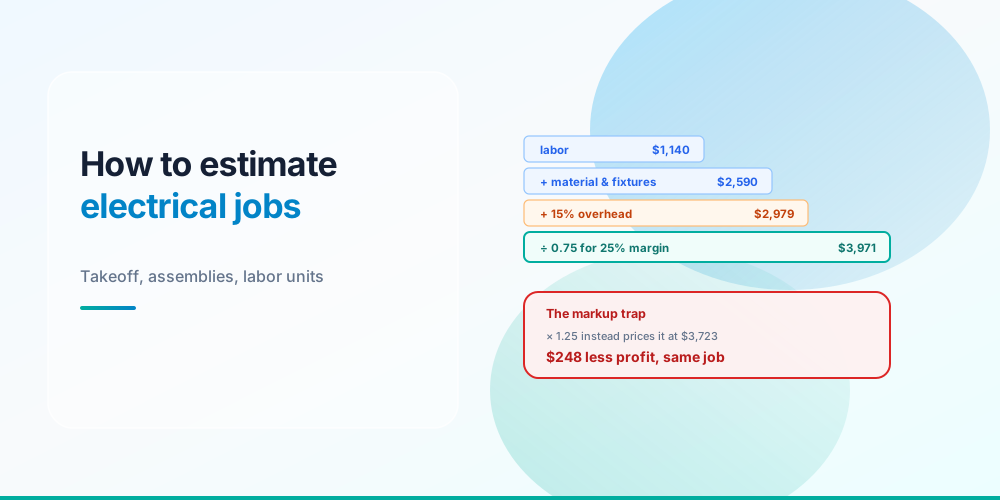
Take a real job: 12 hours at $95/hr, $600 of fixtures, $850 of material.
- Labor: 12 × $95 = $1,140
- Fixtures: $600
- Material: $850
- Direct cost: $2,590
- Overhead at 15%: +$389
- Break-even: $2,979
Now apply a 25% margin. And this is the part that matters:
Price = break-even ÷ (1 − margin) = $2,979 ÷ 0.75 = $3,971, leaving $993 of profit.
"25%" two ways
If instead you’d multiplied - $2,979 × 1.25 = $3,723 - you’d have priced the same job $248 lower, and earned a 20% margin rather than the 25% you intended.
That’s the whole trap. Markup is a percentage of cost. Margin is a percentage of price. They are not the same operation, and a 25% markup is always a 20% margin. The gap widens as the percentage rises: a 50% markup is only a 33% margin.
Multiply to mark up from cost. Divide to hit a margin on price. If your target is stated as a margin - and it should be, because that’s what shows up on your accounts - then you divide.
Repeat the wrong operation across a year of jobs and it’s the difference between a business that works and one that doesn’t.
What Else Belongs in the Price
- Permit fees and inspection time, including the trip to the AHJ.
- Mobilisation - getting to site, unloading, setting up, cleaning up. Real hours on small jobs, and the reason a two-hour job is never priced at two hours.
- Waste and shrinkage on wire and fittings. Nobody uses exactly 250 feet.
- Material price volatility. Copper moves; quote validity periods exist for a reason.
- Contingency on unknowns. Retrofit work in walls you haven’t opened deserves an explicit allowance, not optimism.
- Warranty and callbacks. A percentage, based on your own history.
Common Mistakes
- Multiplying when you mean to divide. The 20%-instead-of-25% error above.
- Leaving overhead out. The most common reason a “profitable” year isn’t.
- Using your wage as your labor rate. Your billing rate is roughly three times your wage - see Electrician Hourly Rate.
- Trusting published labor units unadjusted. They’re an average; your history is data.
- Pricing per-item instead of per-assembly. Slower and easier to miss things.
- Not tracking actuals. Without them you can’t improve any of the above.
- Discounting the margin to win work. Cutting 5 points off a 25% margin removes a fifth of the profit on the whole job.
Price the Job
Estimate Calculator - enter hours, rate, fixtures, material, overhead and target margin; get the price, break-even and profit, plus what the markup error would have cost.
The Estimate Calculator produced every figure above, and it shows the markup-versus-margin gap explicitly so you can see it on your own numbers. Establish your labor rate properly with the Labor Rate Calculator - that’s the input most often wrong. For the two job types most often quoted, see Electrical Panel Upgrade Cost and Cost to Rewire a House.
Cost figures are 2026 US market ranges used for illustration and vary by region and market - planning aids, not quotes. NECA Manual of Labor Units is a published industry reference; your own tracked hours are a better source for your market.
FAQ
How do you estimate an electrical job?
Five stages: take off every item from the plan or walkthrough; price them as assemblies rather than individual parts; apply labor units to get hours; add overhead as a percentage of direct cost; then divide by one minus your target margin to get the price. The last two stages are where most estimates go wrong.
What is the difference between markup and margin?
Markup is a percentage of cost; margin is a percentage of the selling price. A 25% markup on $2,979 gives $3,723, which is only a 20% margin. To achieve a 25% margin you divide by 0.75, giving $3,971 - $248 more on the same job. A 50% markup is only a 33% margin.
What are electrical labor units?
The hours a given assembly is expected to take - for example, hours per receptacle installed. NECA’s Manual of Labor Units is the standard published reference, but it reflects national averages across all conditions. Tracking your own actual hours per assembly gives you better data for your crew and market.
How much overhead should I add to an electrical estimate?
Whatever your books say: annual overhead divided by annual direct cost. Around 15% is common for a small shop, but it varies widely with vehicle count, insurance, software and how much unbillable time you carry. The important thing is that it’s in the price rather than absorbed out of profit.
What profit margin should an electrical contractor target?
Commonly 20–35% gross margin on residential service and small commercial work, depending on market and risk. What matters more than the number is applying it as a margin rather than a markup, and including overhead before you apply it - otherwise the margin you think you have isn’t the margin you get.
Should I use my hourly wage as my labor rate?
No. Your billing rate has to recover wage plus payroll burden plus overhead across only your billable hours, then add margin. That typically works out around three times the wage - a $32/hr wage supports a billing rate near $105/hr. The arithmetic is in Electrician Hourly Rate.