
Electrical Panel Upgrade Cost: 100 A to 200 A
- 04 Aug, 2026
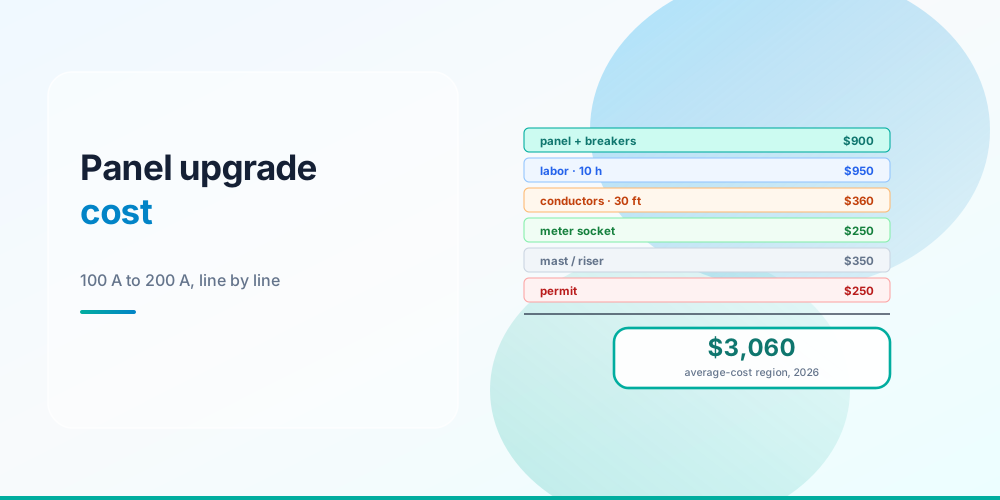
A 100-to-200-amp panel upgrade typically runs $1,300 to $5,000 in the US, and a middle-of-the-road job lands around $3,060. That’s a wide band, and the width is the useful information - it tells you the number depends on things you can actually check before anyone quotes you.
Here’s the job broken into its parts, so you can work out where in that range yours sits.
Where the money goes
| Line item | Typical |
|---|---|
| Panel + breakers (200 A) | $900 |
| Labor - 10 hours at $95/hr | $950 |
| Service conductors - 30 ft at $12/ft | $360 |
| Meter socket | $250 |
| Mast / riser (overhead service) | $350 |
| Permit | $250 |
| Total | $3,060 |
Allow for normal quoting variation and that’s a band of roughly $2,601 to $3,519 for the same scope. Figures are 2026 US market ranges - not a quote.
Two things worth noticing. Labor is the biggest single line, slightly ahead of the panel itself, and it’s the line that varies most between contractors. And the panel is under a third of the cost - which is why “I found the panel online for $400” doesn’t move the total much.
The Five Things That Move the Price
What drives it up or down
Service rating. A 100 A panel is around $400 of material, 200 A about $900, and 400 A about $2,200. Going to 400 A also means heavier conductors at roughly $28/ft instead of $12, so the gap compounds.
Conductor run length. At 200 A you’re paying about $12 per foot for service-entrance conductors. A 30-foot run is $360; a 60-foot run is $720. If the panel is moving to the other side of the house, this line grows fast.
Overhead vs underground. An overhead service needs a mast or riser - about $350. An underground lateral doesn’t. But an underground service that needs trenching is a different conversation entirely, and often more expensive than the mast it saves.
Meter socket. Usually replaced as part of the upgrade, around $250. Some utilities allow reuse of a recent socket, some mandate replacement.
Region. The largest single multiplier, and the one nobody accounts for.
Identical scope, four regions
| Region | Multiplier | Same job |
|---|---|---|
| Low cost | 0.85× | $2,601 |
| Average | 1.00× | $3,060 |
| High-cost metro | 1.25× | $3,825 |
| Very high cost | 1.50× | $4,590 |
Identical work, nearly $2,000 apart. Any national average you read - including the one at the top of this article - is a starting point for a conversation, not a budget.
What Can Push It Past $5,000
- 400-amp or 320/400 service. Heavier gear, heavier conductors, often two panels. See What Size Electrical Service Do I Need.
- Relocating the panel. New conductor run, drywall work, and sometimes a new meter location the utility has to approve.
- A panel in a prohibited space. Panels in clothes closets or over stairs have to move, and that’s not optional.
- Transformer capacity. If the utility’s transformer can’t support the upgrade, who pays for the upgrade to their equipment is a question best asked early.
- Grounding electrode work. An upgrade brings the grounding system to current code - new rods, water-pipe bonding, sometimes a Ufer connection that’s hard to reach.
- Bringing circuits to current code. AFCI and GFCI devices for circuits that never had them add up across 20–40 breakers.
- Aluminum branch wiring discovered mid-job. A serious cost, and one a new panel does not solve - see Cost to Rewire a House.
Before You Spend It: Check Whether You Need It
This is the part worth more than any cost breakdown. A great many panel upgrades are sold to solve problems an upgrade doesn’t solve.
A full panel is not a maxed-out service. If every breaker slot is used but the calculated load still fits the service, tandem breakers or a subpanel solve it for a fraction of the price.
Measured demand often proves the service is fine. NEC 220.87 lets you establish the existing load from the utility’s highest recorded demand over 12 months × 125%. Real houses draw far less than they calculate, and this regularly shows an existing 100 A service has room for what you’re adding.
Both of those are worked through properly in Do I Need a Panel Upgrade - read that first if the upgrade is being driven by “I want to add an EV charger” rather than by a failing panel.
The exceptions where an upgrade genuinely is the answer: a 60-amp service or fuse box (below the 230.79(C) 100 A minimum), an obsolete or hazardous panel, visible damage, or a calculated load that really does exceed the service.
How to Read a Quote
- Get three. With a ±50% regional swing and labour being the largest line, quotes on identical scope vary a lot.
- Check what’s included. Permit, utility coordination, grounding electrode work, and drywall repair are the four things most often left out and added later.
- Ask whether the meter and mast are in scope. That’s $600 of difference.
- Ask who handles the utility disconnect and reconnect, and what the lead time is.
- Be suspicious of anything under about $1,300. That’s below the realistic floor for permitted work with a new meter and conductors, and usually means something isn’t in the scope.
- Confirm the load calculation. If nobody has run one, nobody knows whether 200 A is the right answer.
Price Your Job
Panel Upgrade Cost Calculator - set the rating, run length, meter, service type, permit and region; get the line-item breakdown and a quoting band.
The Panel Upgrade Cost Calculator produced every figure in this article - change the inputs to match your job and the breakdown updates. Before you price the upgrade, confirm you need it with the Service Size Calculator and the Load Calculator; if it’s EV-driven, size the circuit with the EV Charger Calculator first, since a smaller charger often removes the need entirely. Contractors pricing this work should also see How to Estimate Electrical Jobs.
Cost figures are 2026 US market ranges and vary substantially by region, utility and site conditions - they are planning aids, not quotes. Code references: NEC (NFPA 70) 2023 - 220.87, 230.79(C), 230.42, Table 310.12, 250.50. Local amendments override the model code, and the AHJ has final say.
FAQ
How much does it cost to upgrade to a 200 amp panel?
Typically $1,300 to $5,000 in the US, with a middle-of-the-road job around $3,060 - roughly $900 panel, $950 labor, $360 conductors, $250 meter, $350 mast and $250 permit. Region alone moves that by ±50%, so get local quotes rather than relying on a national figure.
Is a panel upgrade worth it?
If the calculated load exceeds the service, or the panel is a 60-amp service, a fuse box, or a known-hazardous type, yes. If it’s being sold to solve a full panel or to add one circuit, often not - a subpanel or a NEC 220.87 measured-demand calculation frequently makes the upgrade unnecessary.
Why is a panel upgrade so expensive?
Because it isn’t just the panel. The panel is under a third of the cost; the rest is labor, new service-entrance conductors, a meter socket, a mast, a permit, grounding electrode work brought to current code, and a utility disconnect and reconnect. The panel itself being cheap online doesn’t change the other lines.
Does a 200 amp panel need a permit?
Yes. A service upgrade is permitted, inspected work everywhere in the US, and it requires the utility to disconnect and reconnect. Permit fees vary widely - $250 is a reasonable planning figure but some jurisdictions charge considerably more.
How long does a panel upgrade take?
The physical work is usually a single day, around 10 hours of labor for a straightforward 200-amp upgrade. The schedule is normally driven by the permit and the utility’s disconnect and reconnect appointment, which can add days or weeks depending on the utility.
Can I upgrade the panel without upgrading the service?
You can replace a panelboard on its own, but that doesn’t raise your service capacity. A new 200-amp panel fed by the original 100-amp service conductors is still a 100-amp service - the conductors, meter and main all have to move together for the rating to change.