
EV Charger Installation Cost: What Drives the $500–$2,500 Range
- 04 Aug, 2026
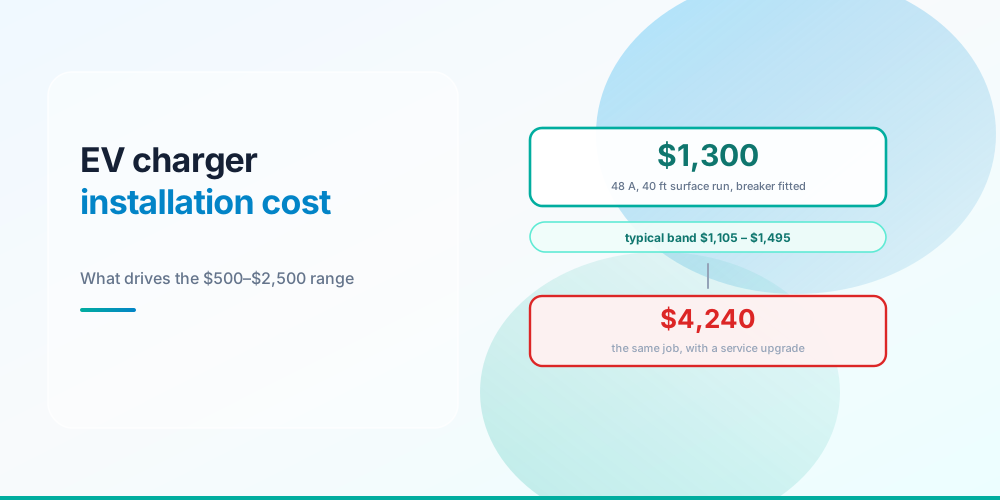
Published ranges for Level 2 EV charger installation sit around $500 to $2,500, excluding the charger itself. That’s a five-fold spread, which makes it nearly useless as a budget - so this article works out where inside the range a given job lands, and which single decision moves it most.
A typical installation - 48 A charger, 40 ft surface-mounted run, breaker fitted into existing panel space, permit, six hours of labour - comes to $1,300, with a realistic band of $1,105 to $1,495.
Where the Money Goes
Where $1,300 of installation actually goes
| Line | Cost | Share |
|---|---|---|
| Conductor & raceway - 40 ft × $7/ft × 1.00 | $280 | 21.5% |
| Hardware - hardwire kit or receptacle, box, disconnect | $180 | 13.8% |
| Panel work - new 60 A breaker in existing space | $120 | 9.2% |
| Permit & inspection | $150 | 11.5% |
| Labor - 6 h × $95/h | $570 | 43.8% |
| Total | $1,300 |
Labour is the largest line at 44%, which is normal for any small electrical job - the material content is modest and the time is real: locating the circuit, drilling and routing, terminating at both ends, setting the disconnect, testing and commissioning the unit. At the $105/hr rate a shop needs to charge to break even with margin (worked out in Electrician Hourly Rate), the labour line is $630 rather than $570.
Conductor cost tracks the circuit size, not the charger. A 48 A charger is a 60 A circuit on 6 AWG at roughly $7/ft; a 32 A charger is a 40 A circuit on 8 AWG at about $5/ft; a 60 A charger is an 80 A circuit on 4 AWG at around $10/ft. Why those sizes, and the Romex trap at 60 A, is in What Size Wire and Breaker for an EV Charger.
What Actually Moves the Number
Five inputs, swept one at a time
| Driver | Range | Cost swing |
|---|---|---|
| Charger rating | 32 A → 60 A | $1,220 → $1,420 |
| Routing method | surface → trenched | $1,300 → $1,692 |
| Run length | 10 ft → 100 ft | $1,090 → $1,720 |
| Region | low cost → very high cost metro | $1,105 → $1,950 |
| Panel work | spare space → service upgrade | $1,180 → $4,240 |
Four of those five drivers move the total by a few hundred dollars. The fifth moves it by $3,060.
Routing method is a multiplier on the conductor line, not an adder: surface-mounted 1.0×, fished through finished walls 1.6×, trenched or underground 2.4×. A 40 ft trenched run costs $672 of conductor and raceway against $280 surface. Trenching to a detached garage is where a “simple” job quietly stops being simple - and if the run is long enough, voltage drop starts to force a larger conductor on top.
Region is a straight multiplier on the whole job: 0.85 in low-cost markets, 1.25 in high-cost metros, 1.5 in the most expensive. The same $1,300 installation is $1,105 in one market and $1,950 in another. That’s not price gouging - it’s the labour rate, and it tracks the loaded cost of employing an electrician in that market.
Panel Work Is the Whole Ballgame
The panel decides the price. Everything else is rounding.
| Panel situation | Added cost | Job total |
|---|---|---|
| Spare breaker space already free | - | $1,180 |
| New breaker fitted | $120 | $1,300 |
| Subpanel added (panel full, service fine) | $900 | $2,080 |
| Service upgrade to 200 A | $3,060 | $4,240 |
The bottom two rows are frequently confused, and the distinction is worth money. A full panel is not the same problem as an undersized service. If the busbar and service conductors are adequate but every slot is occupied, the answer is a subpanel or a pair of tandem breakers - around $900, not $3,060. Panel spaces and service capacity are independent numbers, and only the second one requires an upgrade.
That $3,060 service-upgrade figure is not invented for this article: it’s the same total the panel upgrade cost calculator produces for a 200 A upgrade with the meter replaced on an overhead service - panel $900, meter $250, conductors $360, mast $350, permit $250, labour $950. The full breakdown and its regional variations are in Electrical Panel Upgrade Cost.
The $3,000 Question: Do You Actually Need the Upgrade?
Most quotes that include a service upgrade arrive at it the pessimistic way - a worst-case calculated load. There is a better method, and almost nobody uses it.
NEC 220.87 lets you establish the existing load from the utility’s highest recorded demand over the past 12 months, multiplied by 1.25 (30 days of recorded data is accepted where a year isn’t available). Real houses draw far less than their calculated load, so the result is usually a pleasant surprise.
The worked case: a 100 A service with a recorded 12-month peak of 44 A establishes an existing load of 44 × 1.25 = 55 A. Adding a 32 A charger at 125% (40 A) gives 95 A - it fits, with 5 A to spare. Adding a 48 A charger instead needs 60 A and gives 115 A, which does not fit.
So on that house:
- 32 A charger, no upgrade: $1,220.
- 48 A charger, service upgrade: $4,240.
A $3,020 difference, and the only thing given up is charging speed you almost certainly don’t need. A 32 A charger delivers about 7.7 kW, roughly 25–30 miles of range per hour - over an eight-hour overnight window that’s 200+ miles. Very few drivers can tell the difference between that and 48 A, and the ones who can are usually better served by load management anyway.
Article 750 load management is the third option: a controller that throttles or sheds the charger when the rest of the house is drawing hard, letting a larger charger live on a smaller service. Typically a few hundred dollars in hardware against several thousand for an upgrade. Run the numbers with the Existing Load Calculator before accepting an upgrade quote - the full consumer-facing version of this argument is Do I Need a Panel Upgrade.
The Realistic Extremes
Cheapest defensible job - about $515. A 32 A charger, 10 ft surface run from a panel in the garage with spare space, no permit required, three hours of labour. Below roughly $500 you are outside what the market delivers.
Worst case - about $7,220. A 60 A charger, 100 ft trenched run to a detached garage, service upgrade, $250 permit, fourteen hours. Nothing about that number is unreasonable; it’s four separate difficult conditions stacking.
Both are the same calculator with different inputs, which is the point: quotes that differ by 10× are usually describing different jobs, not different contractors.
What the Number Doesn’t Include
- The charger itself - typically $400–$800 for a reputable 48 A hardwired unit.
- Drywall repair after a fished run. Electricians open walls; most don’t close them.
- A subpanel at a detached garage, which also needs its own disconnecting means and grounding electrode.
- Trenching in rock, or crossing a driveway. Boring under concrete is its own line item.
- Utility work. A service upgrade sometimes requires the utility to change the drop or the transformer, on their schedule.
- Incentives. Federal, state and utility EV-charging incentives exist but have been amended repeatedly in recent years, including changes to eligibility by location. Confirm what currently applies before pricing it into a quote - and never quote a customer a net-of-rebate figure you haven’t verified.
How to Compare Quotes
- Ask what panel work is in the price. This is the single biggest variable, and vague quotes hide it.
- Ask whether a service upgrade was justified by a 220.87 calculation or assumed. If assumed, ask for the utility’s demand data.
- Ask the charger rating the quote assumes. A 32 A and a 48 A install are different jobs.
- Ask whether the permit is included. A new 240 V circuit normally needs one, and some utilities also want notification.
- Ask about routing. “Surface conduit along the garage wall” and “fished through a finished ceiling” are hours apart.
- Compare the total, not the hourly rate. A $95/hr shop with a $150 trip fee can beat a $75/hr shop easily.
Price Your Installation
EV Charger Installation Cost Calculator - set charger rating, run length, routing method, panel work, permit, labour hours and rate, and a regional multiplier. Returns an itemised total with a realistic ±15% band.
Every figure in this article is that calculator’s output. Before you accept a service upgrade, check the Existing Load Calculator; size the circuit itself with the EV Charger Circuit Calculator; and if an upgrade really is needed, price it with the Panel Upgrade Cost Calculator. Contractors pricing this work should also see How to Estimate Electrical Jobs.
Cost figures are 2026 US market planning ranges produced by the calculator, not quotes; regional multipliers and labour rates vary substantially. Sources & standards: NEC (NFPA 70) 2023 - 220.82, 220.87, 625.41, 625.42, Article 750. Local amendments override the model code, and the AHJ has final say.
FAQ
How much does it cost to install an EV charger?
About $1,300 for a typical Level 2 installation - a 48 A charger on a 40 ft surface-mounted run with a breaker fitted into existing panel space, a permit and six hours of labour. The realistic band is $1,105 to $1,495, and published ranges of $500 to $2,500 mostly reflect how much panel work is involved.
Why do EV charger quotes vary so much?
Almost entirely because of panel work. With everything else held constant, using existing spare panel space gives $1,180, fitting a new breaker $1,300, adding a subpanel $2,080, and a service upgrade $4,240. Run length, routing method, charger rating and region together move the total by only a few hundred dollars.
Do I need to upgrade my panel to install an EV charger?
Often not. Check NEC 220.87 first: the utility’s highest recorded demand over 12 months × 1.25 establishes the real existing load, which is usually far below a worst-case calculation. On a 100 A service with a 44 A recorded peak, a 32 A charger fits with 5 A to spare. Where it genuinely doesn’t fit, Article 750 load management costs a fraction of an upgrade.
Is a 32 amp charger enough?
For most drivers, yes. 32 A delivers about 7.7 kW - roughly 25–30 miles of range per hour, or over 200 miles across an overnight charge. Choosing 32 A instead of 48 A saves only about $80 of wire, but it is frequently what removes a $3,060 service upgrade from the job.
How much does it cost to run the circuit to a detached garage?
Trenching multiplies the conductor and raceway line by about 2.4×, so a 40 ft trenched run is roughly $672 against $280 surface-mounted. A 100 ft trenched run to a detached garage, with a subpanel and its own grounding electrode, realistically lands between $2,500 and $4,000 before any panel work at the house.
Is a permit required to install an EV charger?
Almost always, because it’s a new 240 V branch circuit - budget $100–$300 depending on jurisdiction, and expect an inspection. Some utilities also require notification of a new EV load. Skipping the permit risks insurance and resale problems, and it’s the cheapest line in the job.
Does the price include the charger?
No. Installation figures exclude the unit itself, which is typically $400–$800 for a reputable 48 A hardwired charger. Quotes that look unusually low are often quoting labour and materials only, so confirm what’s included before comparing.