
Watts to Amps: The Formula for DC, Single-Phase, and Three-Phase
- 04 Aug, 2026
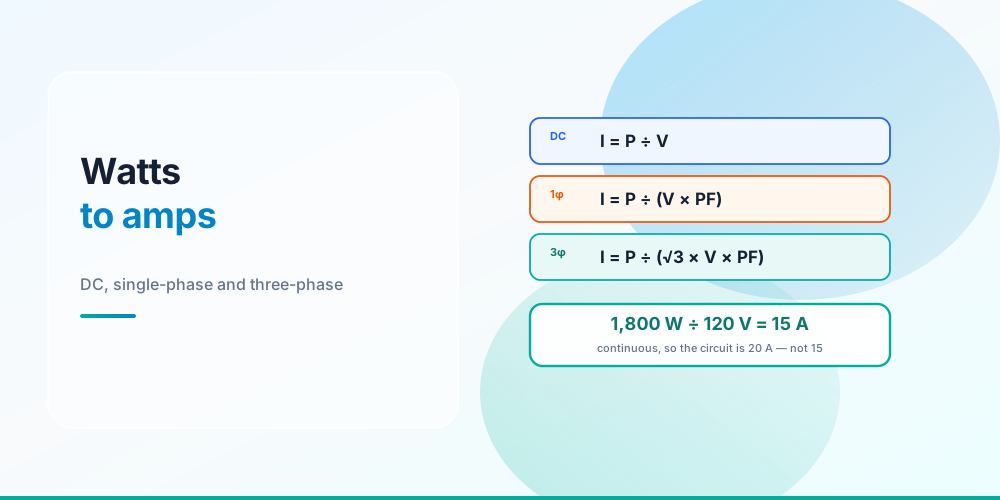
The conversion is one line:
- DC: amps = watts ÷ volts
- AC single-phase: amps = watts ÷ (volts × power factor)
- AC three-phase: amps = watts ÷ (1.732 × volts × power factor)
That’s it, and you can stop reading if the number is all you needed. But almost nobody converts watts to amps out of curiosity - they do it to pick a breaker or a wire size, and the amps you just calculated are not the breaker size. That step is where the mistakes happen, so most of this article is about it.
The Three Forms
One conversion, three divisors
Direct current has no power factor - voltage and current are steady, so all the power is real power. 100 W of solar array at 12 V is 8.33 A.
Single-phase AC needs a power factor because voltage and current can be out of step. Use 1.0 for anything resistive: heaters, water heaters, ovens, toasters, incandescent lamps, resistance duct heaters. Those loads are the majority of what a residential electrician converts, so in practice the residential form is just watts ÷ volts. Use 0.8–0.9 for motors, and read the next section before you do.
Three-phase divides by √3 as well, because the three line currents are 120° apart and the maths of a balanced load works out that way. The result is the current in one line conductor, which is what you size wire and breakers from.
Watts Are Not Always Watts
This is the part that separates a correct answer from a plausible one.
On a motor, the nameplate “watts” is usually output, not input. A 1 HP motor produces 745.7 W of mechanical work at the shaft. It draws more than that from the supply, because it is not 100% efficient - so the honest form of the conversion for a motor is:
I = (HP × 745.7) ÷ (V × PF × efficiency)At 120 V with a 0.85 power factor and 0.85 efficiency, that 1 HP motor lands near 8.6 A. But even that is not the number you build the circuit from. NEC 430.6(A) requires motor conductors to be sized from the Table 430.248 / 430.250 full-load current, not from the nameplate. The nameplate is used for overload protection; the table is used for conductors and the branch-circuit protective device. So on motor work the conversion is a sanity check, not the answer.
On anything with a switching power supply - LED drivers, computer gear, inverters - the “watts” figure is real power and the volt-amperes drawn can be noticeably higher. The conductor carries the volt-amperes.
On a nameplate that reads VA, don’t apply power factor at all. VA is already the apparent power: amps = VA ÷ volts (÷ 1.732 × volts on three-phase). Applying PF to a VA figure double-counts it. The reverse direction of this conversion, and the VA-versus-watts distinction it turns on, is worked through in Amps to Watts.
Voltage and Phase Change Everything
The same 10,000 W on four different supplies
Ten kilowatts is 83.33 A at 120 V, 41.67 A at 240 V, and 12.03 A on three-phase 480 V. Two things follow that are worth internalising:
Doubling the voltage halves the current. This is the entire reason ranges, dryers, water heaters and EV chargers are 240 V circuits - 12 kW at 120 V would need 100 A and 3 AWG conductors. It’s also why voltage drop is a much smaller problem on a 240 V circuit: the same wire reaches twice as far, because the allowable drop in volts doubles while the drop per foot stays the same. That relationship is worked out in Voltage Drop: How to Calculate It.
Three-phase carries the same power on 42.3% less current, because 1 ÷ √3 = 0.5774. Combined with a higher voltage, that’s why commercial equipment above roughly 10 kW is three-phase wherever three-phase is available: the conductors, the raceway and the breaker all get dramatically smaller.
One caution on three-phase: 208 V and 240 V are not interchangeable. A heating element rated 240 V run at 208 V produces about 25% less heat (power scales with V²), and the same nameplate watts at 208 V draws proportionally more current - 10 kW at 480 V three-phase is 13.36 A, but at 208 V it’s 30.84 A.
From Amps to the Circuit
From watts to the breaker and wire that actually go in
An 1,800 W space heater on 120 V converts to exactly 15.00 A. That looks like a 15 A circuit, and it isn’t one.
A space heater runs for three hours or more at a stretch, which makes it a continuous load. NEC 210.20(A) requires the overcurrent device to be rated for 125% of the continuous load, so the required ampacity is 15.00 × 1.25 = 18.75 A, rounded up to the next standard rating in 240.6(A) - a 20 A breaker on 12 AWG copper.
You will also hear this as the “80% rule”: don’t load a breaker past 80% of its rating continuously. It is the same arithmetic inverted (1 ÷ 1.25 = 0.80), and it explains the single most common household complaint about space heaters - a 15 A circuit may only carry 12 A continuously, so 15 A of heater on it will eventually trip.
The full sequence, once you have the amps:
- Is it continuous? Three hours or more of operation at a time. If yes, × 1.25.
- Round up to a standard OCPD rating from 240.6(A): 15, 20, 25, 30, 35, 40, 45, 50, 60, 70, 80, 90, 100 A and up.
- Pick the conductor whose Table 310.16 ampacity meets the breaker rating - 75 °C column for ordinary terminations, per 110.14(C).
- Check 240.4(D) - 14 AWG copper is capped at 15 A, 12 AWG at 20 A, 10 AWG at 30 A regardless of what the table says.
- Check voltage drop over the run, using the actual load current, not the breaker rating.
Steps 2 to 5 are what the What Size Breaker Do I Need and What Size Wire Do I Need guides cover in full.
Worked Examples
Every figure below is the calculator’s own output, including the 240.6(A) breaker and the 75 °C copper conductor.
| Load | Supply | Amps | Continuous? | Breaker | Conductor |
|---|---|---|---|---|---|
| 1,500 W hair dryer | 120 V | 12.50 A | No | 15 A | 14 AWG Cu |
| 1,800 W space heater | 120 V | 15.00 A | Yes | 20 A | 12 AWG Cu |
| 4,500 W water heater | 240 V | 18.75 A | Yes | 25 A | 10 AWG Cu |
| 5,000 W dryer | 240 V | 20.83 A | No | 25 A | 10 AWG Cu |
| 12,000 W range | 240 V | 50.00 A | No | 50 A | 8 AWG Cu |
| 11,520 W EV charger (48 A) | 240 V | 48.00 A | Yes, by rule | 60 A | 6 AWG Cu |
| 10,000 W motor, PF 0.85 | 240 V 1φ | 49.02 A | - | 50 A | 8 AWG Cu |
| 10,000 W, PF 0.9 | 480 V 3φ | 13.36 A | No | 15 A | 14 AWG Cu |
| 10,000 W, PF 0.9 | 208 V 3φ | 30.84 A | No | 35 A | 8 AWG Cu |
| 1,000 W inverter input | 48 V DC | 20.83 A | - | 25 A | 10 AWG Cu |
Three rows in that table need a footnote, because the conversion is not the whole rule:
The 12 kW range. Table 220.55 lets a single 12 kW household range be calculated at 8,000 VA, and 210.19(C) permits the branch circuit to be sized to that demand - which is why 40 A on 8 AWG is the conventional range circuit rather than the 50 A the raw conversion suggests. The demand factors are worked through in Residential Load Calculation.
The dryer. 220.54 puts a floor of 5,000 VA on a dryer regardless of nameplate, and 30 A on 10 AWG is the standard circuit.
The EV charger. NEC 625.41 makes EVSE continuous by rule - you don’t have to judge whether it runs for three hours, because the code decided. That’s why a 48 A charger needs a 60 A circuit, worked through fully in What Size Wire and Breaker for an EV Charger.
Common Mistakes
- Treating the converted amps as the breaker size. Continuous loads need × 1.25 first, then rounding up.
- Applying the 80% rule twice. × 1.25 and ÷ 0.80 are the same rule. Do one.
- Applying power factor to a VA rating. VA is already apparent power; PF only converts between watts and VA.
- Using nameplate watts on a motor. That’s usually mechanical output. Use Table 430.248 / 430.250 full-load current for the circuit.
- Forgetting √3 on three-phase. Omitting it overstates the current by 73%, which is an expensive way to buy wire.
- Using the breaker rating in the voltage-drop formula. Drop is caused by the current actually flowing, not the protection.
- Assuming 208 V behaves like 240 V. It’s 13% lower, and heating elements lose about a quarter of their output.
- Adding up every wattage in the house and dividing by 240 to size a service. That’s connected load. The calculated load uses demand factors, and it’s much smaller - see What Size Electrical Service Do I Need.
Do the Conversion
Watts to Amps Calculator - enter watts, pick DC, single-phase or three-phase, set the voltage and power factor, and flag the load as continuous. Returns the amps, the required ampacity, the 240.6(A) breaker and the 75 °C copper conductor.
Every figure in this article came out of that calculator. Going the other way, use the Amps to Watts Calculator; for the V, I, R and P relationships behind all of it, the Ohm’s Law Calculator; and for the whole set of formulas on one page, the Electrical Formulas Cheat Sheet.
Sources & standards: NEC (NFPA 70) 2023 - 110.14(C), 210.20(A), 220.54, 220.55, Table 220.55, 240.4(D), 240.6(A), Table 310.16, 430.6(A), Tables 430.248 and 430.250, 625.41. Local amendments override the model code, and the AHJ has final say.
FAQ
How do I convert watts to amps?
Divide watts by volts on a DC circuit. On AC single-phase, divide by volts × power factor; on balanced three-phase, divide by 1.732 × volts × power factor. Use a power factor of 1.0 for resistive loads such as heaters and elements, and 0.8–0.9 for motors.
How many amps is 1,500 watts?
12.5 A at 120 V, or 6.25 A at 240 V, at unity power factor. On a 120 V circuit that fits a 15 A breaker on 14 AWG copper - but only if the load is not continuous. If it runs for three hours or more, 1,500 W needs a 20 A circuit.
How many amps is 1,800 watts at 120 volts?
Exactly 15.00 A, which is the whole problem: a space heater is a continuous load, so NEC 210.20(A) requires 125% - 18.75 A - and the next standard breaker is 20 A on 12 AWG copper. A 15 A circuit may only carry 12 A continuously, so it will eventually trip.
Do I need power factor to convert watts to amps?
Only on AC, and only when the load is not purely resistive. Heaters, water heaters, ovens and resistance elements are power factor 1.0, so the conversion is just watts ÷ volts. Motors and some electronics run 0.8–0.9. Power factor never applies to DC, and it must not be applied to a nameplate already given in VA.
Why do you divide by 1.732 for three-phase?
1.732 is √3, and it comes out of the geometry of three line voltages 120° apart. The practical consequence is that three-phase moves the same power with 42.3% less current in each line conductor, which is why large equipment is three-phase wherever three-phase is available.
Is the amps figure the breaker size?
No. Continuous loads - anything running three hours or more, and EV charging by rule - get multiplied by 1.25 first, then rounded up to a standard rating in 240.6(A). The conductor then has to meet that breaker rating, subject to the 240.4(D) caps on 14, 12 and 10 AWG.
How many watts can a 20 amp circuit handle?
2,400 W at 120 V on paper, but only 1,920 W of continuous load, because a breaker may not carry more than 80% of its rating continuously. That’s the reverse conversion - see Amps to Watts for the full set of circuit capacities.