
What Size Wire for a 100 Amp Sub Panel?
- 03 Aug, 2026
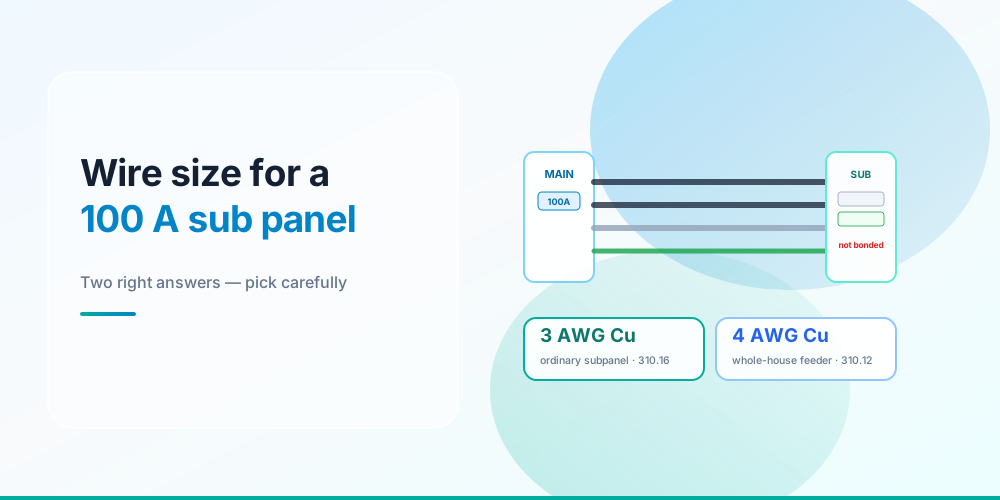
Search this question and you’ll get “4 AWG copper” almost everywhere. That answer is right for one specific case and wrong for the most common one - and the difference is a genuine code violation rather than a matter of opinion.
For a typical subpanel in a garage, shop, or addition, a 100-amp feeder needs 3 AWG copper or 1 AWG aluminum. The 4 AWG answer comes from an allowance that only applies when the feeder carries the entire load of the dwelling.
The One Question That Decides It
Which table applies to your feeder
Table 310.12 permits conductors for a dwelling service - or for a feeder that carries the entire load associated with a one-family dwelling - to be sized at 83% of the rating. At 100 amps that’s 83 amps of required ampacity, which 4 AWG copper (85 A at 75 °C) satisfies.
An ordinary subpanel doesn’t qualify. It carries part of the load; the main panel keeps the rest. So you’re back to Table 310.16, where a 100-amp feeder needs a conductor good for 100 amps at the 75 °C termination column:
| Feeder type | Copper | Aluminum |
|---|---|---|
| Ordinary subpanel (310.16) | 3 AWG | 1 AWG |
| Whole-dwelling feeder (310.12) | 4 AWG | 2 AWG |
Note that 4 AWG copper is only 85 A at 75 °C - genuinely not enough for a 100-amp feeder on its own merits. It works under 310.12 solely because that section lets you size against 83 A instead of 100 A.
Which case is yours?
Ordinary subpanel - use 310.16. A garage panel, a shop panel, a subpanel for an addition, a panel fed from a main that still serves the kitchen and bedrooms. If the panel you’re feeding from keeps any loads of its own, this is you.
Whole-dwelling feeder - 310.12 applies. The classic case is a meter-main or service disconnect outside with a single feeder to the one panel inside that serves everything. Also a dwelling unit in a two-family or multifamily building fed by one feeder carrying that unit’s entire load.
When in doubt, size from 310.16. It’s one trade size larger, it’s never wrong, and the material cost difference on a residential feeder is small.
The Rest of the Feeder
Four conductors, three different sizing rules
The equipment grounding conductor comes from Table 250.122, keyed to the overcurrent device rather than the conductor size. For a 100-amp breaker that’s 8 AWG copper or 6 AWG aluminum. If you upsize the hots for voltage drop, 250.122(B) requires the EGC to grow proportionally.
The neutral is sized per 220.61 for the maximum unbalanced load - the current that would flow if all the 120-volt loads landed on one leg. Many installers simply run it full size, which is always acceptable and simpler to buy as a cable assembly. If you do reduce it, don’t take it below the EGC size from Table 250.122.
Four wires, not three. Two hots, a neutral, and an equipment grounding conductor. The old three-wire feeder to a detached building - relying on a local grounding electrode for the fault path - is no longer permitted. A detached structure gets its own grounding electrode per 250.32, but the EGC still runs with the feeder.
Don’t bond the neutral at the subpanel. Remove the bonding screw or strap so the neutral bar and ground bar stay isolated. The neutral–ground bond belongs at the service disconnect and nowhere else; bonding it again downstream puts normal return current onto the grounding conductors and any metal they touch. It’s the single most common DIY subpanel error.
Distance Usually Decides It
Subpanels tend to be far - the whole point is often a detached garage or a shop at the back of the lot. That makes voltage drop the governing test more often than not.
How far a 100 A copper feeder reaches
At 100 amps on 240 volts, copper reaches roughly 116 feet in 4 AWG, 146 feet in 3 AWG, 185 feet in 2 AWG, and 233 feet in 1 AWG before drop reaches 3%.
Worked example. A detached garage 150 feet from the house, 100-amp subpanel, copper:
- Ampacity: 3 AWG (100 A at 75 °C) ✓
- Drop at 3 AWG: 2 × 12.9 × 100 × 150 ÷ 52,620 = 7.36 V = 3.06% ✗ - just over
- Drop at 2 AWG: 2 × 12.9 × 100 × 150 ÷ 66,360 = 5.83 V = 2.43% ✓
2 AWG copper, with the EGC upsized per 250.122(B). Anyone who’d stopped at the ampacity chart would have pulled 3 AWG and been marginally out of target - the method is in Voltage Drop.
What About Aluminum?
Perfectly normal for feeders and considerably cheaper. 1 AWG aluminum for the ordinary-subpanel case, 2 AWG if 310.12 genuinely applies. Aluminum SER cable is the usual product for an interior feeder; for a direct-burial run to a detached building you want USE-2 or a listed underground cable, since SER isn’t rated for wet locations.
Aluminum also drops more voltage - K is 21.2 against copper’s 12.9 - so re-check the run length after sizing for ampacity. On that same 150-foot garage feeder, 1 AWG aluminum drops 2 × 21.2 × 100 × 150 ÷ 83,690 = 7.60 V, or 3.17%, so you’d step to 1/0.
Don’t Forget the Load Calculation
Sizing the feeder assumes 100 amps is the right feeder rating in the first place. That comes from a load calculation on what the subpanel will actually serve - and just as importantly, whether the existing service can give up 100 amps. Adding a 100-amp subpanel to a 100-amp service is usually not viable. The Load Calculator runs the 220.82 optional method, and the Service Size Calculator checks what the service can carry.
Common Mistakes
- Using 4 AWG for an ordinary subpanel. The 83% allowance doesn’t reach it; 4 AWG copper is 85 A at 75 °C.
- Three-wire feeders. Four conductors, always, including to a detached structure.
- Bonding neutral to ground at the subpanel. Bond only at the service disconnect.
- Sizing the EGC off the wire instead of the breaker. Table 250.122 is keyed to the OCPD.
- Skipping the drop check on a long run. Above ~146 feet at 100 A, 3 AWG copper isn’t enough.
- SER cable underground. Not rated for wet locations - use USE-2 or another listed underground wiring method.
- Forgetting the source side. The main panel needs a spare double-pole space, adequate busbar rating, and enough service capacity.
Size the Feeder
Service & Feeder Wire Size Calculator - toggles between the 310.12 dwelling allowance and straight 310.16 sizing, and returns the neutral, ground, and drop check with it.
The Service & Feeder Wire Size Calculator has the whole-dwelling case as an explicit switch, so you can see both answers side by side. Pair it with the Voltage Drop Calculator for a long run and the Ground Wire Size Calculator for the EGC. The 200-amp version of this question is in 200 Amp Service Wire Size, and the general method in What Size Wire Do I Need.
Sources & standards: NEC (NFPA 70) 2023 - Table 310.16, Table 310.12, 110.14(C), 220.61, Table 250.122, 250.122(B), 250.32, 408.40. Local amendments override the model code, and the AHJ has final say.
FAQ
What size wire do I need for a 100 amp sub panel?
For an ordinary subpanel, 3 AWG copper or 1 AWG aluminum, from Table 310.16 at the 75 °C column. The widely-quoted 4 AWG copper answer applies only where Table 310.12’s 83% allowance is available - a dwelling service, or a feeder carrying the entire load of the house.
Can I use 4 AWG copper for a 100 amp subpanel?
Only if that feeder carries the entire dwelling load. 4 AWG copper is rated 85 A at 75 °C, so on its own it doesn’t support a 100-amp feeder; it works under 310.12 because that section lets you size against 83 amps rather than 100. For a garage or shop subpanel, use 3 AWG.
What size ground wire for a 100 amp sub panel?
8 AWG copper or 6 AWG aluminum, from Table 250.122 based on the 100-amp overcurrent device. If you upsize the ungrounded conductors for voltage drop, 250.122(B) requires the equipment grounding conductor to be upsized proportionally.
Do I need 4 wires to a sub panel?
Yes - two hots, a neutral, and an equipment grounding conductor. Three-wire feeders relying on a local electrode for the fault return path are no longer permitted, including to a detached building. A detached structure also needs its own grounding electrode under 250.32.
Should the neutral and ground be separated in a sub panel?
Yes. Remove the bonding screw or strap so the neutral bar is isolated from the enclosure and the ground bar. The neutral–ground bond is made only at the service disconnect; repeating it downstream puts normal load current on the grounding system.
How far can I run a 100 amp sub panel feeder?
In copper at 240 V and a 3% drop target: about 146 feet on 3 AWG, 185 feet on 2 AWG, and 233 feet on 1 AWG. A 150-foot run therefore needs 2 AWG copper even though 3 AWG passes ampacity - and the ground has to grow with it.