
SEER Rating Savings Calculator: Is Higher SEER Worth It?
- 28 Jun, 2026
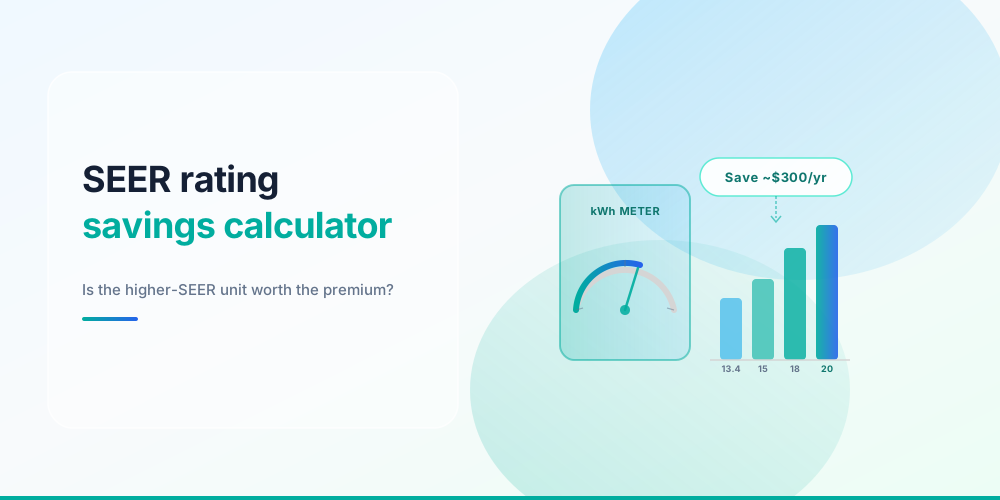
A seer rating savings calculator compares annual cooling cost between two efficiency ratings on the same home. Also called a seer rating calculator, seer efficiency calculator, or hvac energy savings calculator, it answers: does the higher-SEER unit save enough on your bill to justify the price premium?
SEER Savings Formula
Annual kWh = (BTU/hr × cooling hours) ÷ (SEER × 1,000)
Annual cost = Annual kWh × electricity rate ($/kWh)
Annual savings = cost at lower SEER − cost at higher SEER
Payback years = price premium ÷ annual savings
SEER sits in the denominator - higher SEER means fewer kilowatt-hours for the same cooling output.
SEER savings formula - step by step
Example: 3-Ton System, 2,000 Hours, $0.22/kWh
| SEER2 | Annual kWh | Annual cost |
|---|---|---|
| 13.4 (minimum) | 5,373 | $1,182 |
| 15 | 4,800 | $1,056 |
| 16 | 4,500 | $990 |
| 18 | 4,000 | $880 |
| 20 | 3,600 | $792 |
Jumping from SEER2 14 to 18 saves roughly $300/year in this hot-climate scenario. In a mild climate with 600 run hours, savings drop to about $90/year.
Annual cooling cost by SEER2 rating
When Higher SEER Pays Back
A seer rating savings calculator shows clear payback when:
- You cool 1,500+ hours per year
- Electricity exceeds ~$0.15/kWh
- Rebates or tax credits offset the premium
- You value two-stage/variable-speed comfort (not captured in kWh math)
Lean toward mid-tier (SEER2 15–16) when you cool fewer than 800 hours, pay under $0.12/kWh, or plan to move within 5 years.
SEER upgrade payback by climate tier
For rating definitions, see SEER vs SEER2. For the full payback walkthrough, see Will a Higher SEER Save You Money?.
SEER2 Note
Federal labels show SEER2 since 2023 - about 4–5% lower than legacy SEER for the same equipment. Use the number on your unit’s label in any seer efficiency calculator.
Use the Free Calculator
SEER Savings Calculator - seer rating savings calculator with your run hours and rate.
SEER2 Converter - convert legacy SEER to SEER2.
FAQ
How much does each SEER point save?
Savings taper as SEER rises. The jump from minimum to mid-tier captures most savings; 18 to 20 adds less per point.
What is a seer rating calculator?
A tool that converts SEER rating, system size, run hours, and electricity rate into annual cooling cost and savings vs another rating.
Is an hvac energy savings calculator only for cooling?
Most SEER calculators cover cooling. Heating savings use AFUE or HSPF - see 95% AFUE Furnace Worth It? and Heat Pump vs Gas Furnace Cost.
How long is SEER payback?
Divide the price premium by annual savings. Hot climates often see 5–8 year payback on a 14-to-18 upgrade; mild climates may exceed equipment life.