
Drain Cleaning Cost: What You Are Actually Paying For
- 06 Sep, 2026
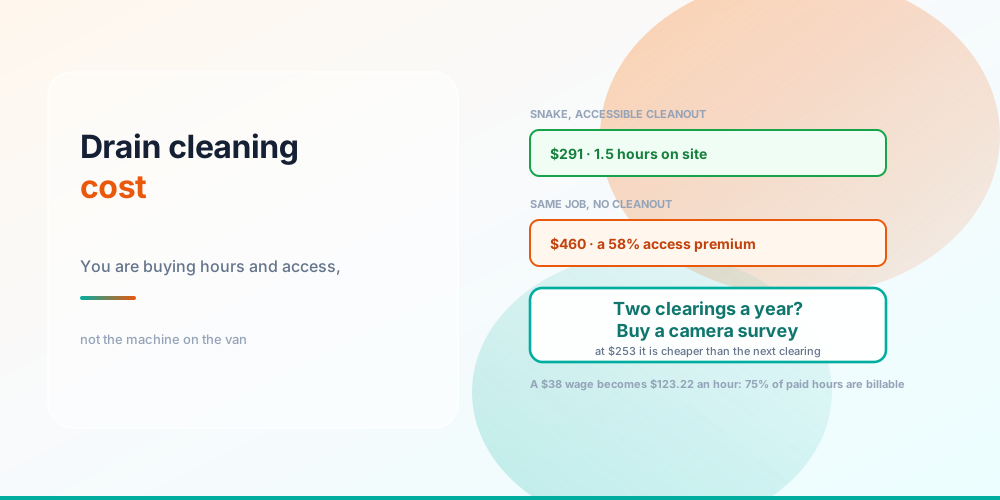
The reason drain cleaning quotes vary so wildly for apparently identical work is that the work is not identical. Almost the whole difference is hours on site and how hard the pipe is to reach — and the machine, which is what the price list implies you are renting, barely registers.
Five services, one basis
You are buying hours and access, not the machine
- Camera inspection only — 1.5 h — $253 ($215 to $291)
- Snake, accessible cleanout — 1.5 h — $291 ($248 to $335)
- Snake, roof vent access — 2.5 h — $460 ($391 to $529)
- Hydro-jetting — 3 h — $621 ($528 to $714)
- Jet, camera and report — 4.5 h — $874 ($743 to $1,005)
Consumables are under a hundred dollars on every line. What separates these prices is time.
The cleanout finding is the one worth acting on. The same blockage cleared through an accessible cleanout costs $291; reached from a roof vent it costs $460 — a 58% premium, and you pay it every time anyone clears that drain. If your house has no accessible cleanout, adding one is a permanent discount on every future visit. Missing and buried cleanouts are also among the commonest findings in common plumbing code violations.
Where the hourly rate comes from
Why the hour costs what it costs
A $110 an hour rate looks like a lot next to a technician’s wage, so it is worth seeing the build:
- Technician wage — $38.00 an hour
- Plus 32% payroll burden — $50.16 — taxes, workers’ comp, insurance, paid leave
- Plus $11,000 a year overhead per tech — $73.93 — van, licensing, software, office
- Divided by 1,560 billable hours of 2,080 paid — 75% utilisation
- Plus 40% margin — $123.22 an hour
That is 3.24 times the wage, and the step people never see is utilisation: 25% of paid hours are never invoiced — driving, quoting, warranty returns, training, waiting — so the billable 75% has to carry them. Details in plumber hourly rate.
Snaking or jetting?
They are not two grades of the same service, and being sold the wrong one is the most common way to overpay.
A cable machine (snake) punches through and pulls out a discrete obstruction — a wipe mass, a root ball, a toy. It restores flow at the blockage and leaves the pipe walls as they were. That is the right tool for the ordinary blocked drain.
Hydro-jetting scours the full bore with high-pressure water. It is the right tool for accumulated grease, scale or soft root fibre over a length of pipe, and for anything that keeps coming back after snaking. It is roughly twice the price because it is twice the time plus a much larger machine.
Two cautions on jetting that a good contractor will raise unprompted. It can damage pipe that is already failing — old clay with cracked joints, or thin-walled Orangeburg — so a camera first is not an upsell, it is diligence. And jetting a line that is blocked by a structural defect cleans a pipe that is going to block again next month, because the defect is still there.
Grease is its own category: if a commercial kitchen is jetting on a schedule, the interceptor is the actual problem, and what size grease trap do I need is the cheaper conversation.
When clearing stops being the cheap option
When clearing stops being the cheap option
At $291 a visit:
- Once a year — $291 a year — $2,913 over ten years
- Twice a year — $583 — $5,827
- Three times a year — $874 — $8,740
- Four times a year — $1,165 — $11,653
Against a $4,079 spot repair and a $10,733 full 40-foot replacement:
Twice a year passes the spot repair in 7.0 years. Four times a year passes a full replacement in 9.2 years.
Those crossovers are longer than people expect, and taken literally they say that clearing a drain annually is a perfectly rational thing to keep doing — which is true. A single annual root cut on a line that is otherwise sound is cheaper than replacing it, and always will be.
But the bars leave out the two things that actually decide it: every clearing is a day arranged around a plumber, and every blockage is a chance of a backup you did not schedule — into a basement, onto a finished floor, at 11pm on a holiday weekend. That risk does not appear in a cumulative-cost chart and it is usually what tips the decision.
So the practical rule is not a crossover year. It is: two clearings in a year means buy a camera survey, not a third clearing. At $253 the survey is cheaper than the visit you are about to book, and it is the only thing that distinguishes “roots at one joint, cut it annually forever” from “this line is failing and every clearing is rent”. Which of the two you have is what sewer line replacement cost then prices.
What moves your quote
- Access. Accessible cleanout, or roof vent, or pulling a WC. The largest single factor.
- Which line. A basin trap is minutes; a main lateral from an exterior cleanout is an hour or more of cable.
- Out of hours. Evening, weekend and holiday call-outs carry a premium that is often 1.5x or more.
- Diagnosis included or not. A camera adds an hour and is frequently quoted separately.
- Whether the cause gets fixed. Clearing is not repair, and a quote for clearing should not be read as one.
Build your own version with the Plumbing Estimate Calculator, or work out a defensible hourly rate with the Labor Rate Calculator.
Frequently asked questions
How much does it cost to unclog a drain?
On the costing basis here, an ordinary snaking through an accessible cleanout prices at about $291, with a band of $248 to $335. Without a usable cleanout — working from a roof vent — the same job is about $460, because it takes an extra hour and needs roof access.
How much does hydro-jetting cost?
Around $621 for a three-hour job, against $291 for snaking. It is roughly double because it is double the time plus a far larger machine. Jetting is the right tool for grease, scale and recurring soft blockages over a length of pipe — not for a single discrete obstruction, which a cable clears faster and cheaper.
Is snaking or hydro-jetting better?
They do different jobs. Snaking punches through a discrete obstruction; jetting scours the full bore. Use a cable for the ordinary blocked drain and jetting for accumulated grease or scale, or for anything that returns after snaking. Ask for a camera before jetting an old line — jetting can damage pipe that is already failing.
Why is drain cleaning so expensive for such a quick job?
Because you are buying an hour of a loaded trade rate, not a machine. A $38 wage becomes $123.22 an hour once payroll burden, per-technician overhead and the fact that only 75% of paid hours can be invoiced are accounted for. That is 3.24 times the wage, and it is arithmetic rather than markup.
How much does a sewer camera inspection cost?
About $253 as a standalone hour and a half, or roughly $874 bundled with jetting and a written report. It is the cheapest useful step in the whole process, because it is what tells you whether you have a blockage or a broken pipe — and those have completely different price tags.
When should I replace the drain instead of cleaning it?
Not on a fixed number of visits — on what a camera shows. For scale: clearing twice a year passes the cost of a spot repair in 7.0 years, and four times a year passes a full replacement in 9.2. But a single annual root cut on sound pipe is genuinely cheaper than replacing it forever. Two clearings in one year is the trigger to survey, not to replace.
Does adding a cleanout save money?
Yes, permanently. Every clearing through a roof vent costs about 58% more than the same clearing through an accessible cleanout — $460 against $291 — and you pay that premium on every visit for as long as you own the building. If your drain gets cleared even occasionally, the cleanout pays for itself.
Will drain cleaning fix the cause?
No, and this is the distinction that matters most. Clearing restores flow; it does not repair a root intrusion, a bellied section, an offset joint or a collapsed pipe. If a drain blocks repeatedly at the same place, the blockage is a symptom and the clearing is rent. A camera survey is what turns that into a decision.
Why did my drain block again a month later?
Almost always because there is a structural cause still in place — roots at a joint, a sag holding water and solids, or an offset the cable slid past. Jetting a line with a defect cleans a pipe that will block again. The repeat interval is itself the diagnostic: the shorter it is, the more likely the fault is physical rather than what you put down the drain.
Sources & standards: All prices are computed from a transparent cost model, not surveyed market data — crew hours times an hourly rate, plus materials, plus overhead as a percentage of direct cost, plus margin, using this site’s plumbing estimate calculator basis of $110 an hour, 15% overhead and 25% margin, with a ±15% quoting band. The hourly rate build-up uses the labour rate calculator’s defaults: a $38 wage, 32% payroll burden, $11,000 annual overhead per technician, 1,560 billable of 2,080 paid hours and a 40% margin, giving $123.22 an hour. Hours for each service are illustrative scopes chosen to make the comparison structurally honest — they are not a quote, and out-of-hours work, which commonly carries a 1.5x or greater premium, is not included. The crossover years follow arithmetically from those figures and deliberately exclude the cost of arranging each visit and the risk of an unscheduled backup, both of which usually dominate the real decision. Drain cleaning is not IPC-priced; the code governs cleanout provision and access (IPC 708), which is exactly why the cleanout premium above is a code question as well as a cost one.