
How Many GPM Does a Shower Use? And How Much of It Is Hot
- 06 Sep, 2026
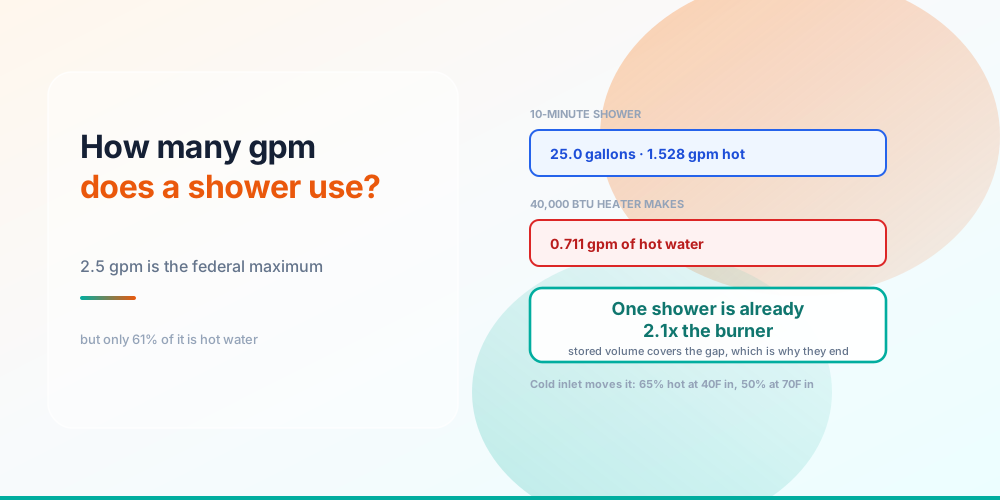
The short answer is 2.5 gallons per minute, because that is the US federal maximum for a showerhead, tested at 80 psi. A ten-minute shower is therefore 25 gallons.
The more useful answer is that only about 1.5 gpm of that is hot, and the hot part is where the money and every “we ran out of hot water” argument actually live.
What the rating costs over a year
Most of a shower is the heating, not the water
Taking a four-person household at one ten-minute shower each per day:
- 2.5 gpm (federal maximum) — 25.0 gallons a shower — 36,500 a year — $749
- 2.0 gpm (common WaterSense head) — 20.0 gallons — 29,200 — $599
- 1.8 gpm — 18.0 gallons — 26,280 — $539
- 1.5 gpm — 15.0 gallons — 21,900 — $449
Dropping from 2.5 to 1.5 gpm saves about $300 a year and shortens nobody’s shower.
The split matters as much as the total: energy is 39% of it at every flow rate. That proportion does not move, because a fixed share of every gallon gets heated — so a low-flow head saves fuel and water in the same ratio, and the fuel half is the larger single line once you separate water from sewer.
Note that the 2.5 gpm rating is measured at 80 psi. On a house sitting at 45 psi many heads deliver noticeably less, which is why an “underperforming” shower is often a pressure problem rather than a head problem — see low water pressure in a house.
Only part of it is hot
A 2.5 gpm shower is not 2.5 gpm of hot water
A shower is a mixed flow. Delivering 105 °F from a tank stored at 140 °F with 50 °F cold coming in, the mix is 61.1% hot — so a 2.5 gpm head draws only 1.528 gpm of hot water.
That number moves with all three temperatures:
- Delivery temperature. At 100 °F it is 1.389 gpm hot; at 115 °F, 1.806. A hotter shower is disproportionately more hot water.
- Storage temperature. Stored at 120 °F instead of 140, the same 105 °F shower needs 78.6% hot — 1.964 gpm. Storing hotter makes each stored gallon go further, which is the whole argument in mixing valve explained.
- Cold inlet temperature, and this is the one nobody expects. At 40 °F incoming the mix is 65.0% hot; at 70 °F it is 50.0%. Colder incoming water needs a bigger share of hot for the same shower — so the tank drains fastest in winter, exactly when recovery is slowest. That is the real reason hot water “runs out faster in January” with nothing having changed.
What actually runs out first
The pipe is fine. The burner is not.
Here is the part that reframes the question. A 40,000 BTU gas water heater at 80% efficiency, raising water 90 °F, recovers 42.7 gallons an hour — 0.711 gpm of hot water.
One 2.5 gpm shower needs 1.528 gpm of hot water. That is 2.1 times what the burner can make.
So a single shower is already running at a deficit, and what covers the gap is the stored volume in the tank, not the burner. That is why showers end abruptly rather than gradually getting cooler: you are drawing down an inventory, and when it is gone the burner alone cannot hold the temperature. Tank sizing is therefore about the first hour, not the recovery rate — which is what what size water heater do I need works through.
Meanwhile the pipe is not the constraint. 3/4-inch Type L copper carries 12.07 gpm at the 8 ft/s cold limit, which is four 2.5 gpm showers at once. The plumbing has capacity long after the hot water has gone.
One methodological note worth making, since it comes up: Hunter’s curve is the wrong tool for this question. It reads 3.80 gpm for a single 1.4-WSFU shower against a true 2.5. Hunter is built for whole systems where diversity does the work, and it deliberately runs high at small fixture counts — which is safe for sizing a service and misleading for counting showers. Size a branch on the raw sum and use fixture units for the system, as in plumbing fixture units explained.
Frequently asked questions
How many gallons per minute does a shower use?
2.5 gpm at most, which is the US federal maximum for a showerhead tested at 80 psi. Many heads sold now are 2.0 or 1.8 gpm, and WaterSense-labelled heads are 2.0 or below. A ten-minute shower at 2.5 gpm is 25 gallons; at 1.8 gpm it is 18.
How much water does a 10-minute shower use?
25 gallons with a 2.5 gpm head, 20 with a 2.0, and 15 with a 1.5. For a four-person household showering daily that is 36,500 gallons a year at 2.5 gpm against 21,900 at 1.5 — a difference of about $300 a year on typical water, sewer and gas rates.
How much of a shower is hot water?
About 61% delivering 105 °F from a 140 °F tank with 50 °F cold inlet — so 1.528 gpm of hot water inside a 2.5 gpm shower. If the tank is set to 120 °F instead, the same shower needs 78.6% hot, because there is less heat in each hot gallon to spread around.
Why does my hot water run out faster in winter?
Because colder incoming water needs a larger share of hot for the same shower temperature. At 40 °F inlet a 105 °F shower is 65.0% hot against 50.0% at 70 °F inlet. The tank has not changed and neither has the shower — the mix has, and it is drawing the tank down faster at exactly the time of year recovery is slowest.
Can my water heater keep up with a shower?
Not on recovery alone. A 40,000 BTU heater at 80% efficiency makes 0.711 gpm of hot water and one shower draws 1.528 gpm — over twice as much. The tank’s stored volume covers the difference, which is why the useful specification is the first-hour rating rather than the recovery rate.
Will a 3/4-inch pipe supply two showers?
Comfortably. 3/4-inch Type L copper carries 12.07 gpm at the 8 ft/s cold-water design limit, and two 2.5 gpm showers are 5.0 gpm. The pipe will supply four. What fails first at that point is the hot water, not the pipe.
Does water pressure affect shower flow rate?
Yes, and the rating hides it. A head is rated at 80 psi, so at 45 or 50 psi it will deliver less than the number on the box. Pressure-compensating heads hold their rated flow across a range and are the reason a 1.8 gpm head can feel better than an old 2.5 — the flow is steadier and better atomised.
Are low-flow showerheads worth it?
On these figures, a 2.5 to 1.5 gpm change saves about $300 a year for a four-person household, and the head costs a fraction of that once. The saving is roughly 39% fuel and 61% water and sewer, so it holds up whether energy or water is the expensive utility where you are.
How do I work out my own numbers?
Time a shower into a bucket to get the actual gpm — the rating is a maximum at a test pressure, not a measurement of your installation. Then the Water Heater Size Calculator covers whether the tank supports it, and the Mixing Valve Calculator gives the hot share for your own storage and delivery temperatures.
Sources & standards: The 2.5 gpm at 80 psi showerhead maximum is the US federal standard (EPCA, as implemented in 10 CFR 430); WaterSense labelling is 2.0 gpm or less. Maximum fixture flow rates are also tabulated in IPC Table 604.4. Hot fractions and mixed flows are computed from a straightforward energy balance on the same basis as this site’s mixing valve calculator; recovery is computed as BTU input times efficiency divided by 8.33 pounds per gallon and the temperature rise, at 40,000 BTU, 80% efficiency and a 90 °F rise to match the water heater size calculator. Costs use $5.50 per 1,000 gallons water, $7.00 sewer and $1.40 a therm — ordinary US figures and this site’s calculator defaults, but yours will differ, and some utilities bill sewer on a winter average rather than metered volume. Velocity limits of 8 ft/s cold and 5 ft/s hot are ASPE and manufacturer design practice, not an IPC requirement. Hunter’s curve and the WSFU weights behind it are tier-3 published values reproduced from IPC Appendix E, which is enforceable only where adopted, and Hunter is known to run high on low-flow fixtures and small fixture counts — the error is toward larger pipe, which is why it stays in use for system sizing and is the wrong tool for a single branch.