
Sewer Smell in the House: Where It Comes From, In Order
- 06 Sep, 2026
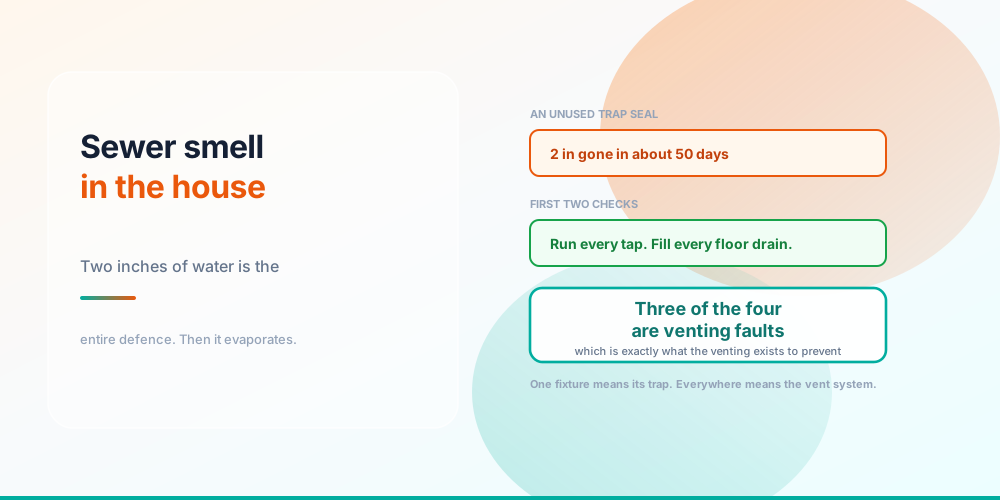
Every drain in a building is an open pipe to the sewer, and the only thing between the sewer and the room is two inches of standing water in a trap. That is the whole defence. A sewer smell indoors means that defence has failed somewhere, and there are exactly four ways it can.
The seal, and how it gets lost
Two inches of water is the entire defence
The IPC requires a trap seal between 2 and 4 inches deep. Lose it and the trap is just a bent pipe.
Evaporation is the mechanism people underestimate. A 2-inch seal disappears in:
- 100 days at 0.02 in/day — cool, humid, closed room
- 50 days at 0.04 in/day — typical conditioned space
- 25 days at 0.08 in/day — warm, dry air, moving
So an unused guest bathroom is on a clock of roughly fifty days. That is why the smell appears after a long trip and not before it, and why it seems to come and go with the seasons — dry winter air with the heating on empties a seal considerably faster than humid summer air.
The other three losses are hydraulic rather than slow:
Self-siphonage — the fixture’s own discharge pulls its seal out behind it, which happens when the trap arm is too long or there is no vent within reach.
Induced siphonage — another fixture discharging past the trap on a poorly vented stack drags the seal out with it.
Back-pressure — a surge in the stack pushes air the other way and blows the seal into the room. This one is characteristic of the lower floors of tall stacks and of a blocked vent terminal.
Note the pattern: three of the four are venting problems, and the venting exists precisely to prevent them.
Where to look, in order
Work down this list, not up it
The order matters, because the common causes are also the free ones and people routinely start at the expensive end.
- An unused fixture. Run every tap and flush every WC in the building. A dry trap is the single most common cause of a sewer smell, and this rules it out for nothing.
- Floor drains and shower drains. Pour a couple of quarts of water down each one. Floor drains are the worst offenders because no fixture above them ever refills the seal — a basement or laundry floor drain may go years without water.
- The WC wax ring or closet flange. Rock the pan. Any movement means the seal has failed, and a leaking flange vents gas around the base of the pan rather than through the drain, so the trap can be perfectly full and the room still smells.
- A cleanout with no cap. Check every cleanout indoors and out. An uncapped cleanout is a direct unsealed opening into the drainage system, and it is a genuinely common find — see common plumbing code violations.
- A failed air admittance valve. AAVs are mechanical and they fail open. They are also usually hidden in a cabinet, so nobody looks. Sniff at the AAV while another fixture drains. Air admittance valve vs vent covers what they can and cannot legally replace.
- A trap arm that is too long or unvented. Measure from the trap weir to the vent. A 1-1/4 inch arm may not exceed 5 feet, a 1-1/2 inch arm 6 feet, and a 2 inch arm 8 feet. Beyond that the fixture siphons its own seal every time it drains — the mechanism and the full table are in how far can a vent be from a trap.
- A blocked or frozen vent terminal. Nest, leaves, snow, or a stack somebody capped off during a roof job. The whole system loses its air path, so seals get siphoned and blown throughout the building rather than at one fixture.
- A broken pipe in a wall or under the slab. Real, and last. It needs a camera and a smoke test, and everything above it is cheaper to eliminate first.
The diagnostic value of this ordering: if the smell is at one fixture, it is that fixture’s trap, arm or seal. If it is general, or shifts around the building, suspect the vent system or an open cleanout. If it appears only when another fixture drains, that is siphonage or back-pressure and the venting is the fault.
If it traces back to venting
If it is the venting, this is the vent that should be there
Vent sizing is half the drain size, floored at 1-1/4 inch, and upsized one step once the developed length to open air passes 40 feet:
- Drain 1-1/2” — vent 1-1/4” (the floor governs) — 1-1/2” past 40 ft
- Drain 2” — vent 1-1/4” (the floor governs) — 1-1/2” past 40 ft
- Drain 3” — vent 1-1/2” (halving governs) — 2” past 40 ft
- Drain 4” — vent 2” — 2-1/2” past 40 ft
The 1-1/4 inch minimum only binds at 2 inches and below. At 3 inches and above the halving already exceeds it, so the floor is irrelevant there. Check your own configuration with the Vent Size Calculator.
Two things that are not sewer gas
A biofilm smell from a shower or basin drain is common and is not sewer gas. It is bacterial growth on the inside of the tailpiece and overflow, it smells sour or musty rather than of sulphur, and it is strongest when water first runs rather than continuously. It cleans out; it is not a venting fault.
A gurgling drain with no smell is a venting symptom that has not yet cost you a seal — the system is pulling air through the trap because it cannot get it from a vent. Worth fixing before it becomes this article: why is my drain gurgling.
One safety note that is not a plumbing nicety. Sewer gas is mostly methane, carbon dioxide and hydrogen sulphide. Hydrogen sulphide deadens the sense of smell at exactly the concentrations that start to matter, so “the smell went away” is not evidence the problem did. A persistent strong sewer smell in an enclosed space is a ventilate-and-investigate situation, not a live-with-it one.
Frequently asked questions
Why does my house smell like sewage?
Because a trap seal has been lost somewhere, or there is an unsealed opening into the drainage system. The most common single cause is a dry trap in a fixture nobody uses — a 2-inch seal evaporates in about fifty days in ordinary conditions. Run every fixture in the building first; it is free and it is usually the answer.
How long does it take for a trap to dry out?
Roughly 50 days at a typical 0.04 inches a day, from the 2-inch minimum seal the IPC requires. In warm dry air with the heating running it can be as little as 25 days; in a cool humid closed room, 100. Floor drains dry out fastest in practice because nothing above them ever refills the seal.
Why does the smell only appear sometimes?
Two usual reasons. If it appears when another fixture drains, that is siphonage or back-pressure — a venting fault. If it appears after the house has been empty, or seasonally when the heating dries the air, that is evaporation emptying a seal that use would otherwise keep topped up.
Can a plumbing vent cause a sewer smell?
Yes, in two ways. A blocked vent terminal removes the system’s air path, so traps get siphoned and blown throughout the building. And an undersized or missing vent lets a fixture siphon its own seal. Three of the four trap-seal loss mechanisms are venting problems, which is what the vent system exists to prevent.
Is sewer gas in a house dangerous?
Treat it as more than a nuisance. It is mostly methane, carbon dioxide and hydrogen sulphide, and hydrogen sulphide deadens the sense of smell at the concentrations where it starts to matter — so a smell that faded is not proof the problem did. Ventilate the space and find the cause rather than masking it.
Why does my bathroom smell but only near the toilet?
Most likely the wax ring or closet flange, not the trap. Rock the pan: any movement means the seal has failed, and a failed flange vents gas around the base rather than through the drain. That is why the trap can be full and the floor area still smells.
Do air admittance valves cause sewer smells?
They can, because they are mechanical and fail open. A stuck AAV is an unsealed opening into the drainage system, usually hidden inside a cabinet where nobody thinks to look. Sniff at it while another fixture drains. AAVs also are not universally accepted by local codes in the first place.
What is the maximum distance from a trap to a vent?
From IPC Table 909.1: 5 feet for a 1-1/4 inch arm, 6 feet for 1-1/2 inch, 8 feet for 2 inch, then 12 feet for 3 inch and 16 for 4 inch. Measured from the trap weir to the vent connection. Beyond the limit the fixture siphons its own seal every time it drains, and no amount of topping up will hold.
How do I stop a floor drain smelling?
Refill it — a couple of quarts of water restores the seal. For a drain that genuinely never gets used, a trap seal primer (a small line that feeds it from a nearby fixture) or a proprietary trap-seal insert is the permanent answer. A drain cover does nothing, because the gas is coming past the missing water, not around the grate.
Sources & standards: Trap seal depths of 2 to 4 inches are IPC 1002.4. Trap arm maximum lengths are IPC Table 909.1 — reproduced here through the same function this site’s vent calculator uses — and vent sizing is half the drain diameter with a 1-1/4 inch minimum (IPC 916.2) plus the developed-length upsizing step. Evaporation rates of 0.02 to 0.08 inches a day are illustrative figures, not code or measurement: the real rate depends on humidity, temperature, air movement and trap geometry, so the timelines are the order of magnitude rather than a prediction for your fixture. Table 906.1 for vent stacks is not reproduced anywhere on this site — multi-storey vent stack sizing goes back to the code. AAV acceptance varies by jurisdiction and one should never be presented as universally legal. Sewer gas composition and the olfactory fatigue effect of hydrogen sulphide are documented by OSHA and NIOSH; this article is not a substitute for gas monitoring where a persistent strong smell is present. The IPC is a model code — confirm the edition your jurisdiction adopts, and note the UPC diverges on venting more than on almost anything else.