
Sewer Line Replacement Cost: How the Number Is Built
- 06 Sep, 2026
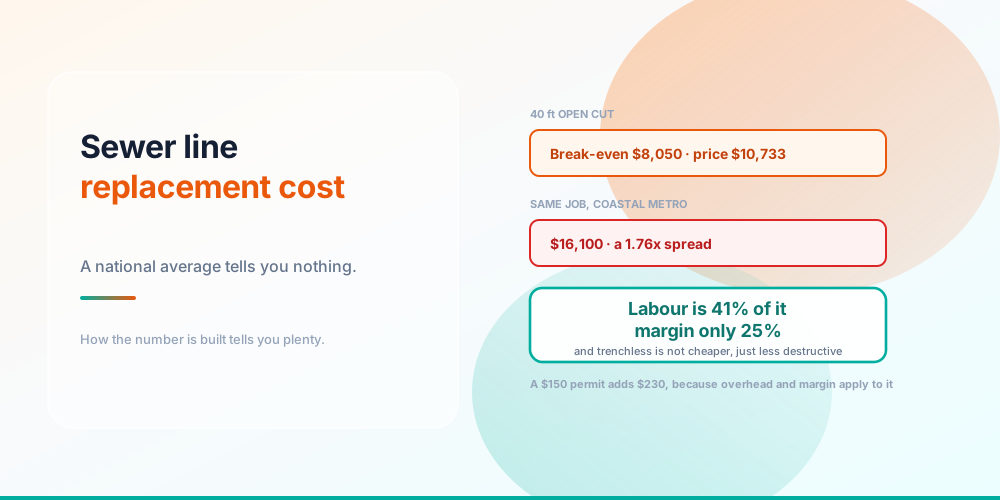
Search for sewer line replacement cost and you get a national average, which is the least useful possible answer. The spread across US markets on the same job is wider than the difference between a spot repair and a full replacement, so an average tells you nothing about whether the quote in your hand is reasonable.
What does help is knowing how the number is built, because then you can interrogate a quote instead of comparing it to a stranger’s.
The build-up
Where a 40 foot open-cut replacement price comes from
Take a 40-foot open-cut replacement through a front garden with no hard surface — 40 crew hours, $2,600 of pipe, bedding, spoil disposal and excavator hire:
- Labour — 40 hours at $110 — $4,400 (41.0% of the price)
- Materials and plant — $2,600 (24.2%)
- Overhead at 15% of direct cost — $1,050 (9.8%)
- Margin at 25% — $2,683 (25.0%)
- Break-even $8,050, price $10,733
Two things worth taking from that.
Labour is the single biggest line, and it is what a scope change actually moves. Depth, hard surfaces, traffic control and hand-digging around other utilities all buy crew hours, which is why “how deep is it” changes a quote more than “how long is it”.
The margin is not where your money went. At a 25% margin the contractor keeps $2,683 of a $10,733 job before tax, and the break-even — the number below which they lose money on the work — is $8,050. If a quote comes in far under that, something in the scope has been left out. The markup-versus-margin distinction behind that arithmetic is in plumbing markup vs margin.
Four scopes on one basis
Four scopes, one costing basis
Costing four scopes the same way makes them comparable:
- Spot repair, 10 ft — 16 h — $4,079 ($3,467 to $4,690)
- Open cut, 40 ft — 40 h — $10,733 ($9,123 to $12,343)
- Open cut, 70 ft — 64 h — $17,235 ($14,649 to $19,820)
- Trenchless, 70 ft — 40 h — $18,247 ($15,510 to $20,984)
The result that surprises people: trenchless is not cheaper. Over the same 70 feet it prices about 6% above the open cut here, because it halves the crew hours and more than doubles the material and plant. Pipe bursting and lining trade labour for equipment; they do not trade away cost.
What trenchless actually buys is what it does not destroy — a driveway, a mature tree, a paved terrace, a finished basement floor. If the run is under 40 feet of lawn, the open cut is usually the better value. If it is under a resin driveway you laid last year, the reinstatement cost that never appears in the plumbing quote is what makes trenchless the cheaper job overall.
Spot repair deserves a warning. At $4,079 it looks like the obvious first move, and it is the right call for a single failed joint or one root intrusion in otherwise sound pipe. It is the wrong call for a clay line that has reached the end of its life, because you will be back — and two spot repairs plus an eventual replacement costs more than the replacement did. A camera survey before deciding is the cheapest money in this whole article.
Region moves it more than scope
Region moves it more than scope does
The same 40-foot job, same hours, same materials:
- Lower-cost metro / rural (×0.85) — $9,123
- National average (×1.00) — $10,733
- Higher-cost metro (×1.25) — $13,417
- Major coastal metro (×1.50) — $16,100
End to end, $7,755 to $18,515 once the quoting band is applied — a 1.76x spread on one scope. That is larger than the gap between the 40-foot and 70-foot runs, which means your market matters more than your run length, and a national average sits in the middle of a range so wide it cannot tell you anything about a specific quote.
And the regional factor does not capture the things that most often blow a sewer quote up:
- Depth. Deeper means shoring, more spoil, and in many jurisdictions a trench safety plan.
- Hard surfaces. Breaking out and reinstating concrete, asphalt or paving is often a separate trade.
- What is in the way. Gas, water and telecoms in the same trench line mean hand-digging.
- The street. If the lateral runs under the carriageway, expect a municipal permit, traffic control, and sometimes a requirement that the city’s own contractor does that section.
- Permits and inspection. Never a pass-through — see below.
The permit is not a pass-through
This is the detail that makes quotes look padded when they are not. A permit fee is a cost like any other, so overhead and margin apply to it. On this costing basis a $150 permit adds $230 to the price, not $150 — a factor of 1.53. A $600 permit adds $920.
That is not a contractor marking up a government fee for sport; it is what happens when a cost enters an estimate that carries overhead and margin. Plumbing permits and inspections works through it, and sewer replacement is squarely permit territory — it is a public health connection, it gets inspected, and doing it without one is the kind of violation that surfaces at resale.
How to read the quote you have
Ask for the scope in the terms above and the number becomes checkable:
- How many crew hours, and at what rate? This is 40%+ of the price. Plumber hourly rate covers what a real loaded rate looks like.
- Open cut or trenchless, and why that one here? The answer should be about what is above the pipe.
- What is the reinstatement scope? Who puts the lawn, path or driveway back, and is it in this price?
- Is the permit in the number? And the inspection, and any municipal section under the street.
- Has anyone actually looked? A camera survey distinguishes a spot repair from a replacement, and buying the survey first is cheaper than buying the wrong job.
Price your own version — hours, materials, overhead and margin — with the Plumbing Estimate Calculator.
Frequently asked questions
How much does it cost to replace a sewer line?
On the costing basis used here, a 40-foot open-cut replacement prices at about $10,733 in an average market, with a quoting band of $9,123 to $12,343. In a major coastal metro the same scope is $16,100. Anyone quoting you a single national number is averaging across a 1.76x regional spread.
Is trenchless sewer replacement cheaper than digging?
Usually not on the plumbing invoice. Over the same 70 feet, trenchless prices about 6% above an open cut here, because it halves the crew hours and more than doubles the material and equipment cost. It becomes the cheaper total job when it saves you from reinstating a driveway, a terrace or a mature tree.
Why is sewer line replacement so expensive?
Because it is mostly excavation labour, and labour is 41% of the price in the worked example. Depth, hard surfaces, other utilities in the trench line and traffic control all buy more hours. The materials — pipe and fittings — are a minor line by comparison.
Should I do a spot repair instead of a full replacement?
Only if a camera survey shows one localised failure in otherwise sound pipe. A spot repair prices around $4,079 against $10,733 for a 40-foot replacement, so it is attractive — but on an end-of-life clay line you will be back, and two repairs plus an eventual replacement costs more than the replacement alone. Buy the survey first.
Who pays for the sewer lateral, me or the city?
Almost always the property owner, for the section from the building to the connection — but where that responsibility ends is a local rule, and it is not always at the property line. Some municipalities own the portion under the carriageway and require their own contractor for it. Confirm before commissioning anything.
Do I need a permit to replace a sewer line?
Effectively always. It is a public health connection, it is inspected, and an unpermitted replacement tends to surface at resale. Note that the fee is not a pass-through — with overhead and margin applied, a $150 permit adds about $230 to a quote, which is arithmetic rather than padding.
What makes a sewer quote come in much higher than expected?
Depth requiring shoring, hard surfaces to break out and reinstate, other utilities in the trench line forcing hand-digging, and any part of the run under a public road — which adds a municipal permit and traffic control. None of these are captured by a length-based estimate, which is why length-based online calculators mislead.
How do I know if my sewer line needs replacing at all?
A camera survey. It distinguishes a blockage from a break, a root intrusion from a collapsed section, and a line with years left from one at the end of its life. It is the cheapest step in the process and the only one that tells you which of the four scopes above you are actually buying. Repeated blockages are the usual trigger — drain cleaning cost covers when clearing stops being the answer.
Does homeowners insurance cover sewer line replacement?
Standard policies generally exclude it, treating a failed lateral as wear rather than sudden damage. Separate service-line endorsements exist and are relatively inexpensive, and some utilities offer their own protection programmes. Check before you need it, because none of them will cover a line that has already failed.
Sources & standards: All figures are computed from a transparent cost model, not surveyed market data: crew hours times an hourly rate, plus materials and plant, plus overhead as a percentage of direct cost, plus margin — the same model as this site’s plumbing estimate calculator, at $110 an hour, 15% overhead and 25% margin. The crew hours and material allowances for each scope are illustrative and chosen to make the comparison structurally honest; they are not a quote and not a national survey. Regional factors of 0.85 to 1.50 and the ±15% quoting band are this site’s own conventions for expressing uncertainty, not published indices. Real costs are driven hardest by depth, hard-surface reinstatement, other utilities in the trench line and any work in the public right of way — none of which a length-based estimate captures. Responsibility for the sewer lateral, permit requirements, trench safety rules and whether a municipal contractor must do the street section are all local, vary widely, and must be confirmed with your jurisdiction and utility. Sewer laterals are not IPC-priced; the IPC governs how the work is done, not what it costs.