
Well Pump Short Cycling: An Over-Charged Tank Looks Exactly Like a Dead One
- 04 Sep, 2026
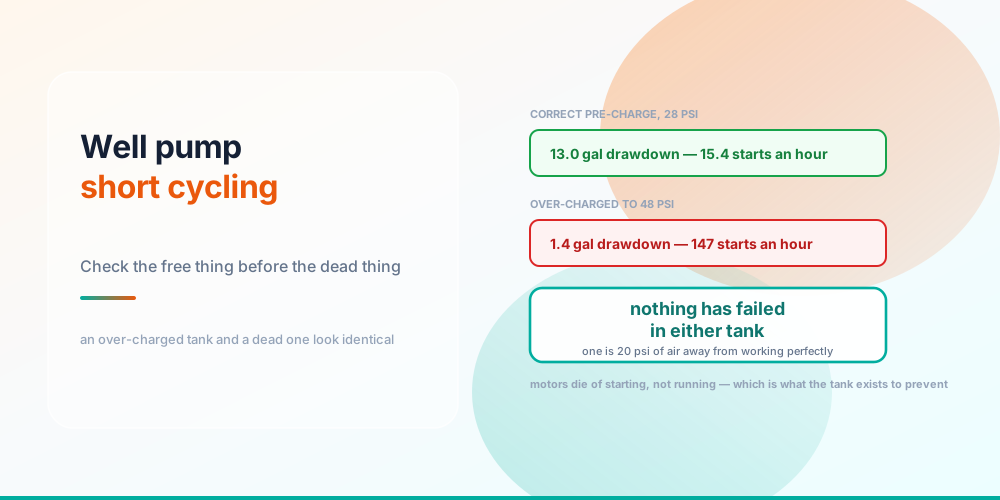
A short-cycling well pump gets diagnosed as a dead pressure tank more often than it deserves to be, and tanks get replaced every year on the strength of a symptom that twenty seconds with a tyre gauge would have explained.
An over-charged tank and a tank with a failed bladder present identically. Same rapid starting, same hammering, same feeling that something has broken. One of them costs several hundred dollars to fix and the other costs nothing at all.
What short cycling actually is
Motors do not wear out running. They wear out starting — that is when the inrush current is highest and the mechanical shock is worst. Everything a pressure tank does is aimed at that one problem: it stores water so the pump can deliver a decent volume per start and then rest.
When the tank stops storing water, the pump starts and stops continuously, and its life collapses.
What twenty psi of surplus air does
Starts per hour, and nothing is broken in any row
With the pre-charge correct at 28 psi — two below cut-in — the tank delivers 13.0 gallons and the pump makes 11.5 starts an hour at a steady 5 gpm draw.
Now over-charge it:
- 35 psi — 10.2 gallons — 14.7 starts an hour
- 40 psi — 6.8 gallons — 22.1 starts
- 45 psi — 3.4 gallons — 44.1 starts
- 48 psi — 1.4 gallons — 110.3 starts an hour
That is 9.6 times the wear, produced entirely by surplus air. The bladder is intact, the pump is healthy, the switch is fine, and the system is destroying itself.
The mechanism is in the drawdown arithmetic: once the pre-charge climbs toward cut-out, the air has almost no room left to expand through, and expansion is the only thing that pushes water out. The full treatment is in what size well pressure tank you need.
Note the 20 psi row too — under-charging costs you as well, though far less dramatically. The curve has a peak, and it is at two psi below cut-in.
Diagnose in cost order
Three causes, one symptom, and a strict order to check them
1. Check the pre-charge. Drain the system of water pressure first — with pressure on it, the schrader valve reads the water side and gives you a number that means nothing. Then a tyre gauge on the valve. On a 30/50 switch it should read 28 psi. Free to check, free to correct with a bicycle pump or a few seconds of released air.
2. Check what comes out of the valve. Press the pin. Air means the bladder is intact and the pre-charge is simply wrong. Water means the bladder has failed and the tank is finished. Tap it as well — a healthy tank rings hollow above the water line and dull below; a waterlogged one is dull throughout and noticeably heavy.
3. Only then, everything else. A genuinely undersized shell, a faulty pressure switch, or — the one that fools people twice — a leak downstream. If water is genuinely leaving the system, the pump cycles because it is doing its job. Shut the main valve after the tank: if the cycling stops, the fault is in the house rather than at the pump, and the Leak & Water Waste Calculator will tell you what it is costing while you find it.
When the tank really is too small
If the pre-charge is right, the tank may just be small
The tank is sized from the pump, not the house:
- 5 gpm pump — needs 16.9 gallons of shell — a 20 gallon tank
- 10 gpm — 33.9 — a 44 gallon tank
- 15 gpm — 76.2 — an 86 gallon tank
- 20 gpm — 101.6 — a 119 gallon tank
A 20 gpm pump needs six times the shell of a 5 gpm one, because it carries both a larger output and a longer conventional minimum run. Past the largest stocked shell, two tanks in parallel is ordinary practice rather than a compromise.
This is why a replacement pump can cause short cycling on a tank that was fine for years. Fit a bigger pump to an existing tank and the tank is now undersized for it — a fact that rarely comes up during the pump sale.
Two things that make it worse
Raising the switch settings. Drawdown is a ratio of absolute pressures, so higher settings deliver less water from the same tank. Going from 30/50 to 40/60 costs about 13% of your drawdown and shortens every cycle.
A constant small draw. An irrigation zone with a partly-closed valve, or a leak, holds the system in the worst possible regime — always drawing, never enough to keep the pump running continuously.
The opposite is worth knowing too: at draws above the pump’s output the pump simply runs continuously, which is not cycling and is not harmful. Short cycling is a small-draw problem.
Frequently asked questions
Why is my well pump short cycling?
Most often the pressure tank’s pre-charge, not the tank itself. At 48 psi on a 30/50 switch, a 44 gallon tank delivers 1.4 gallons instead of 13.0 and the pump makes over a hundred starts an hour. A failed bladder produces the identical symptom, which is why the free check comes first.
How do I check my pressure tank’s pre-charge?
Drain the system of water pressure, then put a tyre gauge on the schrader valve at the top of the tank. It should read two psi below cut-in — 28 psi on a 30/50 switch. With water pressure still on, the gauge reads the water side and the number is meaningless.
Is my pressure tank waterlogged or just over-charged?
Press the schrader pin. Air means the bladder is intact and only the pre-charge is wrong — a free fix. Water means the bladder has failed and the tank needs replacing. Tapping helps too: a healthy tank is hollow above the water line and dull below, a waterlogged one dull all the way up.
How many times per hour should a well pump start?
There is no code figure, but the pump-industry convention is a minimum run time per start — about a minute for small pumps, longer for larger ones — which for a typical residential setup works out around ten to fifteen starts an hour under steady draw. Dozens per hour means something is wrong.
Will a bigger pressure tank stop short cycling?
Only if the tank was genuinely the constraint. If the pre-charge is wrong or the bladder has failed, a bigger tank cycles fast too. Check the pre-charge first — it is free — and only then size the shell, which is done from the pump’s output rather than the house’s demand.
Why did my pump start cycling after I replaced it?
Because the tank is sized from the pump. A 20 gpm pump needs about six times the shell of a 5 gpm one, so a new larger pump on the existing tank is now undersized for it. This is rarely mentioned when a replacement pump is specified.
Can a leak cause short cycling?
Yes, and it is the cause that fools people twice. If water is genuinely leaving the system, the pump cycles because it is doing its job — nothing is wrong with the tank at all. Shut the main valve downstream of the tank: if the cycling stops, the fault is in the house.
Does raising the pressure switch help?
No, it makes it worse. Drawdown is a ratio of absolute pressures, so raising both settings narrows that ratio and delivers less water per cycle. Moving from 30/50 to 40/60 costs roughly 13% of the drawdown and shortens every cycle.
Sources & standards: Drawdown is derived from Boyle’s law with all pressures converted to absolute at 14.7 psi, which is why these figures disagree with gauge-pressure rules of thumb. The two-psi-below-cut-in pre-charge rule and the minimum pump run times are pump-industry and manufacturer practice, not code — no plumbing code publishes either. Starts per hour are computed from the drawdown at a stated steady draw; real cycling depends on the actual demand pattern. Stocked shell sizes are common diaphragm tank capacities and vary by manufacturer. Well construction and pump installation sit largely outside the IPC and are governed by state and county rules. Confirm sizing against your pump manufacturer’s data, and have a licensed well contractor commission the system.