
How Many Fixtures Can a 3/4 Inch Line Serve?
- 04 Sep, 2026
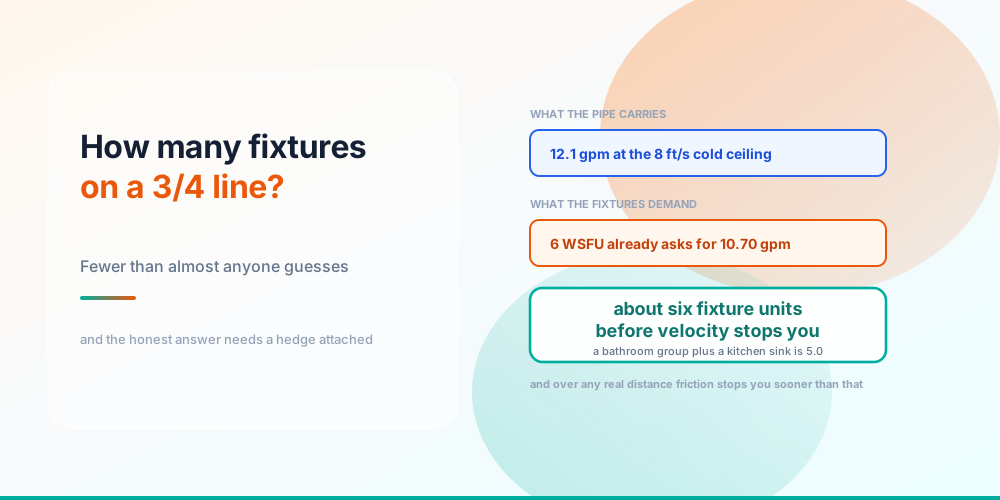
“How many fixtures can I put on a 3/4 inch line?” is asked constantly and it is not quite a question yet. It needs a length attached before it has an answer, because a 3/4 inch line ten feet long and the same pipe a hundred feet long are two different pipes.
But there is a ceiling that applies regardless of length, and it is lower than most people expect: about six fixture units. That is one bathroom group plus a kitchen sink.
The velocity ceiling comes first
A 3/4 inch line runs out sooner than anyone guesses
A 3/4 inch type L copper line carries 12.1 gpm at the 8 ft/s cold ceiling, and only 7.5 gpm at the 5 ft/s hot ceiling.
Now run the fixture unit load up against that:
- 4 WSFU — 8.00 gpm — fine on cold, already over on hot
- 6 WSFU — 10.70 gpm — close to the cold ceiling
- 8 WSFU — 12.80 gpm — past it
So the velocity answer is six fixture units on the cold side, and rather fewer on the hot. That is before any consideration of how long the pipe is.
The reason it comes up so fast is that the demand curve is steep at the bottom. Fixture units only start behaving generously once there are a lot of them — the flattening is the whole point of fixture units explained, and at the small end of the curve you get very little benefit from it.
Six fixture units is not many fixtures
Ordinary fixtures reach the limit quickly
- One full bathroom group — 3.6 WSFU
- Bathroom group + kitchen sink — 5.0
- + clothes washer — 6.4
- + a hose bibb — 8.9
That last row is the one worth sitting with. The hose bibb is 2.5 WSFU — the heaviest single residential fixture on the whole list. It outweighs a private water closet, a bathtub, a shower and a kitchen sink individually. It is entirely cold. And it is the fixture nobody puts on the drawing, because it is outside.
A sillcock is a wide-open 3/4 inch outlet with a hose on it. Of course it is heavy. It just does not feel like a fixture when you are counting bathrooms.
Then the run kills it
Two constraints, two answers, and you take the smaller
Velocity is a ceiling that does not care about distance. Friction is a budget that gets spent by it. Over any real developed length, friction gives the smaller answer — and the smaller answer is the one that governs.
That is why the honest response to “how many fixtures on 3/4 inch” is a question back: how far, and from what pressure? A short branch off a generous main can carry the full velocity load. A hundred-foot run from a 45 psi service cannot carry half of it. Work it properly with the Water Supply Fixture Unit Calculator for the demand and the pipe size calculator for the size — what size water line do I need runs both constraints together.
Two practical rules that survive
A 3/4 inch branch is a two-or-three-fixture branch, not a wing. One bathroom group, or a bathroom plus a kitchen sink, on a reasonably short run. The moment a second bathroom or a hose bibb joins it, go to 1 inch.
Count the hose bibbs. All of them. Two sillcocks are 5 WSFU by themselves, which is a whole bathroom group’s worth of load on a pipe that does not look like it is serving anything.
The honest caveat about these numbers
The fixture unit weights and the demand curve used here come from IPC Appendix E, and two things about that deserve saying plainly.
Appendix E is an appendix. It is enforceable only where a jurisdiction has specifically adopted it. Many have; do not assume yours has.
Hunter’s curve runs high on modern fixtures. It was derived when a water closet used several gallons a flush and a shower head ran unrestricted. Today’s 1.6 gpf toilets and 2.0 gpm shower heads do not load a system the way the curve assumes, so the demand it predicts is conservative. The error is toward a larger pipe, which is the safe direction, but it does mean the “six fixture units” ceiling is a cautious figure rather than a hard physical one.
These are among the least independently verified figures on this site, and they are marked as such in the source data. Treat them as a sound design method rather than a measurement.
Frequently asked questions
How many fixtures can a 3/4 inch water line serve?
On velocity alone, about six water supply fixture units — roughly a bathroom group plus a kitchen sink. A 3/4 inch type L copper line carries 12.1 gpm at the 8 ft/s cold ceiling, and 6 WSFU already asks for 10.70 gpm. Over a long run friction reduces it further.
Why does the answer depend on the length of the run?
Because two different limits apply. Velocity is a ceiling that ignores distance; friction is a budget that distance spends. A short branch can carry the full velocity load, and a hundred-foot run from a modest service cannot. Without a length and a starting pressure, the question has no single answer.
How many fixture units is a bathroom?
A full bathroom group with a flush-tank water closet is 3.6 WSFU on the supply side. Add a kitchen sink and you are at 5.0; add a clothes washer and you are at 6.4. Note that supply fixture units and drainage fixture units are different numbers for the same fixture.
Does a hose bibb count as a fixture?
Yes, and it is the heaviest one in a house — 2.5 WSFU, more than a private water closet, a bathtub, a shower or a kitchen sink individually. It is entirely cold load. Two sillcocks are 5 WSFU between them, which is a whole bathroom group’s worth on a pipe nobody thinks of as serving anything.
Can I add a bathroom to an existing 3/4 inch line?
Usually not without checking. One bathroom group is 3.6 WSFU and a second takes you past the velocity ceiling of a 3/4 inch line before you have counted the kitchen or the hose bibbs. Measure the developed length and work the friction budget; if the run is long, the answer is almost certainly no.
Should I size the hot and cold separately?
Yes. They carry different loads — a water closet is entirely cold, a dishwasher entirely hot — and the hot side has a lower velocity ceiling, 5 ft/s against 8, so the same pipe carries only 7.5 gpm hot against 12.1 cold. The hot side frequently governs the size.
What size line should serve a whole house?
Typically 3/4 or 1 inch for the service and main distribution, with 1/2 inch branches to individual fixtures — but that is a starting point, not an answer. It depends on total fixture units, developed length and static pressure. A long run or a low-pressure service pushes it up a size.
Are these fixture unit numbers code?
They come from IPC Appendix E, which is an appendix — enforceable only where a jurisdiction has specifically adopted it. Hunter’s curve behind them also predates low-flow fixtures and runs conservative on modern ones, meaning it errs toward a larger pipe. Sound design method; not a measurement, and not universally enforceable.
Sources & standards: Fixture unit weights and the probable-demand curve are from IPC 2021 Appendix E, which is an appendix and is enforceable only where specifically adopted — and Hunter’s curve behind it was derived before low-flow fixtures, so it runs conservative on modern ones. These are flagged as the least independently verified figures in this site’s data and should be treated as a design method rather than a measurement. The 8 ft/s cold and 5 ft/s hot velocity ceilings are ASPE and manufacturer design practice, not IPC requirements. Flows and velocities are computed over ASTM B88 bore dimensions for type L copper; friction uses Hazen-Williams at C = 140. The 8 psi per 100 ft friction budget shown is illustrative — your own budget comes from your static pressure, height, meter loss and fixture requirement. The IPC is a model code; confirm the edition your jurisdiction adopts and have a licensed plumber size anything that matters.