
Why Is My Drain Gurgling? It Is Almost Always the Vent
- 04 Sep, 2026
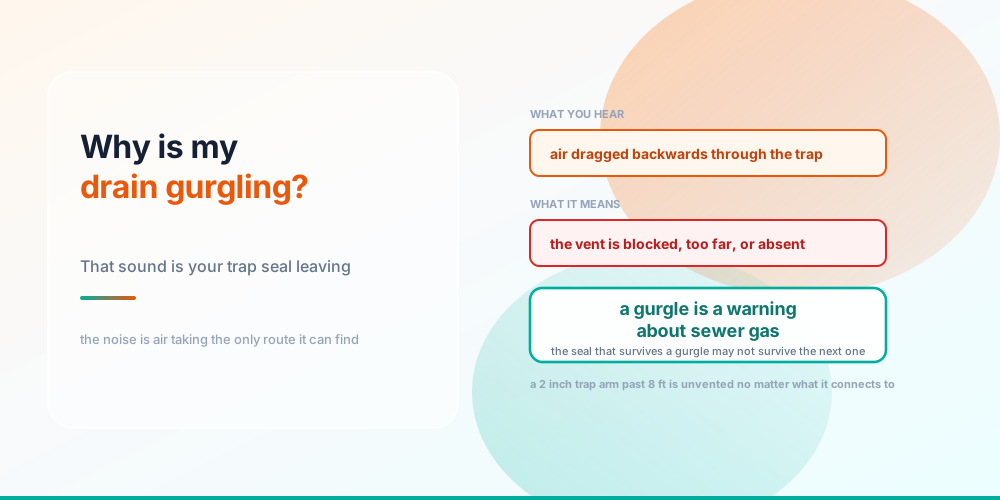
A gurgling drain is treated as a nuisance. It is better understood as an alarm, because the sound is made by the exact thing that keeps sewer gas out of your house being pulled out of position.
A gurgle is air arriving through a trap seal. Something in the system needed air, the vent could not supply it, and the nearest trap was the path of least resistance. The noise is water being dragged past the seal on the way.
What is actually happening
The gurgle is air arriving the wrong way
Water falling down a drain behaves like a loose piston. It pushes air ahead of it and pulls a partial vacuum behind it, and that vacuum has to be filled.
With a working vent, air comes down the vent pipe from the roof. Nothing else moves, and you hear nothing.
Without one — blocked, too far away, or never fitted — the only other opening is a trap. Atmospheric pressure pushes air in through the fixture, past the water in the trap, and up into the drain. The water bubbles as the air passes, and that bubbling is the gurgle.
Every gurgle removes some of the seal. Enough of them and the trap is empty, at which point the drain has stopped being a barrier. Sewer gas is the actual risk, not the noise, and it is why a gurgle deserves attention rather than tolerance.
The most common single cause
The limit is geometry, not a preference
A trap arm is the pipe between a trap and its vent, and it has a maximum length:
- 1-1/4 inch — 5 ft
- 1-1/2 inch — 6 ft
- 2 inch — 8 ft
- 3 inch — 12 ft
- 4 inch — 16 ft
The reason is geometric, and the fall column makes it visible. At its maximum length a 1-1/4, 1-1/2 or 2 inch arm has fallen exactly one pipe diameter. That is the point at which the top of the pipe at the vent connection has dropped below the level of the trap weir — so the vent opening is no longer above the flow, and it can no longer supply air. Past that length the arm is self-siphoning regardless of what it connects to.
The trade rule “never fall more than one diameter” is not an approximation of the table. For the small sizes it is the table. Interestingly the code is twice as strict at 3 and 4 inch, where the maximums correspond to half a diameter of fall.
This is the single most common cause of a gurgle in remodelling work, because a relocated fixture is exactly how an arm gets long. The full treatment is in how far a vent can be from a trap, and the Vent Pipe Size Calculator checks both the arm and the vent size.
Diagnosing by pattern
What gurgles, and when, names the fault
One fixture gurgles when it drains. Its own trap arm or its own vent. Measure the arm first — weir to vent fitting, and slope counts.
One fixture gurgles when a different one drains. They are sharing a vent that cannot supply both. Classically a fixture added to an existing branch during a remodel without re-venting.
The toilet bubbles when the washing machine discharges. A washer pump moves a lot of water very fast, and the vent has to supply air at that rate. This one is almost always a marginal vent rather than a blocked one.
Everything gurgles and everything drains slowly. Not a vent problem. A partial blockage in the main restricts the airway as much as the waterway — clear the blockage and the gurgling goes with it.
It started after roof work. The terminal is covered, crushed or painted over. Frost closure and bird nests produce the same thing seasonally.
Only on windy days. Wind across the terminal can pull the system down. It points at a vent that was only just adequate to begin with.
What not to do
Do not pour anything down it. Drain cleaner treats a blockage. A gurgle from a vent fault is not a blockage, and the chemical stays in the trap.
Do not fit an air admittance valve as a first move. An AAV is a legitimate device with real limits — it only admits air, it never relieves positive pressure, and it can never be the vent that reaches open air. Where it is legal and where it is not is covered in air admittance valves.
Do not ignore it because the smell is not bad yet. The seal depth is finite. A trap that gurgles is a trap that is losing water it needs — and once it is gone you are reading sewer smell in the house instead, which is the same fault one stage later.
Do not assume it needs clearing. A gurgle is an air-path symptom, so paying to snake a drain that is not blocked buys nothing. Drain cleaning cost covers what clearing does and does not fix, and why two visits in a year should buy a camera instead of a third visit.
When it is genuinely worth calling someone
A gurgle traced to a blockage is a rod-and-jet job. A gurgle traced to an undersized, blocked or absent vent is pipework, and often pipework inside a wall. Neither is a homeowner fix once the cause is upstream of the fixture.
The one thing you can usefully do first is establish which fixture gurgles and what triggers it. That single observation removes most of the diagnostic work, and it is free.
Frequently asked questions
Why does my drain gurgle?
Because air is being pulled through the trap seal. Falling water leaves a partial vacuum behind it, and if the vent cannot supply air to fill it, the system takes air through the nearest fixture instead — bubbling it through the water in the trap on the way. That bubbling is the sound.
Is a gurgling drain dangerous?
The noise is not, but what it does is. Every gurgle removes part of the trap seal, and the seal is the only thing keeping sewer gas out of the room. A trap that gurgles regularly can end up empty, at which point the drain is an open path to the sewer.
Why does my toilet gurgle when the washing machine drains?
A washing machine pump discharges fast, and the vent has to supply air at that rate. If it cannot, the system finds air through the nearest trap — usually the toilet, because it holds the largest and most visible body of water. It generally means the vent is marginal rather than blocked.
How far can a trap be from its vent?
8 ft for a 2 inch arm, 6 ft for 1-1/2 inch, 5 ft for 1-1/4 inch, measured from the trap weir to the vent fitting. Those maximums correspond to exactly one pipe diameter of fall, which is the point where the vent opening drops below the trap weir and stops working.
Will a drain cleaner fix a gurgling drain?
Only if the cause is a blockage. If everything in the house gurgles and drains slowly, a blockage is likely and clearing it will help. If one fixture gurgles while everything drains normally, it is a vent fault, and a chemical does nothing except sit in the trap.
Can I fix a gurgling drain myself?
You can diagnose it, which is most of the value. Note which fixture gurgles and what triggers it — its own discharge, another fixture’s, or the washer. If it turns out to be a blockage, rodding may be within reach. If it is a trap arm length or a vent, it is pipework and usually inside a wall.
Will an air admittance valve stop the gurgling?
Sometimes, and it is not always legal or appropriate. An AAV admits air only — it cannot relieve positive pressure, and it can never replace the vent that must terminate in open air. Acceptance varies by jurisdiction and it is restricted or prohibited under the UPC. Diagnose before you fit one.
Why did my drain start gurgling suddenly?
Something changed at the vent. A roof job that covered the terminal, a bird nest, frost closure in cold weather, or a fixture added elsewhere in the house that is now sharing a vent that cannot serve both. Sudden onset with no plumbing work usually points at the terminal.
Sources & standards: IPC 2021 Table 909.1 for maximum trap arm developed length, measured from the trap weir to the vent fitting; Section 906.2 for vent sizing at half the drain diameter with a 1-1/4 inch floor; Section 918 for air admittance valves, which are permitted where the authority having jurisdiction accepts them and are restricted or prohibited under the UPC. The fall figures shown are computed from the table’s own lengths and slopes rather than quoted, which is what shows the one-diameter relationship at the smaller sizes. Vent stacks on multi-storey drainage stacks are sized from Table 906.1, which is deliberately not reproduced on this site. The IPC is a model code — confirm the edition your jurisdiction adopts, and have a licensed plumber address anything that turns out to be inside a wall.