
What Size Sump Pump Do I Need? Head First, Horsepower Second
- 06 Sep, 2026
Sump pumps are sold by horsepower and specified by head, and those are not the same conversation. A 1/2 hp pump is not “twice as good” as a 1/3 hp one — it is a different curve, and whether it moves more water than the smaller pump depends entirely on how high it has to lift.
Two numbers size a sump pump: how much water arrives, and how hard it is to get rid of.
Total dynamic head, and why the lift is nearly all of it
For a sump, the lift is nearly the whole answer
Total dynamic head is what the pump works against, and it has four parts. On a typical basement installation — 30 gpm, 40 feet of 1-1/2 inch PVC, 12 feet of lift:
- Static lift — 12.00 ft (83.2% of the total)
- Friction — 2.08 ft
- Pressure head — 0.00 ft
- Velocity head — 0.35 ft
- Total dynamic head — 14.4 ft
The pressure-head term being zero is worth pausing on. A sump discharges to open air, so there is nothing downstream to push against. On a well pump that term normally dominates everything — 40 psi of discharge pressure is 92.4 feet of head on its own, which is why the two jobs feel so different despite the same arithmetic. That comparison is worked through in how to calculate pump head.
For a sump, then: measure the lift accurately and you have essentially sized the pump. Lift is from the water level in the pit — not the pit floor — to the point of discharge, which is usually well above grade rather than at it.
Do not reduce the discharge
Reducing the discharge is the expensive shortcut
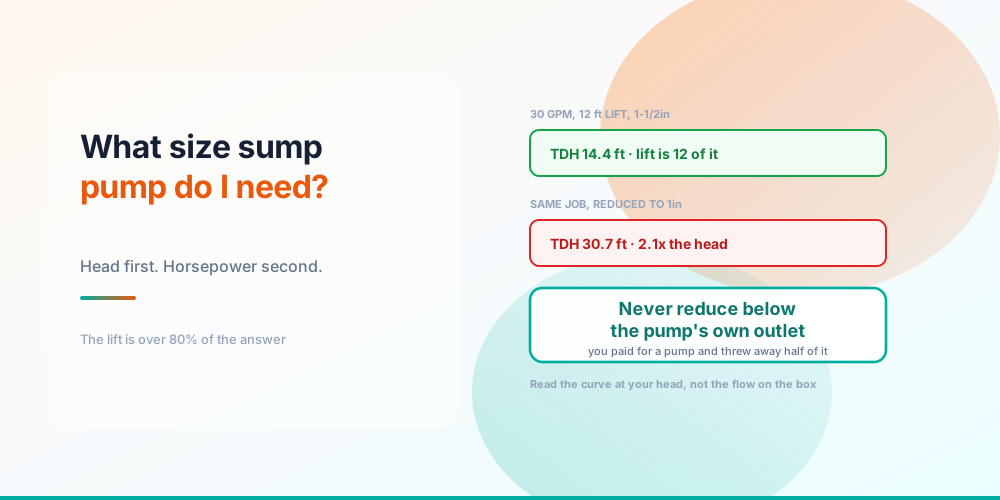
The most common field error is bushing a 1-1/2 inch pump discharge down to 1-1/4 or 1 inch because that is what runs to the outside wall already. Same pump, same lift, same 40-foot run:
- 1” — 11.14 ft/s — friction 16.79 ft — TDH 30.7 ft
- 1-1/4” — 6.44 ft/s — friction 4.41 ft — TDH 17.1 ft
- 1-1/2” — 4.73 ft/s — friction 2.08 ft — TDH 14.4 ft
- 2” — 2.87 ft/s — friction 0.62 ft — TDH 12.7 ft
Reducing to 1-inch more than doubles the head — 2.1 times — for no change in the actual job. The pump then sits far back on its curve delivering much less than its rating, runs longer for every cycle, and at 11.14 ft/s the water is moving fast enough to erode fittings. You have paid for a pump and thrown away half of it at the fitting.
The rule is simple: never reduce below the pump’s own discharge tapping. If anything, go up a size — 2-inch drops the head another 1.7 feet and costs a few dollars in pipe.
Two other things you must add and people forget: a check valve to stop the standing column in the riser draining back into the pit (without one, every cycle re-pumps the same water and the pump short-cycles), and the equivalent length of the fittings, which on a sump riser with two elbows and a check valve is a meaningful fraction of the straight run. The Pump Head Calculator takes fittings directly.
Then size to the inflow
Size to the inflow, not to the pit
Head tells you what the pump can do. Inflow tells you what it needs to do, and this is the half that gets skipped — most people buy the same 1/3 hp pump the last one was and hope.
A footing drain serves a contributing area, and it sheds water the same way a roof does. An inch of rain over a square foot is 0.6234 gallons, which converts an area and a rainfall rate straight to gpm. For a 1,600 sq ft footprint:
- Steady rain, 1 in/hr — 16.6 gpm
- Heavy rain, 2 in/hr — 33.2 gpm
- Cloudburst, 4 in/hr — 66.5 gpm
This is deliberately an upper bound. Soil absorbs a great deal, grading sheds some away from the building, and a footing drain intercepts only part of what reaches it. Treat these as the worst case the installation has to survive rather than a prediction of what will arrive.
But the shape of the answer is the useful part: a pump that copes all year can still drown in one storm, because the difference between steady rain and a cloudburst is a factor of four on the same house. If the basement matters, that gap is the argument for a second pump on a higher float, or a battery backup — not for a bigger single pump, which spends its life short-cycling.
Note that the runoff arithmetic here is the same used for roof drainage, and if you are also sizing gutters and leaders, how much water comes off a roof covers that side.
Practical sizing, in order
- Measure the lift from the pit’s high water level to the discharge point. This is 80% or more of your head.
- Keep the discharge at the pump’s tapping size or larger. Never bush it down.
- Add the check valve and count the fittings — they belong in the friction term.
- Estimate the inflow from the drained area, then choose a pump whose curve delivers that flow at your head, not at zero head.
- Read the curve, not the horsepower. A pump rated “50 gpm” is rated at some specific head, usually 0 or 10 feet. At your 14.4 feet it will deliver less.
That last point is the whole trick. Manufacturer headline flows are quoted at a convenient head, and the number you need is the one on the curve at your TDH.
Frequently asked questions
What size sump pump do I need for a basement?
Size it by total dynamic head and required flow, not horsepower. A typical basement — 12 feet of lift, 40 feet of 1-1/2 inch discharge, 30 gpm — works out at 14.4 feet of TDH, and you want a pump whose curve delivers your flow at that head. For most single-family homes that is a 1/3 to 1/2 hp pump, but the curve is what decides it.
How do I calculate total dynamic head for a sump pump?
Add four things: static lift from the pit water level to the discharge point, friction through the pipe and fittings, pressure head at the discharge, and velocity head. For a sump the pressure head is zero because it discharges to open air, and the lift is typically over 80% of the total — 12 of 14.4 feet in the worked example here.
Is a 1/2 hp sump pump better than 1/3 hp?
Not automatically — it is a different curve. More horsepower buys either more flow at the same head or the same flow at a higher head, and which you get depends on where your installation sits. If your lift is modest, a 1/3 hp pump may deliver as much water as a 1/2 hp one while cycling less. Compare curves at your actual head.
What size discharge pipe for a sump pump?
At least the size of the pump’s own discharge tapping, which is usually 1-1/2 inches. Reducing to 1 inch takes the same job from 14.4 to 30.7 feet of head — over twice as much — and pushes the velocity to 11.14 ft/s, fast enough to erode fittings. Going up to 2 inches is cheap and gains a little.
Do I need a check valve on a sump discharge?
Yes. Without one, the water standing in the riser drains back into the pit every time the pump stops, so the pump re-pumps the same water and short-cycles. Fit it low on the riser, above the pump, and remember its equivalent length belongs in your friction calculation.
How many gallons per minute does a sump pump need to handle?
It depends on the drained area, not on the pit. A 1,600 sq ft footprint sheds roughly 16.6 gpm in steady rain and 33.2 gpm in heavy rain, and four times the steady figure in a cloudburst. Those are upper bounds — soil and grading take a lot of it — but the factor-of-four spread between ordinary rain and a storm is the number that should drive the decision.
Should I install two sump pumps?
If the basement is finished or holds anything that matters, a second pump on a higher float is a better answer than one larger pump. It covers both the storm case and the failure case, and neither pump short-cycles in ordinary weather. A battery or water-powered backup covers the other common failure, which is a power cut during exactly the storm that needed the pump.
Why does my sump pump run constantly?
Usually one of three things: no check valve (or a failed one), so the riser drains back and is pumped repeatedly; a float set too low so the pump starts on a nearly empty pit; or genuine continuous inflow — a high water table or a spring, which is a drainage problem rather than a pump problem. Rule out the check valve first, because it is the cheapest.
Does discharge pipe length matter much for a sump pump?
Less than people expect, and much less than the diameter. In the worked example, 40 feet of 1-1/2 inch pipe adds only 2.08 feet to a 14.4-foot total. Doubling the length would add about two more feet; halving the diameter adds sixteen. Diameter is the lever, length is the detail.
Sources & standards: Head components are computed with the same functions this site uses throughout — Hazen-Williams friction loss on Schedule 40 PVC dimensions (ASTM D1785), velocity head as V squared over 2g, and total dynamic head as the sum of static lift, friction, pressure and velocity head. The base case matches this site’s pump head calculator defaults: 30 gpm, 40 ft, 12 ft lift. Inflow figures are an upper bound, not a prediction — they apply the runoff arithmetic from IPC Chapter 11 storm drainage (0.6234 gallons per square foot per inch of rain) to a contributing drained area, and real inflow is reduced by soil absorption, grading and how much a footing drain actually intercepts. Local rainfall intensities come from NOAA Atlas 14 for your location, not from the round numbers used here. Sump pumps are not IPC-sized — there is no code table for them; discharge point, whether you may discharge to a storm sewer or must discharge to grade, and backflow requirements are all local rules. Pump performance must be read from the manufacturer’s curve at your own head, since headline flow ratings are quoted at a convenient head rather than yours.