
Air Admittance Valves: Where They Are Legal and Where They Are Not
- 04 Sep, 2026
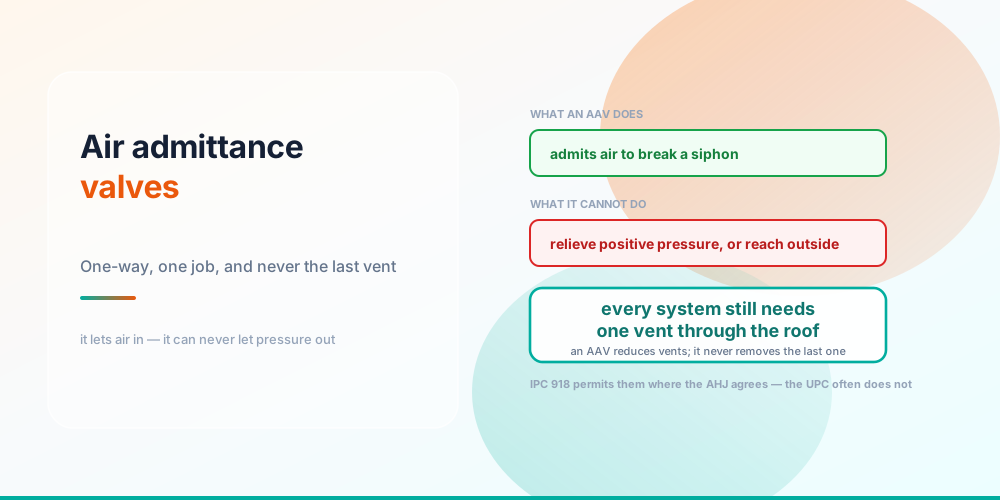
An air admittance valve is a legitimate, listed, useful device that solves a real problem. It is also the most frequently misused fitting in residential plumbing, and the misuse comes from one misunderstanding: it is not a vent. It is half of one.
One direction only
A one-way device doing half a vent's job
Inside the cap is a light diaphragm sitting on a seat under its own weight. When the drainage system goes slightly negative — a fixture discharging, water falling in a stack — the diaphragm lifts and room air is drawn in. Siphon broken, trap seal preserved.
When the system goes positive, the diaphragm is pressed harder onto its seat. That is by design; you very much do not want sewer gas coming out of a fitting under a sink. But it means positive pressure has to leave the system somewhere else, and if there is nowhere else, it leaves through a trap and into a room.
Four jobs, one of which it does
A vent does four things. An AAV does one.
It admits air. Yes — and well.
It relieves positive pressure. No. It seals against it.
It vents sewer gas to atmosphere. No. Gas still has to leave the system, and it leaves through the open vent, which means there must still be one.
It works with no moving parts. No. A diaphragm is a wear item; a length of open pipe is not. AAVs fail, typically stuck shut, and typically after years of service.
That is why the rule is absolute: an AAV reduces the number of vents a system needs and never removes the last one. A house vented entirely with AAVs has no connection to atmosphere at all.
Where they are and are not permitted
The IPC permits them in Section 918, where the authority having jurisdiction accepts them. Acceptance still varies locally even under the IPC — some jurisdictions allow them freely, some only for island fixtures, some only on remodels where a vent genuinely cannot be run.
The UPC has historically restricted or prohibited them, and roughly fifteen states enforce the UPC or a derivative such as California’s CPC. The broader divergence between the two codes is in IPC vs UPC.
Never assume from the model code. This is one of the few subjects where “the IPC allows it” genuinely does not settle the question, and where getting it wrong means opening a wall after inspection.
The rules that come with one
A real device with real limits
It must stay accessible. This is the most common defect by a wide margin. An AAV sealed inside a finished wall or ceiling cannot be replaced, and it is a part that eventually needs replacing. A removable access panel is not optional.
It needs air to admit. Inside a sealed cabinet with no ventilation, it has nothing to draw on. It needs a louvred panel or an open space.
It goes above the trap weir, and above the branch it serves, at the height the manufacturer specifies. Too low and it can be flooded.
It must be listed and sized. ASSE 1051 for individual and branch fixture vents, 1050 for stack vents. Sizing matters — a fixture AAV on a stack is undersized for the job.
It does not extend a trap arm. A 2 inch trap arm still stops at 8 ft with an AAV on the end of it. The arm limit is geometric and no device changes it — see why is my drain gurgling for why that length exists.
When one is genuinely the right answer
An island sink. The classic case, and the one AAVs were popularised for. There is no wall to run a vent up, and the alternative — a loop vent under the floor — is a substantial and failure-prone piece of work.
A fixture added where no vent can be run. A basement bathroom below the stack, a powder room under a stair, a bar sink in the middle of a room.
Reducing roof penetrations on a remodel. Fewer holes in a finished roof is a genuine benefit, provided at least one remains.
Not as a way to avoid working out the venting on new construction. That is where they get used and where inspectors object.
Failure modes worth knowing
Stuck shut is the common one, and it presents exactly as no vent at all: gurgling, slow drains, and a trap that empties.
Stuck open is rarer and more unpleasant — you get sewer smell at the fitting, usually intermittently.
Correctly working but overwhelmed happens when a fixture AAV is asked to serve a load it was not sized for. The symptom is gurgling under heavy discharge only.
All three are diagnosed the same way: pull it off and see whether the symptom changes. With the AAV removed the opening is an unrestricted vent — if the gurgling stops, the valve was the problem. Do not leave it like that.
Frequently asked questions
What is an air admittance valve?
A one-way valve that admits air into a drainage system when the pressure inside drops, breaking a siphon and protecting the trap seal. A light diaphragm lifts under negative pressure and seats under positive pressure. It replaces a vent’s ability to supply air and none of its other functions.
Are air admittance valves legal?
Under the IPC, yes — Section 918, where the authority having jurisdiction accepts them, and local acceptance still varies. Under the UPC they have historically been restricted or prohibited, and roughly fifteen states enforce the UPC or a derivative. Never assume from the model code alone; ask the AHJ.
Can an AAV replace a vent through the roof?
No. It admits air and seals against positive pressure, so sewer gas and pressure surges still need somewhere to go. Every system must retain at least one vent terminating in open air. An AAV reduces the number of vents; it never removes the last one.
Where must an air admittance valve be installed?
Accessible, in a ventilated space, above the trap weir and above the branch it serves, at the height the manufacturer specifies, and listed to ASSE 1051 or 1050 for the application. Burying one in a sealed wall is the most common defect — it is a serviceable part that eventually fails.
Do air admittance valves fail?
Yes. The diaphragm is a wear item. Stuck shut is the usual failure and presents exactly like having no vent — gurgling, slow drains, an emptying trap. Stuck open produces intermittent sewer smell at the fitting. Both are why access is required.
Can I use an AAV for an island sink?
That is the case they are most often the right answer for. An island has no wall to run a vent up, and the alternative loop vent under the floor is substantial work with its own failure modes. Confirm local acceptance first, and make sure the cabinet is ventilated and the valve is reachable.
Does an AAV let me put a trap further from the vent?
No. Trap arm limits are geometric — a 2 inch arm stops at 8 ft regardless of what vents it — because past that length the arm has fallen a full pipe diameter and the vent opening drops below the trap weir. An AAV changes where the vent is, not how far the trap may sit from it.
How do I know if my AAV has failed?
Remove it. With the valve off, the opening is an unrestricted vent — if the gurgling or slow draining stops, the valve was the problem. Reinstall a new one rather than leaving it open, because an open fitting under a sink is a direct path for sewer gas.
Sources & standards: IPC 2021 Section 918 permits air admittance valves where the authority having jurisdiction accepts them; the UPC has historically restricted or prohibited them and roughly fifteen states enforce the UPC or a derivative, so acceptance must be confirmed locally rather than assumed from the model code — this page deliberately does not present them as universally legal. Product listings are ASSE 1051 for individual and branch fixture vents and ASSE 1050 for stack vents. Trap arm limits are IPC Table 909.1 and are unaffected by the presence of an AAV. Vent sizing is IPC 906.2, at half the drain diameter with a 1-1/4 inch floor and upsizing past 40 ft of developed length. Installation height, orientation and sizing come from the manufacturer’s listing. The IPC is a model code — confirm the edition your jurisdiction adopts and ask the AHJ before rough-in.