
IPC vs UPC: Which Code Applies, and Where They Actually Diverge
- 03 Sep, 2026
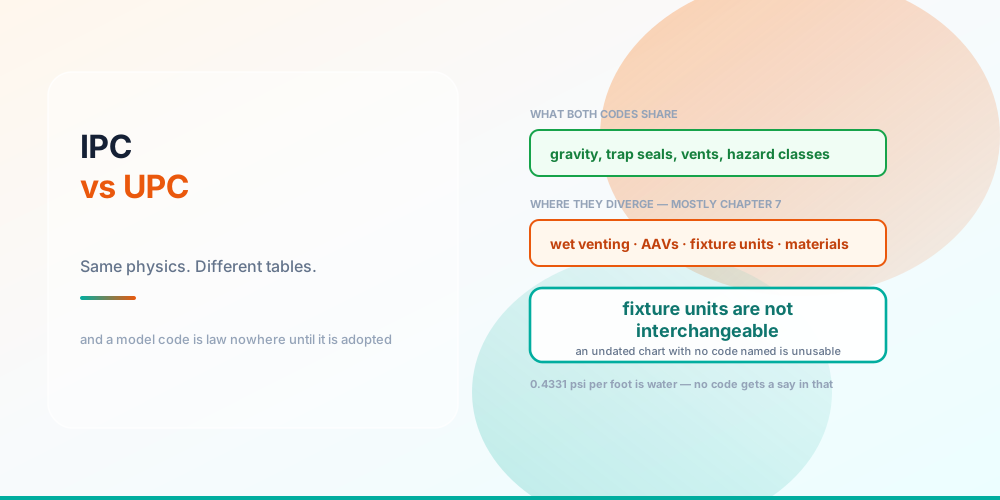
The United States has two competing model plumbing codes, and which one governs your job is decided by where the job is — not by which one you learned, and not by which one the chart you found online was based on.
The IPC is published by the International Code Council, alongside the IBC and IRC. The UPC is published by IAPMO. Roughly two thirds of states are on an IPC-based code and roughly fifteen are on the UPC or a derivative — California’s CPC being the most consequential.
Neither is law anywhere on its own. A model code becomes enforceable only when a state or local jurisdiction adopts it, usually with amendments, and usually a couple of editions behind current. The document you actually answer to is “the 2021 IPC as amended by this state”, and that amendment list is the part nobody reads.
Most of it is not in dispute
Most of plumbing is not in dispute
It is worth starting here, because the differences get more attention than they deserve. Both codes agree that drainage flows by gravity and is sized on fixture units. Both require a water seal in every trap and a vent for every trap. Both cap trap arm length. Both require a system to reach open air. Both control cross connections by hazard class and direction.
The slope bands are shared: 1/4 inch per foot for 2-1/2 inch and under, 1/8 inch for 3 to 6 inch, 1/16 inch above that. So are the underlying reasons — too flat and solids sit, too steep and water outruns them.
If you know why plumbing works, you can work in either jurisdiction. What you cannot do is carry the numbers across.
Where they genuinely part company
Where they part company — and it is mostly Chapter 7
Wet venting is the biggest. The IPC’s horizontal wet venting in Section 912 is comparatively generous about letting one drain vent a whole bathroom group; the UPC’s approach is narrower with different fixture and sizing rules. A layout that passes in Ohio can fail in California. The IPC version is worked through in wet venting explained — and that post is IPC, which is exactly the point of this one.
Air admittance valves. The IPC accepts them in Section 918 where the AHJ permits. The UPC has historically restricted or prohibited them, and acceptance still varies by jurisdiction even where the model code allows it. Never assume an AAV is legal because a code allows it in principle.
Fixture unit values. Both codes use fixture units and the two sets of numbers are not interchangeable. A DFU from IPC Table 709.1 is not a UPC fixture unit, and a chart that does not say which code it came from is worse than no chart.
Trap arm measurement. Both cap the length; they do not measure it the same way, and they treat the slope within the arm differently. Same concept, different arithmetic.
Approved materials. The IPC is broadly permissive on plastics in both DWV and supply. The UPC has historically been more restrictive, and local amendments sit on top of both.
Cleanout spacing. Different intervals and different access requirements. A routine inspection difference.
Which of this site’s numbers change
Which of these numbers changes if you are under the UPC?
This site’s calculators are IPC-based and say so. If you are in a UPC jurisdiction, this is the useful list:
Re-check these — they come from tables:
- A bathroom group is 5 DFU — IPC Table 709.1
- A 4 inch building drain at 1/4 in/ft carries 216 DFU — IPC Table 710.1(1)
- A 2 inch trap arm stops at 8 ft — IPC Table 909.1, and measured IPC’s way
- Vent sizing at half the drain diameter with a 1-1/4 inch floor — IPC 906.2
These do not change, because they are not code:
- 0.4331 psi per foot of head — water at 62.37 lb/ft³ divided by 144. Physics.
- 0.0408 × diameter² gallons per foot — geometry.
- The 8 ft/s cold and 5 ft/s hot velocity ceilings — ASPE and manufacturer design practice, and not an IPC number either. Worth saying plainly: those limits are quoted everywhere as if they were code, and they are not, in either code.
That third bullet is the general lesson. Before asking “which code says this”, ask whether it is a code question at all. A great deal of what circulates as plumbing code is derived physics or trade practice that no code publishes.
The site’s plumbing formulas reference separates the two throughout — every block says whether it is derived, tabulated, or practice.
The practical version
Find out what your jurisdiction actually adopted, including the edition and the amendments. Your building department publishes it. “We’re an IPC state” is not enough — the amendments are where local requirements live.
Never trust an undated, unattributed chart. A fixture unit table with no code and no edition on it is unusable. This is not pedantry: the numbers genuinely differ.
Ask the AHJ before rough-in, not after. On wet venting, AAVs and materials, a five-minute conversation before the walls close is worth more than any code reference. The inspector’s reading of the adopted code is the one that counts.
Design conservatively across the difference where you can. A layout that satisfies both codes exists more often than people assume, and it survives an inspector’s interpretation either way.
Watch for the third document. Residential work in many jurisdictions falls under the IRC rather than the IPC, and the IRC’s plumbing chapters are IPC-derived but not identical. Some states adopt the IPC for commercial and the IRC for one- and two-family dwellings, so both apply depending on the building.
Frequently asked questions
What is the difference between the IPC and the UPC?
Two competing model plumbing codes: the IPC from the International Code Council and the UPC from IAPMO. They agree on nearly all of the physics and principles and diverge most in drainage, waste and vent — wet venting, air admittance valves, fixture unit values, trap arm measurement, materials and cleanout spacing.
Which states use the IPC and which use the UPC?
Roughly two thirds of states are on an IPC-based code and roughly fifteen on the UPC or a derivative such as California’s CPC. Adoption changes over time and is sometimes split between state and local level, so confirm with your building department rather than relying on a map.
Is the IPC or the UPC the law?
Neither, on its own. Both are model codes, enforceable only where a jurisdiction adopts them — normally with local amendments and often an edition or two behind current. The enforceable document is “this edition, as amended here”, and the amendments are the part most people never read.
Can I use IPC fixture unit values in a UPC state?
No. Both codes use fixture units and the values are not interchangeable. A drainage fixture unit from IPC Table 709.1 is not a UPC fixture unit. Any chart that does not name its code and edition should not be used for either.
Are air admittance valves allowed under the UPC?
Historically restricted or prohibited, and acceptance still varies by jurisdiction. The IPC accepts them in Section 918 where the AHJ permits. Never assume an AAV is legal from the model code alone — confirm with the authority having jurisdiction on the specific job.
Does wet venting work the same in both codes?
No, and this is the largest practical difference. The IPC’s horizontal wet venting in Section 912 is comparatively generous about one drain venting a whole bathroom group; the UPC takes a narrower approach with different fixture and sizing rules. A compliant IPC layout can fail a UPC inspection.
Which code are TradesQuote’s plumbing calculators based on?
The IPC, and every page says so alongside the specific table it uses. Where a figure is derived physics — the 0.4331 psi per foot of head, or 0.0408 × diameter² gallons per foot — it is labelled as derived, because it does not change with the code. Where a figure is design practice rather than code, such as the 8 ft/s velocity ceiling, that is labelled too.
What is an AHJ and why does it matter more than the code?
The authority having jurisdiction — the building department, inspector or official who enforces the adopted code. It matters more than the model code because the AHJ decides which edition applies, what the amendments say, and how ambiguous provisions are read on your job. When a code text and an inspector disagree, you build to the inspector.
Sources & standards: IPC 2021 throughout for the numbers cited — Table 709.1 for drainage fixture units, Table 710.1(1) for drain capacities, Table 909.1 for maximum trap arm developed length, Section 906.2 for vent sizing, Section 912 for wet venting, Section 918 for air admittance valves. UPC provisions are described in general terms and deliberately not reproduced as values: they vary by edition and by local amendment, and transcribing them from secondary sources is exactly the error this page warns against. Get the adopted code your jurisdiction actually enforces. State adoption counts are approximate and change over time. Derived quantities are labelled as derived, and the velocity ceilings quoted across this site are ASPE and manufacturer design practice rather than a requirement of either code. Confirm with your AHJ before rough-in.