
Backflow Prevention: No Vacuum Breaker Stops Backpressure
- 03 Sep, 2026
Most published guidance on backflow prevention lists the devices, gives each an acronym, and leaves the reader to work out which one goes where. That ordering hides the single distinction everything else hangs off.
Nothing with “vacuum breaker” in its name protects against backpressure. Not an atmospheric vacuum breaker, not a pressure vacuum breaker, not a spill-resistant one, not the hose bibb device. They are all excellent at the failure they are built for and completely blind to the other one. Put a PVB on a boiler make-up line and you have installed decoration.
Two directions, and only two
Backflow happens in exactly two ways, and which one is possible at a given connection is what narrows the device list before hazard class ever enters.
Backsiphonage — supply pressure drops below downstream pressure and the line siphons backwards. A main break, a hydrant flowing, a pump starting on the same main. The archetype is a hose lying in a full bucket when the street main is cut.
Backpressure — the downstream system is pushed above supply pressure and forces water back. A boiler, a pressurised process line, a booster pump, or simply elevation head from piping standing above the supply main.
The second one is what vacuum breakers cannot see. A vacuum breaker works by admitting air when pressure falls; when pressure rises from downstream there is nothing for it to do.
The matrix
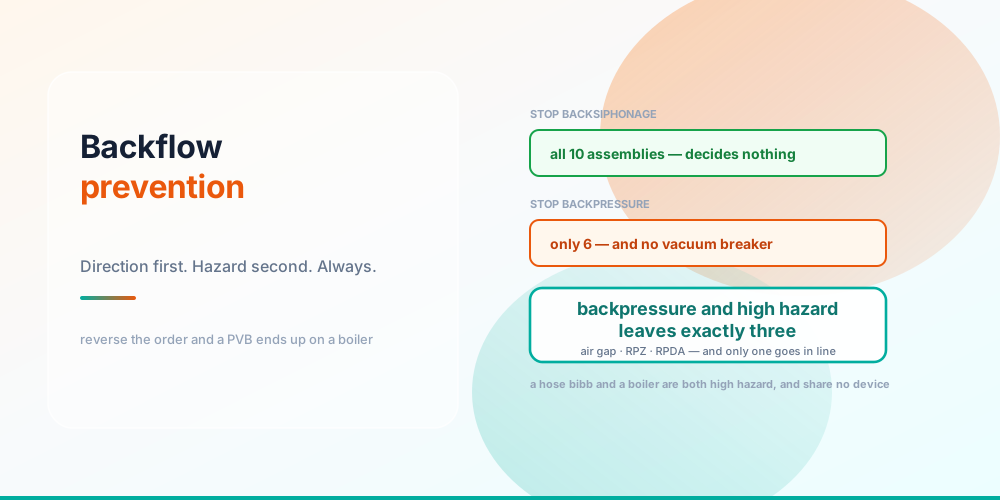
Every device stops backsiphonage. That column decides nothing.
Read the backsiphonage column: all ten are ticked. It is not a selection criterion at all, which is why a list organised around it teaches nothing.
Now read the backpressure column. Six devices: the air gap, the double check, the double check detector, the ASSE 1012 dual check with intermediate vent, the RPZ and the RPDA. Four fail it: HVB, AVB, PVB, SVB — every one of them a vacuum breaker.
Then intersect that with high hazard, and the list collapses to three: the air gap, the RPZ and the RPDA. Since the RPDA is an RPZ with a fire-line bypass meter, and an air gap destroys line pressure so cannot sit mid-run, the RPZ is effectively the only in-line assembly for high hazard under backpressure. That is why it appears on every difficult connection, and why it is the expensive one.
There is a fourth column worth noting: continuous pressure. The HVB and the AVB may not sit under supply pressure for more than 12 hours in any 24, which in practice means no shutoff valve downstream of an AVB — the most common installation error on the device, because a downstream valve holds it under pressure permanently and the float sticks shut.
Selecting in the right order
Direction first, hazard second — always in that order
Direction first. It eliminates whole categories. If backpressure is possible, every vacuum breaker is out before you consider anything else.
Hazard class second. The IPC draws it as pollution against contamination. Pollution affects taste, odour or colour — unpleasant, not dangerous. Contamination can make someone ill or kill them. The class decides the device, not the pipe size and not the budget, and anything you are unsure about is treated as contamination.
The two examples worth holding onto are a hose bibb and a boiler. Both are high hazard. They take completely different devices — a $12 hose vacuum breaker and an RPZ — because backflow reaches them from different directions. Hazard class alone would have told you nothing.
Two more that catch people:
Lawn irrigation with nothing injected is still high hazard. Buried heads sit in soil and standing water. The code does not care that you never added fertiliser.
A fire sprinkler on plain potable water is low hazard but under permanent backpressure, because the riser is full of water standing above the main. Low hazard, backpressure — that is the double check’s exact niche. Add antifreeze or foam and it becomes high hazard, and the device becomes an RPZ or RPDA.
The full application table lives on the Backflow Prevention reference page, with the assembly for each connection and the reasoning behind it.
The air gap
The only device with nothing in it to fail
An air gap is a physical vertical separation between an outlet and the flood level rim below it. There is no valve, no spring, no float and no seat — so there is nothing to fail, wear out, or need annual testing. It is the most reliable backflow protection that exists and the only one that stops both directions absolutely.
The rule is simple: twice the effective opening, three times where the outlet is close to a wall, with floors of 1 inch and 1.5 inches. A 1/2 inch opening therefore needs 1.00 inch, or 1.50 inches near a wall. A 1 inch opening needs 2.00 and 3.00.
The near-wall multiplier exists because a wall lets water climb the surface by capillary action and bridge a gap that would otherwise be adequate.
The catch is that an air gap destroys the pressure in the line, which is why it appears at fixtures, tanks and dishwasher connections rather than mid-run on a service. Where you can use one, use one.
Testing, and where an RPZ may not go
Assemblies are tested annually by a certified tester in most jurisdictions — DC, DCDA, PVB, SVB, RPZ and RPDA all have test cocks for the purpose. That is a recurring cost and a recurring compliance obligation, and it is a real argument for an air gap where an air gap is possible.
An RPZ discharges when it operates. The relief port dumps to atmosphere the moment the zone loses its differential, and a failed one can discharge continuously at full line flow. So:
- Never in a pit or a vault. It has to be above grade, above the flood level of the space.
- Plan the discharge. An air gap fitting and a drain of adequate capacity, not a floor that happens to slope.
- Above the flood rim. A submerged relief port is not a relief port.
A double check may often go below grade in an approved vault; an RPZ may not, and that constraint frequently drives where the whole assembly ends up on a site.
Where it goes wrong
A vacuum breaker on a backpressure connection. The subject of this post.
A shutoff valve downstream of an AVB. It holds the device under continuous pressure, which it is not rated for.
A PVB or SVB mounted too low. Both need to sit at least 12 inches above the highest downstream outlet. Height is the mechanism.
A double check on a high hazard connection. Two checks in series is redundancy, not containment — the code approves the DC for low hazard only, and the difference is deliberate.
Copper upstream of a carbonated beverage dispenser. CO2 pushes back into the line and carbonic acid dissolves copper. The material rule matters as much as the device.
Forgetting the expansion tank. The moment you install a backflow preventer on a service you have created a closed system, and IPC 607.3 then requires thermal expansion control — see thermal expansion tank sizing.
Frequently asked questions
What is the difference between backsiphonage and backpressure?
Backsiphonage is supply pressure falling below downstream pressure so the line siphons backwards — a main break or a hydrant flowing. Backpressure is the downstream system being pushed above supply pressure and forcing water back — a boiler, a pump, or elevation head. Every backflow device stops the first; only some stop the second.
Does a vacuum breaker stop backpressure?
No — none of them do. Not the hose bibb device, not an atmospheric vacuum breaker, not a pressure vacuum breaker, not a spill-resistant one. A vacuum breaker admits air when pressure falls; when pressure rises from downstream there is nothing for the mechanism to do.
What is the difference between a double check and an RPZ?
A double check is two spring check valves in series and is approved for low hazard only. An RPZ adds a pressure-differential relief valve between the two checks that dumps to atmosphere the instant the zone loses its differential, and it is approved for high hazard. Two checks is redundancy; the relief port is containment.
When is an RPZ required?
Whenever the connection is high hazard and backpressure is possible — chemical injection, treated boiler feed, a sprinkler system with antifreeze or foam, most industrial process water. It is effectively the only in-line assembly for that combination, since the only other options are an air gap, which destroys line pressure, and the RPDA, which is an RPZ with a fire-line meter.
How big does an air gap need to be?
Twice the effective opening, or three times where the outlet is close to a wall, with minimums of 1 inch and 1.5 inches. A 1/2 inch opening needs 1.00 inch; a 1 inch opening needs 2.00 inches, or 3.00 near a wall. The wall multiplier exists because water can climb a surface and bridge a smaller gap.
Do I need a backflow preventer on my garden hose?
Yes, and it is the cheapest device in plumbing. A hose can reach a bucket, a pool, or a sprayer of weedkiller, so the code treats a hose bibb as a high hazard backsiphonage connection. A hose connection vacuum breaker screwed onto the thread handles it; many sillcocks now have one built in.
How often do backflow preventers need testing?
Annually in most jurisdictions, by a certified tester, for every testable assembly — DC, DCDA, PVB, SVB, RPZ and RPDA. An air gap is the exception: with no mechanism, there is nothing to test. That recurring cost is a real reason to use an air gap wherever the application allows one.
Why can’t an RPZ be installed below grade?
Because its relief port has to discharge freely to atmosphere. In a pit or vault the port can end up submerged, which defeats the device entirely, and a failed RPZ can discharge at full line flow. It must sit above grade, above the flood level of the space, with a planned drain of adequate capacity. A double check may often go in an approved vault; an RPZ may not.
Sources & standards: IPC 2021 Section 608 for cross-connection control and the pollution-versus-contamination hazard classes, and Section 608.15.1 with ASME A112.1.2 for air gaps. Minimum air gaps on this page are computed from the rule — twice the effective opening, three times near a wall, with 1 inch and 1.5 inch floors — rather than transcribed, so they cannot disagree with the rule stated beside them. Assembly designations follow their ASSE standards: 1011 hose connection vacuum breaker, 1001 AVB, 1020 PVB, 1056 SVB, 1015 DC, 1048 DCDA, 1012 dual check with intermediate vent, 1013 RPZ, 1047 RPDA. The protection matrix and the application pairings are consistent across the standards and published cross-connection control manuals, but your water purveyor’s own cross-connection programme governs — many run stricter requirements than the model code, and testing frequency, approved device lists and installation details are set locally. The IPC is a model code; confirm the edition your jurisdiction adopts and have assemblies installed and tested by certified people.