
Plumber Hourly Rate: Utilisation Moves It More Than Wage Does
- 03 Sep, 2026
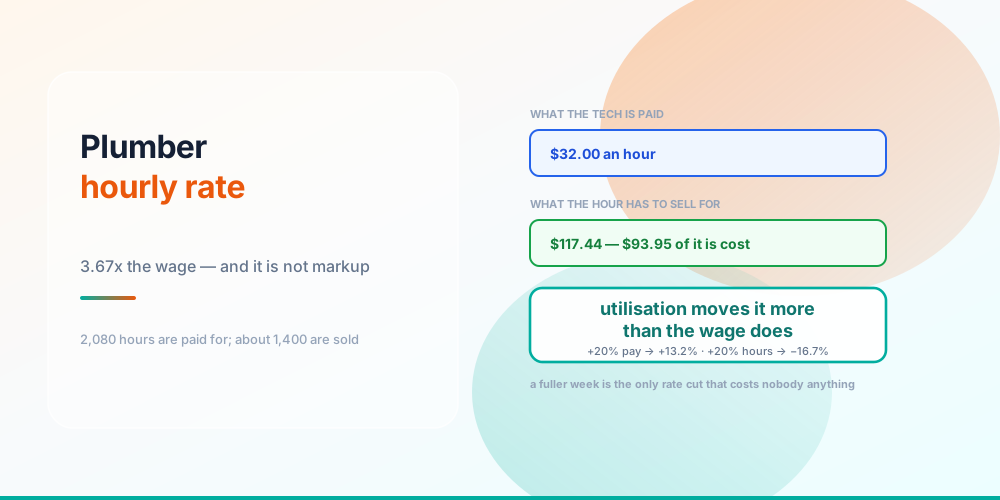
“My plumber charges $120 an hour and pays his guys $32” is a complaint with a number in it, and the number is right. The inference is not.
A $32 an hour plumber costs $131,528 a year to employ and sells about 1,400 hours. That is $93.95 of cost before any profit at all, and $117.44 at a 20% margin — 3.67 times the wage. The multiple is not markup. It is arithmetic, and most of it is the hours nobody buys.
What the technician actually costs
What a $32 an hour plumber actually costs
Base wage: $66,560. That is $32 an hour across 2,080 paid hours — a full year of full weeks.
Labour burden: $19,968. Thirty percent for payroll taxes, workers’ compensation, liability insurance, health cover and paid time off. Comp rates for plumbing are not trivial, and the rate is not optional.
Overhead share: $45,000. The van and its fuel, tools, the phone, the software, the licence, the yard, the bookkeeper, the person answering the phone. Divided across the technicians who exist to be dispatched.
Total: $131,528 a year, before profit and before a single hour has been sold to anybody.
Then comes the step that produces the whole surprise: divide by hours sold, not hours paid. 2,080 hours are paid for. Around 1,400 are sold. The other 680 are drive time, warehouse time, the estimate that did not convert, the callback, training, holiday, the morning a customer was not home.
$131,528 ÷ 1,400 = $93.95 of cost per sold hour. Add a 20% margin and it is $117.44. Run your own numbers through the Plumber Labor Rate Calculator.
Utilisation is the lever
Every unsold hour is paid for by the ones that sell
The annual cost of employing someone does not care how busy they are. So every hour that goes unsold is redistributed across the hours that do sell:
- 1,000 hours (48.1% utilisation) — the rate must be $164.41
- 1,400 hours (67.3%) — $117.44
- 1,800 hours (86.5%) — $91.34
Same technician, same pay, same overhead. The rate the business has to charge nearly halves across that range, and the curve is steepest at the bottom — exactly where a shop that is not quite busy enough is sitting.
This is why the cheap quote is not always the well-run shop. A firm at 86% utilisation can genuinely charge $91 and be more profitable than one charging $164 at 48%. It is also why the same shop’s rate can be honest in one quarter and painful in another.
The result the post is named for
Move each by 20% and see which matters
Take the baseline and move each input by the same 20%:
- Pay the technician 20% more — $32 to $38.40 — and the rate must rise from $117.44 to $132.89, up 13.2%
- Sell 20% more hours — 1,400 to 1,680 — and the rate falls from $117.44 to $97.86, down 16.7%
Utilisation moves the rate 1.3 times as far as wage does, and it moves it in the direction that wins work. A pay rise raises what you must charge; a fuller week lowers it. Only one of those makes you more competitive, and it is the one that does not involve paying people less.
The practical version of that: dispatch, routing, stocking the van properly, converting estimates, and cutting the drive time between calls are all rate reductions. They are also the only rate reductions available that do not come out of somebody’s wage or your own margin.
Reading the multiple
A useful sanity check is the ratio of bill rate to wage. At the baseline it is 3.67x, and it moves in ways that are worth understanding:
- 1,000 billable hours: 5.14x — a poorly utilised business, and the multiple looks outrageous
- 1,800 billable hours: 2.85x — a well-run one
- $24 wage: 4.09x — the fixed overhead is a bigger share of a smaller wage
- $45 wage: 3.31x — the same overhead spread over a bigger number
So a high multiple usually means low utilisation or a low wage, not profiteering. It is a diagnostic, not an accusation. Anywhere from about 2.5x to 4x is ordinary for a licensed trade carrying a van, insurance and a licence.
Electricians land in the same place by the same route — the identical build-up is in electrician hourly rate.
Flat rate and where it fits
Most established shops price flat rate rather than hourly. The customer sees “$X to replace a garbage disposal” instead of a clock, which removes the argument about how long it took and the incentive to work slowly.
The hourly rate does not disappear when you do that — it is the input. A flat-rate book is built by estimating the hours for each task and applying the loaded rate, so a shop that has its rate wrong has its whole book wrong. Getting this number right first is what makes flat rate work.
Frequently asked questions
How much do plumbers charge per hour?
Commonly $90 to $160 an hour for residential service, varying widely by market. The figure is not the technician’s wage: a $32 an hour plumber costs about $131,528 a year to employ and sells roughly 1,400 hours, which is $93.95 of cost per sold hour before any profit.
Why do plumbers charge so much more than they pay?
Because burden, overhead and unsold hours all sit between the two. A $32 wage becomes $66,560 of pay, plus about $19,968 of burden and $45,000 of overhead share — and that total is divided by the roughly 1,400 hours actually sold, not the 2,080 paid. The result is 3.67 times the wage, and only the last 20% of it is profit.
What is a good utilisation rate for a plumbing business?
Around 65 to 70% of paid hours is typical; above 80% is very good. It matters more than most owners realise: moving from 1,000 to 1,800 billable hours takes the required rate from $164.41 to $91.34 with nothing else changing.
How do I calculate my plumbing labor rate?
Annual wage plus burden plus overhead per technician, divided by billable hours, then divided by one minus your target margin. At $32 an hour, 30% burden, $45,000 overhead and 1,400 billable hours with a 20% margin, that is $117.44.
What is labor burden?
Everything you pay on top of the wage: payroll taxes, workers’ compensation, liability insurance, health cover and paid time off. Thirty percent of the base wage is a common figure for a plumbing shop, and workers’ comp for the trade is a meaningful part of it.
Should I raise my rate or sell more hours?
Sell more hours, if you can. A 20% pay rise pushes the required rate up 13.2%; selling 20% more hours pulls it down 16.7%. Utilisation moves the rate further and in the direction that wins work rather than losing it.
Why is one plumber’s rate half another’s?
Usually utilisation and overhead rather than skill or greed. A shop at 86% utilisation can charge $91 an hour profitably; one at 48% needs $164 for the same wage and the same overhead. The lower rate can equally mean a one-person operation with a small van and no office — or a business that is not covering its costs.
Is flat rate better than hourly?
For most established shops, yes — it removes the argument about duration and the perverse incentive to be slow. It does not remove the hourly rate, though: the flat-rate book is built from estimated hours multiplied by the loaded rate, so an incorrect hourly rate produces an incorrect book.
Sources & standards: The build-up here is business arithmetic, not code. 2,080 paid hours a year is the standard full-time convention — 40 hours across 52 weeks — and everything else is an assumption you should replace with your own: the wage, the burden percentage, the overhead allocation per technician, the billable hours and the target margin. The 30% burden and $45,000 overhead figures are illustrative for a small US plumbing shop in 2026 and are the part of this page most likely to date. Workers’ compensation rates for plumbing vary substantially by state and by experience modifier. Nothing here substitutes for your own accounts or your accountant.