
Low Water Pressure in a House: Static vs Flowing, and What Each Tells You
- 03 Sep, 2026
Almost everyone diagnosing low water pressure starts by screwing a gauge onto a hose bibb, reading 60 psi, and concluding the pressure is fine. It is a reasonable thing to do and it proves almost nothing.
Static pressure is what the street gives you. Flowing pressure is what survives the house. A house can read a perfectly healthy 60 psi with everything shut and still deliver a miserable shower, because the fault is not in the supply — it is in what happens to the water between the meter and the head. One reading cannot tell those apart. Two can.
Take both readings
One gauge, two readings, two different faults
Screw the gauge onto an outside bibb and read it with the house quiet. That is static pressure — no flow, so no friction, so the number is purely what the main and any pressure reducing valve are delivering.
Now open the two largest fixtures you have, ideally a bath tap and another bibb, and read it again. That is flowing pressure, and every psi that has disappeared has gone into friction in the pipe, height above the meter, or a restriction somewhere.
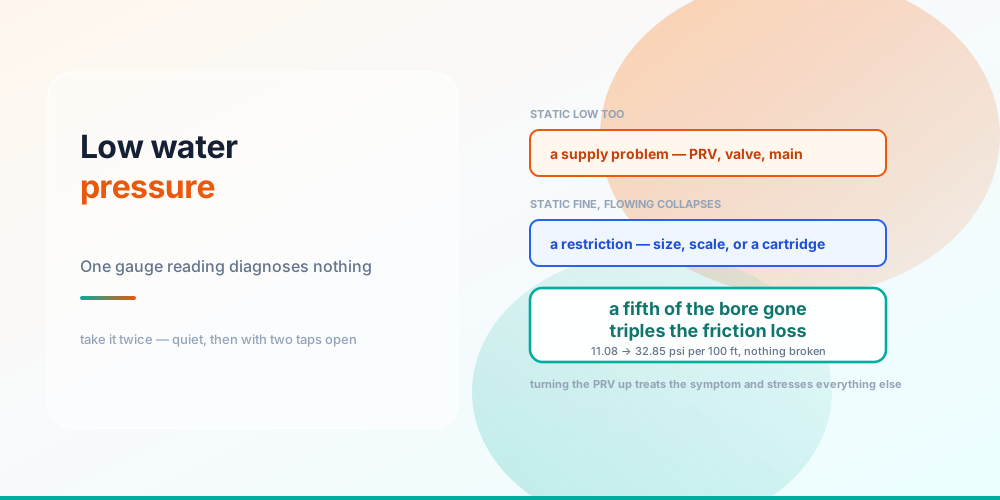
Static low as well? The problem is upstream of the house. A failed or misadjusted pressure reducing valve, a main shutoff or meter valve that is only part open, a weak street main, or a well system that is not maintaining its cut-out.
Static fine but flowing collapses? The supply is healthy and the house is eating it. That is undersized pipe, scaled pipe, a long run, or a specific restriction like a clogged cartridge or aerator.
A third case worth naming: static fine, flowing fine, one fixture still weak. Then it is that fixture — an aerator, a supply stop that was never fully opened, or a cartridge. It is not a house problem at all, and it is the one most likely to be fixed in five minutes.
Where the pressure actually goes
Pressure at the fixture is what is left after four subtractions from the static reading: what the meter costs, what height costs, what friction costs, and what the fixture itself needs to function.
Height is the easy one. Water weighs a fixed amount, so every foot of lift costs 0.4331 psi — about 4.33 psi per storey. An upstairs bathroom starts 4 or 5 psi behind the ground floor before anything else happens, which is why the complaint is nearly always upstairs.
Work the whole budget with the Water Pressure Calculator. At 60 psi static with 10 ft of lift, 8 psi lost in the meter and 15 psi needed at the fixture, 32.67 psi is left to spend on friction. That is the number pipe sizing has to fit inside, and it is what a long run of undersized copper spends in a hurry.
Friction is brutally sensitive to diameter
One size down is not a small penalty
This is the figure that explains most complaints. At 10 gpm:
- 1/2 inch runs at 13.75 ft/s and loses 65.52 psi per 100 ft
- 3/4 inch runs at 6.63 ft/s and loses 11.08 psi per 100 ft
- 1 inch runs at 3.89 ft/s and loses 3.02 psi per 100 ft
Going from 1/2 to 3/4 inch cuts the loss by almost six times at the same flow. Friction scales as roughly the fifth power of diameter, so one size down multiplies the loss rather than adding to it. A 1/2 inch branch that was adequate for one tap becomes hopeless the moment a second fixture opens on it.
Note the velocity column too. At 13.75 ft/s that half-inch line is far past the 8 ft/s ceiling normally applied to cold water — which is a noise and erosion problem as much as a pressure one. Velocity limits are ASPE and manufacturer practice rather than an IPC number, but they are the reason 1/2 inch is not a trunk line. There is more on this in what size water line do I need, which works both constraints together.
The house that got worse without anything breaking
A little scale is not a little problem
Galvanised steel corrodes inward. Copper in hard water scales. Neither produces a leak, an alarm, or anything you can see — the bore just closes, slowly, for decades.
The arithmetic is unforgiving. A 3/4 inch copper line at 10 gpm loses 11.08 psi per 100 ft when new. Take 10% off the bore and it becomes 18.51. Take 20% off and it is 32.85 psi per 100 ft — 3.0 times the original loss. The house has not changed, nobody added a fixture, and the shower is now unusable.
This is the honest answer to “why did my pressure get worse”. In an old galvanised house it usually did not get worse suddenly. It got worse continuously, and it crossed the threshold where you noticed. It is also why repiping fixes pressure complaints that no amount of valve adjustment will — the section on what it costs to repipe a house covers what that job actually involves.
Working through it in order
1. Static reading at a bibb. Under about 40 psi and you have a supply problem, full stop.
2. Check the PRV if there is one. They fail, and they usually fail low. A PRV is a serviceable part with a spring and a diaphragm, typically good for ten to twenty years. If static is low and the street is fine, this is the first suspect.
3. Check both valves are fully open. The main shutoff and the meter valve. A gate valve that has been partly closed for years — often after a repair — throttles the whole house. This is more common than it sounds.
4. Flowing reading. Two big fixtures open. Compare.
5. Isolate one fixture. If the whole house drops together, it is the service or the trunk. If one fixture drops and the others do not, it is that branch.
6. Pull an aerator and a cartridge. Free, and often the answer.
7. Count the length. Developed length includes fittings. A run with a dozen elbows behaves like a much longer straight run, and long runs of 1/2 inch are where the pressure goes.
What raising the pressure does not fix
If the fault is friction, turning the PRV up is treating a symptom. You will get some improvement — the extra static gives friction more to eat — and you will also push every fixture, appliance hose and solder joint in the house harder.
Above 80 psi the IPC requires a pressure reducing valve, and manufacturers void warranties on water heaters and appliances installed above their rated inlet pressure. Cranking a PRV to 90 psi to compensate for undersized pipe is a way to trade a shower complaint for a burst supply line. The section on normal water pressure for a house covers where the sensible band sits and why.
Thermal expansion is the other side of this. A house with a PRV or a check valve at the meter is a closed system, and heating water in a closed system raises pressure with nowhere for it to go — see thermal expansion tank sizing.
Frequently asked questions
What is normal water pressure for a house?
40 to 60 psi static is the usual working band, with 80 psi the point at which the IPC requires a pressure reducing valve. Below about 40 psi upstairs fixtures start to struggle once anything else is running.
Why is my water pressure low only in the shower?
If static and flowing pressure at a bibb are both healthy, the fault is at or near that fixture. A clogged shower head, a failing mixing cartridge, or a supply stop that was never fully opened will each do it. Pull the head and run the arm on its own — if the flow is strong, the head is the problem.
What is the difference between static and flowing pressure?
Static is measured with nothing running, so it is purely what the supply delivers. Flowing is measured with fixtures open, so it is what remains after friction, height and restrictions. The gap between the two is the diagnosis — a small gap means the house is fine and the supply is weak, a large gap means the supply is fine and the house is restricting it.
Why did my water pressure get worse over time?
Usually a closing bore rather than a sudden fault. Galvanised steel corrodes inward and copper scales in hard water. At 10 gpm, a 3/4 inch copper line loses 11.08 psi per 100 ft when new and 32.85 psi per 100 ft with a fifth of the bore gone — three times the loss, with nothing broken. The alternative explanation is a slowly failing pressure reducing valve.
Does pipe size affect water pressure?
It affects flowing pressure enormously and static pressure not at all. Friction scales as roughly the fifth power of diameter, so at 10 gpm a 1/2 inch copper line loses 65.52 psi per 100 ft where a 3/4 inch line loses 11.08 — nearly a six-fold difference for one nominal size.
Will a pressure booster pump fix low water pressure?
Only if the fault is genuinely low supply pressure. If the static reading is healthy and the flowing reading collapses, a booster pushes more water into the same restriction and gains far less than expected while adding noise, cost and a failure point. Diagnose before you buy hardware.
Can a water softener cause low pressure?
Yes. Softeners, whole-house filters and their bypass valves all impose a loss, and a neglected filter cartridge can impose a very large one. Take a flowing reading upstream and downstream of the unit — if the drop across it is more than a few psi, that is your restriction.
How many psi do I lose per storey?
About 4.33 psi per 10 feet of rise, from 0.4331 psi per foot of water column. A second-storey bathroom therefore starts roughly 4 to 5 psi behind the ground floor, and a third storey nearly 9 psi behind, before any friction is counted.
Sources & standards: Friction losses computed with the Hazen-Williams equation at C = 140 for type L copper, over the ASTM B88 bore dimensions. The 0.4331 psi per foot of head is derived from water at 62.37 lb/ft³ rather than quoted. IPC 2021 Section 604.8 requires a pressure reducing valve where static pressure exceeds 80 psi, and Section 604.3 sets minimum fixture flow pressures. The 8 ft/s cold and 5 ft/s hot velocity ceilings used here are ASPE and manufacturer design practice, not an IPC requirement — the code addresses velocity indirectly through sizing rather than by publishing a limit. Appendix E, where a jurisdiction has adopted it, is an appendix rather than mandatory text. The IPC is a model code; confirm the edition your jurisdiction adopts, and have a licensed plumber diagnose anything that turns out to be upstream of the meter.