
Thermostatic Mixing Valves: How Storing Hot Stretches a Tank
- 05 Sep, 2026
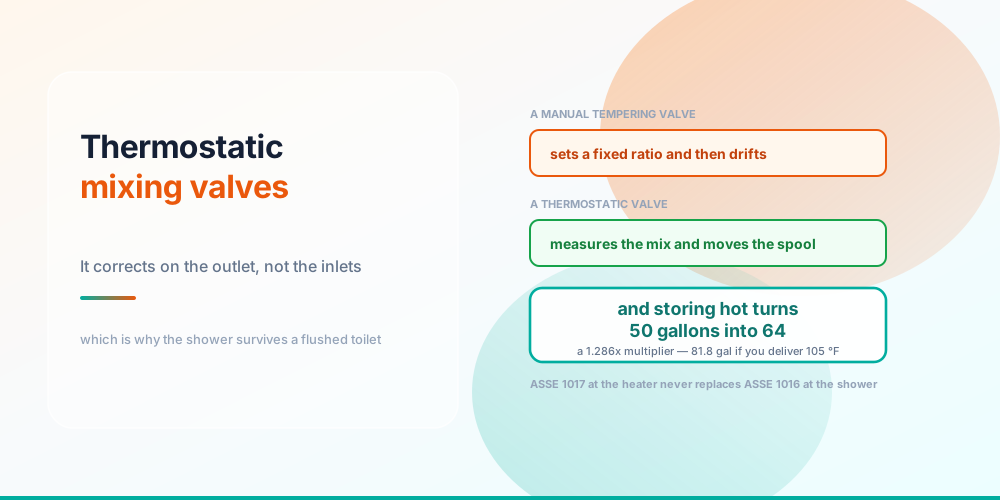
A thermostatic mixing valve is a small brass device that does one thing well, and the thing it does is more interesting than “blends hot and cold”. Plenty of arrangements blend hot and cold. This one measures the result and corrects itself, which is the difference between a shower that holds temperature and one that does not.
It corrects on the outlet
It measures the outlet, not the inlets
Inside the body is a spool with a hot port at one end and a cold port at the other, and a thermostatic element — wax or bimetallic — sitting in the mixed stream. The element expands as the outlet gets hotter and pushes the spool toward the cold side; it contracts as the outlet cools and lets the spool move back.
At the calculator’s defaults — 140 °F stored, 50 °F cold, 120 °F delivered, 2.5 gpm — the valve settles at 77.8% hot, 22.2% cold.
But the ratio is not the setting. The outlet temperature is the setting, and the ratio is whatever achieves it. So when the cold pressure drops because someone flushed a toilet, or the tank starts running cool, or the draw changes, the element moves and the delivered temperature stays where it was.
A manual tempering valve sets a fixed ratio instead. It is cheaper, it works while nothing changes, and it is why the shower goes cold when the toilet flushes.
Storing hot stretches the tank
Both ends of the mix move the multiplier
Because only part of every draw comes from the tank, each stored gallon buys more than a gallon of delivered water. That ratio is the storage multiplier, and it moves at both ends:
Raising storage, delivering 120 °F throughout:
- Store 120 — 1.000x — 50.0 gal
- Store 140 — 1.286x — 64.3 gal
- Store 160 — 1.571x — 78.6 gal
Lowering delivery, storing 140 °F throughout:
- Deliver 130 — 1.125x — 56.3 gal
- Deliver 120 — 1.286x — 64.3 gal
- Deliver 105 — 1.636x — 81.8 gal
So a tank storing 140 and delivering 105 behaves like 81.8 gallons — well over half as much again. That is why hand-wash and lavatory-only applications gain the most from a mixing valve, and why commercial installations with a low delivery setpoint see the biggest capacity effect.
Work your own numbers with the Mixing Valve Calculator. The safety argument for storing hot and delivering cool — the bacteria-versus-scalding conflict — is the separate question covered in water heater temperature.
Three devices with overlapping names
Three devices, and they do not substitute for each other
ASSE 1017 — the thermostatic mixing valve at the water heater. Whole system, one setpoint.
ASSE 1070 — a point-of-use tempering valve at a fixture or small group. Limits temperature at that outlet.
ASSE 1016 — the shower or bath control valve itself. Scald protection at the bathing fixture, and required in most jurisdictions regardless of what is at the heater.
This is the trap: a whole-house mixing valve is a system-level control and does not remove the fixture-level requirement. The two are additive, not alternative.
Cold inlet temperature moves everything
The same valve, the same 140 °F store, the same 120 °F delivery:
- 40 °F cold in — 80.0% hot — 1.250x multiplier
- 50 °F — 77.8% — 1.286x
- 60 °F — 75.0% — 1.333x
- 70 °F cold in — 71.4% — 1.400x
Colder incoming water needs a larger share of hot for the same delivered temperature, so the multiplier is worst in winter — exactly when the tank is under most load and the recovery is slowest. Nothing in the system has changed; the arithmetic has. It is the real reason hot water seems to run out faster in January.
Installing and living with one
On the cold inlet side of the heater outlet, with the cold supply teed in ahead of it. Isolating valves on all three ports, and a union or removable connection — this is a serviceable device.
Check the minimum flow rating. Every thermostatic valve has one, below which it cannot regulate. A low-flow lavatory on a valve sized for a whole house may fall under it and deliver unregulated temperature.
Set it with a thermometer at a fixture, not from the dial. Then re-check after the tank has fully recovered, because a valve adjusted against a cool tank is set wrong.
They drift and they fail. Elements age, and scale in hard water is the usual killer. A drifted valve delivers the wrong temperature silently — nothing alarms — so periodic verification with a thermometer is the only way to know. Some jurisdictions require annual verification on commercial installations.
Failure mode matters. A good valve fails closed or to cold rather than to full hot; check what the specific product does, because “fails safe” is not universal.
Frequently asked questions
What is a thermostatic mixing valve?
A valve that blends hot and cold water to a set outlet temperature and holds that temperature as conditions change. A thermostatic element in the mixed stream expands and contracts with the outlet temperature, moving a spool that opens one inlet as it closes the other.
How is it different from a tempering valve?
A thermostatic valve corrects on the outlet temperature, so it compensates automatically when inlet pressure or temperature changes. A manual tempering valve sets a fixed ratio — it works while conditions are stable and drifts when they are not, which is why the shower goes cold when a toilet flushes.
Does a mixing valve increase hot water capacity?
Yes, as a side effect. Since only part of each draw comes from the tank, every stored gallon delivers more than a gallon. Storing 140 °F and delivering 120 turns a 50 gallon tank into 64.3 gallons of usable water — a 1.286x multiplier — and delivering 105 °F takes it to 81.8.
Where should a mixing valve be installed?
On the outlet of the water heater, with cold teed in ahead of it, and with isolating valves on all three ports plus a removable connection. It is a serviceable device that eventually needs replacing, so access matters.
Do I still need a shower valve if I have a mixing valve at the heater?
Almost certainly yes. A whole-system valve is ASSE 1017 and a shower or tub control valve is ASSE 1016 — different devices under different standards, and most jurisdictions require the fixture-level device regardless of what is at the heater. They are additive.
Why does my hot water run out faster in winter?
Because colder incoming water needs a larger share of hot for the same delivered temperature. At 70 °F inlet the multiplier is 1.400x; at 40 °F it is 1.250x. The tank has not changed — the mix has, and it is drawing down faster to deliver the same shower.
How do I set a mixing valve?
With a thermometer at a fixture rather than from the dial, and then re-check after the tank has fully recovered. A valve adjusted against a partly cooled tank ends up set wrong once the heater catches up.
Do mixing valves fail?
Yes. Elements age and scale in hard water is the usual cause. The important part is that a drifted valve delivers the wrong temperature silently — there is no alarm and no leak — so periodic verification with a thermometer is the only way to detect it. Some jurisdictions require annual verification on commercial systems.
Sources & standards: ASSE 1017 covers thermostatic mixing valves for water heater outlets, ASSE 1070 covers point-of-use temperature-actuated mixing valves, and ASSE 1016 covers individual shower and tub control valves — three separate standards for three separate devices, and a requirement under one is not satisfied by a device listed to another. Mixing ratios, storage multipliers and effective capacities are computed from a straightforward energy balance on the same 140 °F stored, 50 °F cold, 120 °F delivered basis as this site’s mixing valve calculator. Minimum regulating flow, failure behaviour and setpoint adjustment are product-specific — read the listing for the valve you are installing. Scald-protection requirements at bathing fixtures, maximum delivered temperatures for particular occupancies, and any annual verification requirement are set locally. The IPC is a model code; confirm the edition your jurisdiction adopts.