
How to Estimate Plumbing Jobs: Markup Is Not Margin
- 03 Sep, 2026
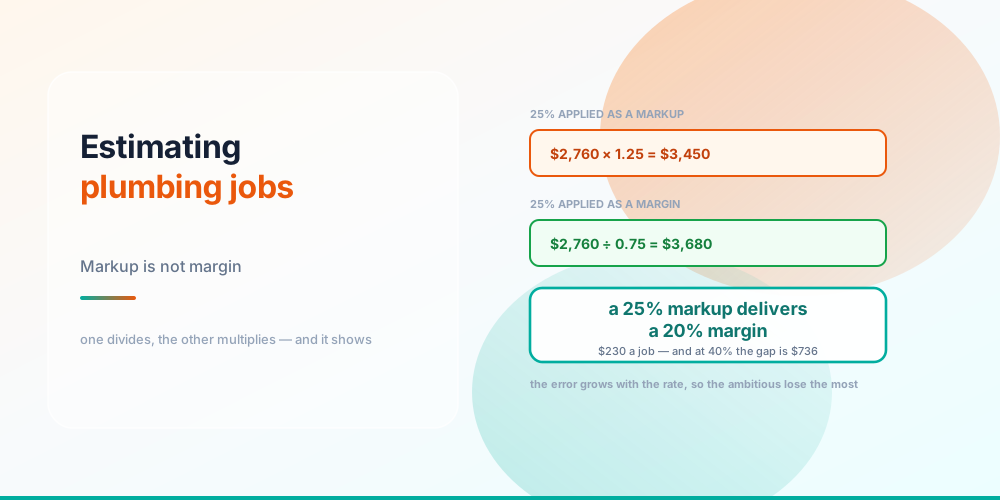
There is a specific arithmetic error that quietly costs small plumbing shops more money than any amount of bad buying, and it is committed by people who are careful about everything else.
Adding 25% to your cost does not give you a 25% margin. It gives you 20%. On a $2,760 job that is $230 — every job, forever, and the gap widens the more ambitious your percentage gets. At 40% the shortfall on one job is $736.
The build-up, in order
Every layer, in the order it has to be added
labour = hours × loaded labour rate direct = labour + fixtures + materials overhead = direct × overhead % break-even = direct + overhead price = break-even ÷ (1 − margin)
Ten hours at $110, an $850 fixture and $450 of materials is $2,400 of direct cost. Fifteen percent overhead adds $360, so break-even is $2,760. A genuine 25% margin makes the price $3,680, leaving $920 of profit.
Two steps in that sequence are where the money goes missing, and they are the last two.
Overhead is not in the labour rate
Overhead is not optional and it is not in the labour rate
Overhead is everything that does not attach to a job: the van, the insurance, the phone, the software, the yard, the person answering the phone, your own unbillable hours. It is real money that leaves the account whether you sold anything this week or not.
The common mistake is assuming the loaded labour rate already covers it. It does not, or at least not all of it — a loaded rate covers a technician’s overhead allocation, and it is built from that person’s billable hours. It does not carry the fixture, the material, or the parts of the business that scale with revenue rather than with labour.
Quote this job at $3,200 while actually carrying 15% overhead and the 25% margin you thought you had is 13.8% — $440 of profit instead of $920. Nothing has gone wrong on site. The estimate was simply built on a cost that was not the real cost.
The corollary matters too: overhead rises with the price. If overhead is genuinely 30% of direct cost, break-even on the same job is $3,120, not $2,400, and any price under that is a loss dressed as a sale. Work your own numbers with the Plumbing Job Estimate Calculator.
And then the arithmetic that costs the most
The same percentage, two different prices
Margin is a fraction of the price. Markup is a fraction of the cost. They are measured against different denominators, so the same number means two different things:
margin: price = cost ÷ (1 − rate) markup: price = cost × (1 + rate)
On the $2,760 break-even:
| Rate | As a margin | As a markup | Markup really delivers |
|---|---|---|---|
| 15% | $3,247 | $3,174 | 13.0% |
| 20% | $3,450 | $3,312 | 16.7% |
| 25% | $3,680 | $3,450 | 20.0% |
| 30% | $3,943 | $3,588 | 23.1% |
| 35% | $4,246 | $3,726 | 25.9% |
| 40% | $4,600 | $3,864 | 28.6% |
The gap between the two price columns is what the confusion costs on a single job — $73 at 15%, $230 at 25%, and $736 at 40%. The figure above plots it.
Read the last column downward. The error grows as the rate grows, which means the shops trying hardest to be profitable are losing the most to it. A shop believing it works at 40% margin while applying 40% markup is actually running at 28.6% — the difference between a comfortable business and a fragile one, expressed entirely in one operator.
If you want a 25% margin, divide by 0.75. If you prefer to think in markup, the markup that delivers a 25% margin is 33.3%. Electricians hit the identical trap, and the same arithmetic is worked through in markup vs margin for electricians.
Estimating the hours
Everything above is downstream of the hours, and the hours are the part that takes judgement rather than arithmetic. Three things reliably cost more than the estimate says:
Access. The fixture is not the job; getting to it is. A slab, a crawlspace, a finished ceiling, a tiled wall — none of it appears in a materials list and all of it appears in the hours.
Discovery. Open a wall in a house of a certain age and you will find something: galvanised where you expected copper, a vent that goes nowhere, a drain at the wrong slope. Estimating this to zero is how a profitable job becomes a break-even one.
Code catch-up. Once a permit is pulled, adjacent non-compliant work becomes yours. A water heater swap that finds no expansion tank, no pan and an unvented T&P discharge is three additional line items — see what a water heater costs to replace for how quickly that stacks up.
Track actual hours against estimated hours on every job. It is the only way to find out whether you are systematically optimistic, and almost everybody is.
Quote a band, not a number
Every cost figure on this site carries a plus or minus band for a reason: a single number implies a precision that a job with a wall in it does not have. Quote a range for exploratory work, quote firm for what you can see, and be explicit about which is which.
The alternative — a firm number that turns into a change order — costs more in trust than the difference was worth.
Frequently asked questions
What is the difference between markup and margin?
Margin is a percentage of the selling price; markup is a percentage of the cost. Same number, different denominators. A 25% markup on $2,760 of cost gives $3,450 and a 20% margin. A 25% margin gives $3,680. The $230 difference is what the confusion costs on one job.
What markup gives me a 25% margin?
33.3%. The conversion is markup = margin ÷ (1 − margin). For a 20% margin use 25% markup; for 30% margin use 42.9%; for 50% margin use 100%.
How do I calculate the price of a plumbing job?
Labour hours times the loaded rate, plus fixtures and materials, gives direct cost. Add overhead as a percentage of that to get break-even. Then divide break-even by one minus your target margin. Ten hours at $110 with an $850 fixture and $450 of materials, at 15% overhead and a 25% margin, prices at $3,680.
What overhead percentage should a plumbing business use?
Whatever yours actually is — calculate it rather than adopting a figure. Total annual non-job costs divided by total annual direct job costs. The important thing is not the number but that it is in the estimate at all: at 15% overhead it is $360 on a $2,400 job, and leaving it out turns a 25% margin into 13.8%.
Is overhead included in my hourly labour rate?
Partly, and not enough to skip the overhead line. A loaded labour rate carries a technician’s own allocation, built from their billable hours. It does not carry overhead attributable to fixtures, materials, or the parts of the business that scale with revenue. Applying both is correct, not double-counting.
Should I quote a fixed price or a range?
Fixed for what you can see and verify, a range for anything behind a wall or under a slab. Say which is which. A firm number that becomes a change order costs more goodwill than the range would have cost margin.
How much profit should a plumbing job make?
That is a business decision rather than a formula, but the arithmetic has to be honest about which figure you are hitting. A shop that intends 25% and applies markup is running at 20%; one that intends 40% and applies markup is running at 28.6%. Decide the number, then use the operator that delivers it.
Why do my jobs feel busy but not profitable?
Two usual causes, both above. Overhead omitted or guessed low, so break-even is higher than the estimate assumed — and markup applied where margin was intended, which takes another few points off every job. Together they can turn an intended 25% into something close to single digits without a single job going wrong on site.
Sources & standards: The pricing model here — markup versus margin, overhead applied to direct cost, and the plus-or-minus band on estimates — is business arithmetic, not code. The specific dollar figures are illustrative national-average assumptions for 2026 and are the part of this page most likely to date; use your own labour rate, your own overhead percentage and your own material costs. The estimating calculator this page links to computes both the margin price and the markup price side by side so the difference is visible rather than assumed. Nothing on this page is a substitute for your own accounts.