
Water Heater Replacement Cost: The Upgrades Turn a Swap Into a Project
- 03 Sep, 2026
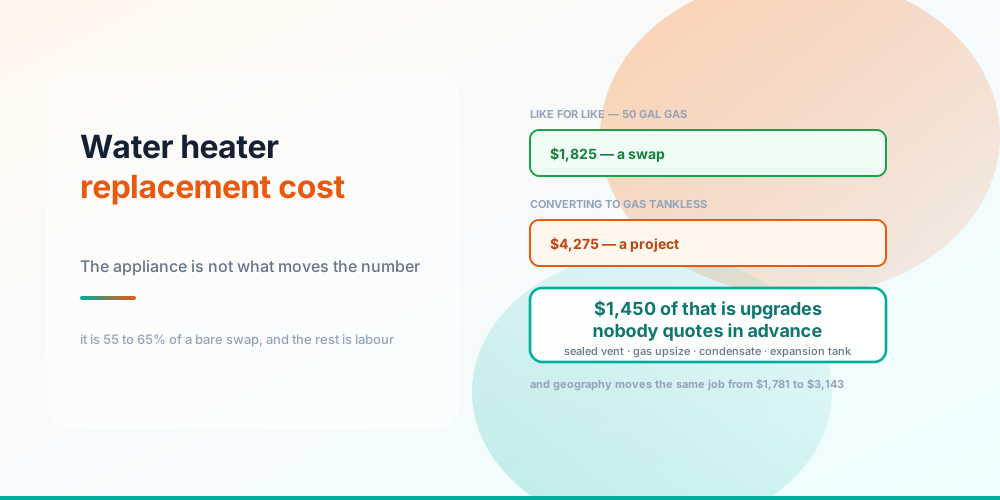
Most water heater quotes are wrong in the same direction, for the same reason. The homeowner prices the appliance, the appliance is the visible thing, and the appliance is not what makes the number move.
A like-for-like 50 gallon gas swap runs about $1,825. The same house converting to gas tankless runs $4,275 — and $1,450 of that difference is upgrade work that has nothing to do with which brand of heater you chose. Almost none of it is optional, and almost all of it is discovered after the old unit comes out.
The baseline: a straight swap
A straight swap, with nothing upgraded
With nothing upgraded and nothing moved:
- 40 gal gas tank — $1,675 (unit is 57%)
- 50 gal gas tank — $1,825 (unit is 60%)
- 50 gal electric tank — $1,463 (unit is 55%)
- 50 gal heat pump — $2,975 (unit is 67%)
- Gas tankless — $2,825 (unit is 57%)
- Electric tankless — $1,725 (unit is 43%)
Notice how consistent the split is. The appliance is roughly two fifths to two thirds of a bare swap, and the rest is four hours of a licensed plumber, a permit, and getting 150 lb of old steel out of a basement. That is why shopping the unit price aggressively moves the total less than people expect — a $200 saving on the heater is about 11% of the job.
The labour hours are what separate the rows more than the sticker does. A gas tankless is eight hours where a tank is four, because it is a different mounting, a different vent and a different gas connection even before any upgrades.
Where the money actually appears
The upgrades turn a swap into a project
Same appliance, code catch-up: $1,825 → $2,095. An expansion tank ($150) and a drain pan ($120). Both are required, both are frequently absent on an older installation, and neither can be skipped once an inspector is involved.
Heat pump: $3,895. The unit itself is the biggest single line, but it also needs a dedicated electrical circuit ($450) and a condensate path ($200), because a heat pump water heater produces condensate and a gas tank does not.
Gas tankless conversion: $4,275, of which $1,450 is upgrades. A sealed Category IV vent ($500) because the old atmospheric flue cannot be reused. A gas line upsize ($600) because a 199k BTU appliance replacing a 40k BTU one wants roughly five times the gas and will not run on the branch that fed the tank. A condensate drain ($200) because a condensing unit makes acidic condensate that has to be neutralised. And the expansion tank ($150) that was needed anyway.
That is the shape of the whole subject. A swap is a swap. A change of appliance type is a project, and the project cost is code-driven rather than product-driven. Work your own combination through the Water Heater Replacement Cost Calculator, which lets you tick the upgrades individually.
The upgrades, and why each one exists
Thermal expansion tank — $150. Required by IPC 607.3 on any closed system, and most houses are closed systems now because of meter check valves and pressure reducing valves. The full argument is in thermal expansion tank sizing.
Drain pan and drain line — $120. Required wherever a leak would damage the structure, which means any heater not standing on a floor with a drain in it.
Seismic strapping — $90. Required in seismic design categories C and above. Cheap, and non-negotiable where it applies.
Vent or flue upgrade — $500. The one that catches tankless conversions. A condensing tankless is Category IV and needs its own sealed, positive-pressure vent — the existing B-vent is not reusable, and if the old heater shared that flue with a furnace, removing it changes the sizing for the furnace too.
Gas line upsize — $600. Five times the input on the same pipe does not work.
Electrical circuit — $450. Heat pump and electric tankless units. Electric tankless is the extreme case: a whole-house unit can want 100 amps or more of dedicated capacity, which is frequently a panel problem rather than a circuit problem.
Condensate drain or neutraliser — $200. Condensing gas appliances produce acidic condensate. It needs somewhere to go and often needs neutralising before it goes there.
Geography moves it nearly as much
One job, four markets, and a band rather than a number
The identical job runs $1,781 in a lower-cost market and $3,143 in a major coastal metro — a 1.8x swing driven by labour rates, permit costs and what the local market will bear.
The bands matter as much as the midpoints. Every figure on this page carries a plus or minus 18% band, which means an honest quote for the average-market job is $1,718 to $2,472, not “$2,095”. Anyone quoting a water heater replacement to the dollar sight-unseen is guessing at what they will find behind the old unit.
The things that push it past the estimate
Location. A heater in a finished basement with a straight path out is four hours. A heater in an attic, a crawlspace, or up a spiral staircase is not, and the labour line moves accordingly.
Code catch-up on an old install. Undersized combustion air, a flue that never met clearance, a missing shutoff, no drip leg on the gas, a T&P discharge that terminates somewhere it should not. All of it becomes your problem once a permit is pulled.
Water quality. A heater that failed at six years in hard water suggests the replacement needs treatment ahead of it, or it will do the same.
Emergency premium. A failed heater on a Sunday is not priced like a planned replacement, and the failed heater is how most people arrive at this question.
Should the number change the decision?
Sometimes, and not always in the obvious direction.
Tankless pays back on longevity more than on energy. Around 20 years against 10 to 12, so a $4,275 conversion against two $1,825 swaps over the same period is closer than the sticker suggests. The energy saving is real but smaller than marketing implies — the trade-offs are in tankless vs tank.
Heat pump water heaters have the strongest energy case and the worst installation constraints. They need volume, air, a condensate path and a circuit, they cool the space they sit in, and they recover slowly.
Staying with what you have is usually the cheapest correct answer. If the existing unit is the right size and the fuel is right, a like-for-like swap is the job with the fewest surprises in it. Size it properly first — what size water heater do I need.
Frequently asked questions
How much does it cost to replace a water heater?
For a like-for-like 50 gallon gas tank, about $1,825 in an average market — $1,374 to $1,977 allowing for the band. A 50 gallon electric is about $1,463 and a 40 gallon gas about $1,675. Add an expansion tank and a pan, which many older installations lack, and the gas job goes to about $2,095.
Why is my water heater quote so much higher than the unit price?
Because the appliance is only about 55 to 65% of a bare swap, and any upgrade work sits on top of that. Four hours of licensed labour, a permit and haul-away make up the rest, and a job that needs an expansion tank, a pan, a vent change or a gas upsize can add $150 to $1,450 more.
How much does it cost to convert to a tankless water heater?
Around $4,275 for a gas tankless in an average market, against $1,825 for a like-for-like tank swap. About $1,450 of the difference is upgrades — a sealed Category IV vent, a gas line upsize, a condensate drain and an expansion tank — none of which are optional and most of which are discovered on site.
Do I need an expansion tank when replacing a water heater?
If the house is a closed system, yes — IPC 607.3 requires it, and a pressure reducing valve, backflow preventer or meter check valve makes a house closed. Many older installations predate the check valve their utility later fitted, so the requirement appears at replacement time. It adds about $150.
Why does a heat pump water heater cost more to install?
The unit itself is the largest part, but it also needs a dedicated electrical circuit and a condensate drain that a gas tank does not. With an expansion tank and pan as well the job comes to roughly $3,895 against $1,825 for a like-for-like gas swap.
Is it cheaper to repair or replace a water heater?
Repair a heater under about eight years old with a failed element, thermostat, gas valve or T&P valve — those are inexpensive parts. Replace anything with a leaking tank, at any age: the tank is the appliance, and a corroded one cannot be repaired. Past ten years, most significant repairs are worth putting toward a replacement.
Do I need a permit to replace a water heater?
In most jurisdictions, yes, and it is around $150. It is also the reason the code catch-up items appear — an inspection is what surfaces a missing expansion tank, an absent pan, or a flue that never complied. Unpermitted work is a problem at resale and can void insurance on a water-damage claim.
How long does a water heater last?
Ten to twelve years for a storage tank and around twenty for a tankless, with water hardness the biggest variable in both. A tank that fails at six years is telling you something about the water, and the replacement will do the same without treatment ahead of it.
Sources & standards: Costs are US national-average retail assumptions for 2026 carrying a plus or minus 18% band, with regional multipliers of 0.85, 1.00, 1.25 and 1.50 — the same ladder used across this site’s cost calculators so the categories stay comparable. They are market assumptions, not code, and they are the part of this page most likely to date. Get local quotes. The requirements driving the upgrade lines are code: IPC 2021 Section 607.3 for thermal expansion control on closed systems, Section 604.8 for the pressure reducing valve that often creates one, and the fuel gas code for venting, combustion air and gas pipe sizing on any change of appliance. Seismic strapping applies in seismic design categories C and above. The IPC is a model code — confirm the edition your jurisdiction adopts, pull the permit, and have a licensed plumber do the work.