
Water Heater Temperature: Store at 140, Deliver at 120, and Why
- 04 Sep, 2026
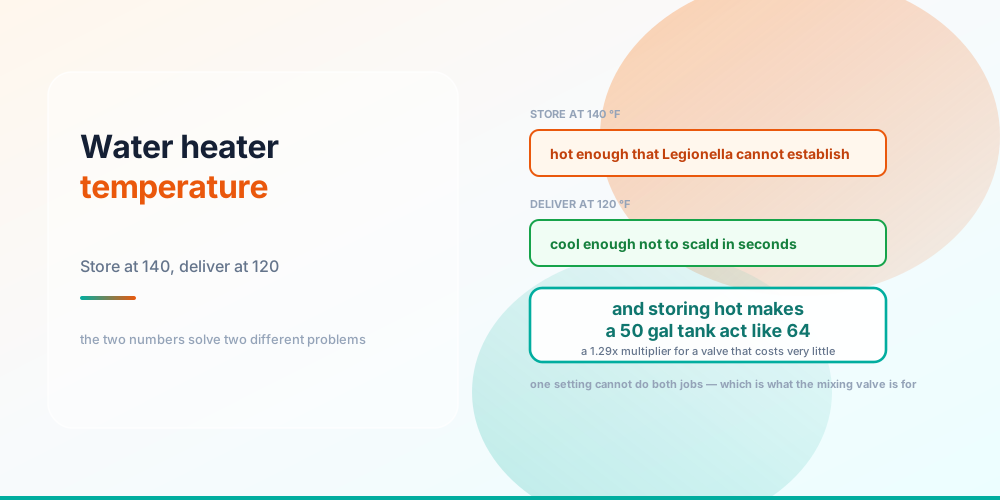
“What should I set my water heater to?” gets two confident and contradictory answers. Set it to 120 to avoid scalding. Set it to 140 to avoid bacteria. Both are right, which is the problem.
Store at 140. Deliver at 120. One setting cannot do both jobs, so you stop trying and use two numbers — and the device that lets you costs very little and hands back a surprising amount of tank capacity as a bonus.
Two hazards, opposite directions
Two hazards, pulling opposite ways
Legionella grows readily in warm stagnant water. Growth slows as temperature rises, stops in the low 120s, and the organism dies off progressively faster above that. A tank held at 120 sits close to the edge of the range where it is merely inhibited rather than killed — and the bottom of a tank, below the thermostat, runs cooler than the setting anyway.
Scalding works the other way, and it is not linear. The difference between 120 and 140 at the tap is the difference between minutes of contact and seconds. Children, older adults and anyone with reduced sensation are at particular risk, and the injuries are severe.
These are health-agency and burn-injury figures rather than anything this site computes, and they are quoted here to explain the conflict rather than to size anything.
The resolution is a thermostatic mixing valve at the heater outlet: the tank runs at 140 and the house sees 120.
What a mixed draw is made of
A shower is mostly, but not only, tank water
At the calculator’s defaults — 140 °F stored, 50 °F cold, 120 °F delivered, a 2.5 gpm shower:
- 77.8% comes from the tank — 1.94 gpm
- 22.2% is cold — 0.56 gpm
So every gallon you draw at the shower head only spends 0.78 gallons of stored hot water. That ratio is the whole mechanism behind the capacity bonus.
Note that the cold inlet temperature moves it. Colder incoming water in winter needs a larger share of hot for the same delivered temperature, which is why hot water seems to run out faster in January even though nothing changed.
The capacity you get back
Storing hotter makes the tank bigger
- Store at 120 — 100% of the draw comes from the tank — behaves like 50 gallons
- Store at 130 — 87.5% — behaves like 57.1
- Store at 140 — 77.8% — behaves like 64.3 gallons
- Store at 150 — 70.0% — behaves like 71.4
A 50 gallon tank stored at 140 delivers as much 120 °F water as a 64 gallon tank stored at 120 — a 1.29× multiplier, for the price of a mixing valve.
That is not a rounding. It is the cheapest capacity increase available on a water heater, it needs no more energy per delivered gallon, and it comes with the safety improvement rather than trading against it. Work your own numbers with the Mixing Valve Calculator.
The standby loss argument is the honest counterweight: a tank at 140 loses slightly more heat to the room than one at 120. On a modern insulated tank that is a small number, and it is generally outweighed by not needing a larger heater — but it is real.
Doing it properly
Fit a thermostatic mixing valve at the heater outlet, not at individual fixtures. One valve, whole house.
Set the tank to 140 and the valve to 120. Verify at a tap with a thermometer rather than trusting the dial, which on a gas heater is frequently just “hot / warm / very hot”.
Point-of-use valves are additional, not alternative. Many jurisdictions require a separate device at tubs and showers under ASSE 1016, and a whole-house valve does not remove that requirement.
Without a mixing valve, 120 is the safer setting, and that is the standard advice for good reason. Storing at 140 with no mixing is how people get burned. If you cannot fit the valve, take the 120 and accept the compromise.
Related things this changes
Sizing. First-hour rating is computed at the storage temperature, so a mixed system genuinely stretches further than the raw number suggests — see what size water heater do I need.
Thermal expansion. A hotter tank expands its contents more. Going from 120 to 140 °F storage on a closed system increases the expansion volume, and the tank sizing follows — thermal expansion tank sizing.
Tankless. A tankless has no storage to hold at temperature, so the bacterial argument largely does not apply and the setting is simply the delivery temperature. It also means no capacity bonus — the trade-offs are in tankless vs tank.
The device itself
Everything above is the case for storing hot and delivering cool. How the valve that lets you do it actually works — why it holds temperature when someone flushes a toilet, which of the three overlapping standards applies where, and how far the capacity bonus goes at lower delivery temperatures — is in thermostatic mixing valves explained.
Frequently asked questions
What temperature should a water heater be set to?
140 °F stored with a thermostatic mixing valve delivering 120 °F is the arrangement that satisfies both hazards. Without a mixing valve, 120 °F is the safer single setting — storing at 140 and delivering it unmixed is how scald injuries happen.
Is 120 degrees hot enough to kill Legionella?
Not reliably. Growth slows through the 110s and stops around the low 120s, but die-off is slow at that temperature and the bottom of a tank runs cooler than the thermostat setting. Water stored at 140 kills it far more rapidly, which is the case for storing hot and mixing down.
Is 140 degrees too hot for a water heater?
Too hot to deliver, not too hot to store. At 140 °F, contact causes serious burns in seconds rather than minutes. Store at 140 only with a mixing valve bringing the delivered temperature down to about 120.
What is a thermostatic mixing valve?
A valve at the heater outlet that blends stored hot water with cold to a set delivery temperature and holds it as conditions change. It is what allows a tank to be stored at 140 while the house sees 120 — and it increases usable capacity as a side effect.
Does turning up the water heater give me more hot water?
Yes, more than people expect. Storing at 140 instead of 120 makes a 50 gallon tank behave like 64.3 gallons of 120 °F water, because each stored gallon is blended with cold. That is a 1.29× multiplier and it needs a mixing valve to be safe.
Why does my hot water run out faster in winter?
Because the incoming cold water is colder, so a larger share of every mixed draw has to come from the tank to reach the same delivered temperature. Nothing in the system has changed — the arithmetic has.
Will a higher setting waste energy?
Slightly. A tank held at 140 loses a little more standby heat to the room than one at 120. On a modern insulated tank that is a small number, and it is usually outweighed by the extra effective capacity — but it is a genuine cost, not zero.
Do I still need scald protection at the fixtures?
Usually yes. Many jurisdictions require a point-of-use device at showers and tubs under ASSE 1016 regardless of what happens at the heater. A whole-house mixing valve is a system-level control; the fixture-level requirement is separate and additional.
Sources & standards: Mixing ratios and effective capacity are computed from a straightforward energy balance on the same 140 °F stored, 50 °F cold, 120 °F delivered basis as this site’s mixing valve calculator. The temperature bands for bacterial growth and scald injury are public-health and burn-injury guidance, not values computed or verified here — they are shown to explain why the two requirements conflict, and specific thresholds vary between agencies. Point-of-use scald protection at showers and tubs is governed by ASSE 1016 and by local requirements that apply in addition to any whole-house mixing valve. IPC 2021 Section 607.3 covers thermal expansion, which storing hotter increases. The IPC is a model code — confirm the edition your jurisdiction adopts, and note that some jurisdictions and some occupancies specify a maximum delivered temperature directly.