
NEC Adoption by State: Which Code Cycle Applies to You
- 04 Aug, 2026
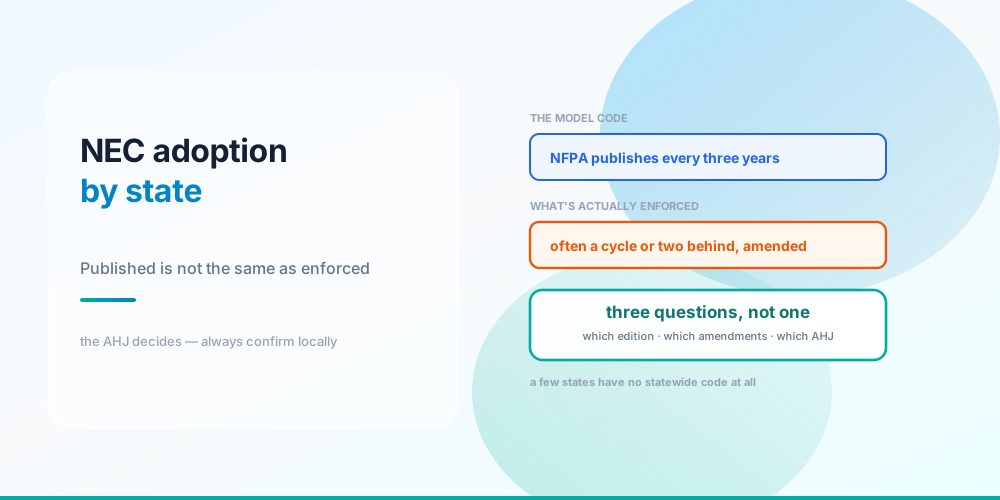
The National Electrical Code is not law. It’s a model standard published by the NFPA, and it becomes enforceable only when a state or local government adopts it - on its own schedule, and usually with amendments.
That produces a situation people find genuinely confusing: “the NEC requires it” can be true and irrelevant at the same time. A provision in the newest edition may not be adopted where you work, or may be adopted with that section deleted.
One deliberate omission in this article: there’s no state-by-state table. Adoption changes constantly - states move editions, delay them, and amend individual sections mid-cycle - so any table published here would be wrong within months and would be wrong in the specific direction of making you confident. What follows instead is how the mechanism works and where to get the current answer authoritatively.
How a Model Standard Becomes Law
"The NEC says" is an incomplete sentence
NFPA publishes a new edition every three years, roughly a year before the edition year - NEC 2023 appeared in 2022, NEC 2026 in 2025.
A state adopts an edition through its legislature, an electrical board, or agency rulemaking. This takes anywhere from months to several years, and involves public comment periods where trade groups, builders and utilities all argue for changes.
The state amends it. Sections get deleted, delayed, or modified. This is not unusual or improper - it’s how the system is designed to work, letting jurisdictions respond to local cost, climate and construction practice.
Local government may amend again. Cities and counties can add requirements on top, and frequently do in seismic, coastal, wildfire or historic districts.
The AHJ interprets and enforces. NEC 90.4 explicitly grants the authority having jurisdiction the responsibility for interpreting the rules and for permitting alternative methods. So even with the edition and amendments settled, the inspector’s reading matters.
A few states have no statewide electrical code at all, leaving adoption entirely to counties and municipalities - which means neighbouring jurisdictions can be on different editions.
Why Several Editions Are Always in Force
Several editions are always in force at once
| Edition | Published |
|---|---|
| NEC 2017 | 2016 |
| NEC 2020 | 2019 |
| NEC 2023 | 2022 |
| NEC 2026 | 2025 |
With a three-year publication cycle and adoption lags of one to four years, the enforcement windows overlap heavily. At any given moment, different jurisdictions in the same country are working to editions several cycles apart - and some skip an edition entirely, jumping from 2017 to 2023.
The practical consequence: a contractor working across state lines, or even county lines, is working to different rules on different jobs. Learning “the code” as a single body of requirements doesn’t survive that.
Where the Differences Actually Bite
Most of the NEC is stable. Table 310.16 hasn’t moved in decades, box fill under 314.16 is unchanged, and the fundamentals of grounding and bonding are settled. What varies is the recent additions, and a few specific ones account for most real-world confusion:
GFCI expansions. 210.8(D) for specific appliances (dishwashers first, then further into cooking equipment) and 210.8(F) for all outdoor dwelling outlets are among the most-amended provisions in the code. 210.8(F) in particular caught air-conditioning condensers, produced genuine nuisance-tripping problems, and prompted a wave of state amendments and delays. Where GFCI Protection Is Required handles this carefully.
AFCI expansions. 210.12’s scope has widened across cycles, and the additions attract amendments.
Emergency disconnects. 230.85 requires an outdoor emergency disconnect for one- and two-family dwellings in recent cycles - a significant change to panel replacement work, and adopted unevenly.
The service disconnect grouping change. NEC 2020 revised 230.71(A) so a single enclosure may contain only one service disconnect, ending the six-handle panelboard. Whether that applies to your alteration depends on the adopted cycle. Main Breaker vs Main Lug Panels.
Island and peninsula receptacles. NEC 2020 required them by area; the 2023 cycle removed the requirement. This is a case where the newer code is less demanding, so working from the newest book can over-build. Receptacle Spacing Rules.
The rooftop ambient adder. Older cycles added up to 33 °C for raceways on a roof; that was largely removed in the 2017 cycle. If you learned the rule, check whether it still applies. Wire Derating Explained.
Notice the pattern: these are all provisions where the model code moved and local practice diverged. They’re exactly the items worth confirming rather than assuming.
Finding Your Answer
Three questions, answered from primary sources
1. Which edition is adopted? The authoritative sources are your state’s building code or electrical licensing board website, and NEMA’s code adoption maps, which track this nationally and are updated as changes happen. Don’t assume the newest edition.
2. What has been amended? States publish an amendment document alongside the adoption - often as a chapter of the state building code, sometimes as a separate administrative rule. This is the document that tells you whether 210.8(D) applies.
3. What does the local AHJ add? The city or county building department. Many publish contractor handouts summarising local requirements, and those handouts are gold - they’re written precisely because the same questions keep coming.
Then, for anything genuinely ambiguous: ask, before you build, and get the answer in writing or by email. An inspector’s pre-decision costs one message and settles the question. Arguing after the fact costs a re-inspection and a schedule. Electrical Permits and Inspections.
Practical Habits
Own the edition your jurisdiction enforces, not just the newest one. If you work across two jurisdictions on different cycles, own both.
Read your state’s amendment list once, properly. It’s usually a handful of pages and it’s the difference between designing correctly and designing to a book that doesn’t fully apply.
Watch for the effective date, not the adoption date. Adoptions frequently take effect months after they’re voted, sometimes with a grace period where either edition is acceptable, and permits pulled before the date usually remain under the old edition.
Note that existing installations are generally not retroactive. Work installed legally under a previous edition doesn’t become illegal when a new one is adopted. What triggers current code is new work and, to a degree that the AHJ decides, alterations.
Don’t design to the newest code as a safety margin. It sounds prudent and it isn’t reliably so - the island receptacle change is a case where the newer code requires less, so building to it would be under-building relative to a 2020 jurisdiction.
Remember that other codes interact. The International Residential Code, state energy codes, and local utility service requirements all touch electrical work, and the utility’s own rules about service equipment and meter location are not in the NEC at all.
Common Mistakes
- Treating the NEC as law. It’s a model standard until adopted, and it’s amended when adopted.
- Assuming the newest edition applies. Adoption lags publication by one to four years.
- Designing to the newest code as a margin. Sometimes the newer edition requires less.
- Assuming 210.8(D) and 210.8(F) are in force. They’re among the most-amended provisions.
- Not reading the state amendment document. It’s short, and it’s the operative text.
- Confusing adoption date with effective date. They differ, often by months.
- Thinking a new edition makes old work illegal. Existing installations generally aren’t retroactive.
- Assuming neighbouring jurisdictions match. Where there’s no statewide code, they routinely don’t.
- Relying on a published adoption table. They go stale fast. Check the primary source.
Calculate to the Right Code
NEC Tables Reference - the ampacity, derating, grounding, conduit and box-fill tables the calculators use, in one place, so you can see the values being applied rather than trusting a black box.
The calculators on this site are built on NEC 2023 as a baseline, which is the most widely adopted recent edition - but where a provision is contentious or recently changed, the posts say so rather than asserting a single answer. See NEC 2023 vs 2026 for what’s changed most recently, Common NEC Violations for what gets flagged, and Electrical Permits and Inspections for working with your AHJ.
Sources & standards: NEC (NFPA 70) - 90.4 for AHJ authority, and the provisions discussed at 210.8(D), 210.8(F), 210.12, 210.52(C)(2), 230.71(A), 230.85 and 310.15. Publication years are NFPA’s. Adoption status by jurisdiction changes continually and is deliberately not tabulated here - consult your state electrical board or building code authority, NEMA’s code adoption resources, and your local building department. The AHJ has final say on both the applicable edition and its interpretation.
FAQ
Is the NEC actually law?
No. The National Electrical Code is a model standard published by the NFPA. It becomes enforceable only where a state or local government adopts it into law, and adoption almost always comes with amendments that delete, delay or modify specific sections. So a requirement can exist in the published NEC and not apply where you work.
Which NEC edition applies to my work?
Whichever edition your jurisdiction has formally adopted, plus its amendments - which may be one to four editions behind the newest published one. Check your state’s building code or electrical licensing board site, and NEMA’s code adoption maps, then confirm local amendments with the city or county building department. A published table in an article will be out of date.
Why don’t all states use the same NEC edition?
Because adoption is a legislative or rulemaking act in each jurisdiction, with its own timetable, public comment process and politics. Costs, climate, construction practice and industry lobbying all shape whether and when an edition is adopted and which sections survive. A few states have no statewide electrical code at all, leaving it to counties and municipalities.
How long after publication does a state adopt an edition?
Typically one to four years, and sometimes never for a given edition - jurisdictions occasionally skip one entirely. Since a new edition is published every three years, the enforcement windows overlap heavily, so several editions are always in force somewhere at the same time.
Which NEC provisions vary most between jurisdictions?
The recent expansions, especially the GFCI requirements in 210.8(D) for specific appliances and 210.8(F) for outdoor dwelling outlets, which are amended out or delayed in a number of states. The 230.85 emergency disconnect requirement and the 230.71(A) single-service-disconnect change are also adopted unevenly. Most of the code - ampacity tables, box fill, grounding fundamentals - is stable across editions.
Should I just design to the newest NEC to be safe?
No, and this catches people. Sometimes the newer edition requires less - the 2023 cycle removed the island and peninsula receptacle requirement that 2020 imposed, so designing to 2023 in a 2020 jurisdiction would under-build. Design to the adopted edition and its amendments, and treat “newer is stricter” as an assumption to check rather than a rule.
Does a new code edition make my existing wiring illegal?
Generally no. Existing installations that were legal under the edition in force when they were installed remain legal; the NEC is not retroactive as a rule. What triggers current code is new work, and - to an extent the AHJ decides - alterations and extensions to existing systems. Some specific provisions and local ordinances do impose retroactive requirements, so it’s worth asking on a major alteration.
What is an AHJ and how much discretion do they have?
The authority having jurisdiction - usually the local building or electrical inspector. NEC 90.4 explicitly assigns them responsibility for interpreting the code’s rules, for deciding on the approval of equipment and materials, and for permitting alternative methods where the intent is met. That’s substantial discretion, which is why getting an ambiguous question answered in writing before you build is worth the email.