
Sizing a Rainwater Harvesting System: The Dry Spell, Not the Roof
- 04 Sep, 2026
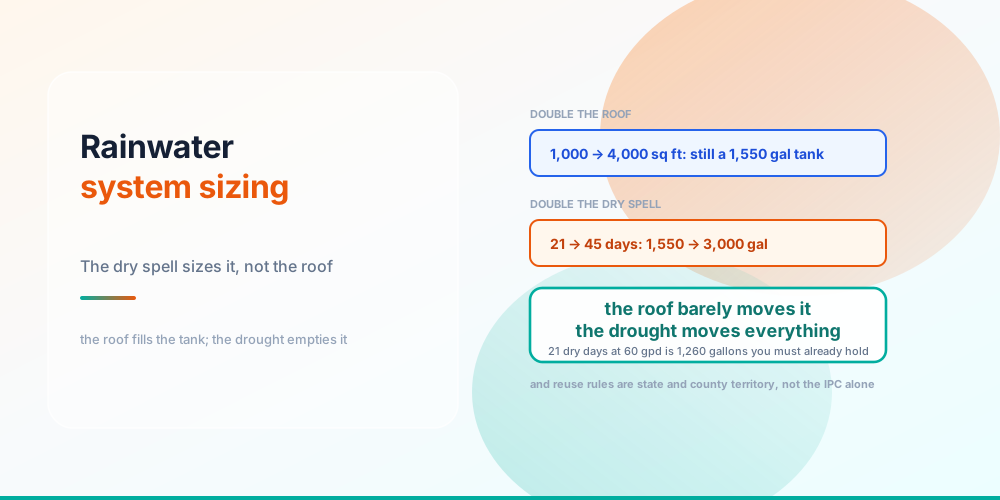
Almost every conversation about rainwater harvesting starts with the roof. How big is it, which way does it face, how much rain falls here. All reasonable questions, and none of them size the tank.
A cistern is sized by the dry spell. The roof determines whether the system can keep up over a season; the drought determines how much water you have to be holding when the rain stops. Those are different questions and only the second one produces a tank size.
Two candidates, and which one wins matters
Which candidate wins tells you whether it works
Demand storage — 60 gallons a day across a 21-day dry spell — is 1,260 gallons. That is what you must already have in the tank on the last day of rain.
Yield storage — what 3.5 inches of rain on 2,000 square feet of asphalt shingle actually delivers after losses — is 3,066 gallons.
The smaller of the two is the tank: 1,260 gallons required, so a 1,550 gallon shell, covering 25.8 days at full draw.
The important part is which one governed. Here it is demand, which means the roof comfortably out-supplies the demand and the tank is genuinely sized for the drought. If yield had been the smaller number, the tank would be capped by what the roof can deliver — and a yield-governed system is not a correctly sized system. It is a system that will run dry no matter how large the tank is.
The sweeps that make the point
The roof fills it. The drought sizes it.
Quadruple the roof — 1,000 to 4,000 square feet — and the required tank does not move. 1,260 gallons in every row, a 1,550 gallon tank in every row. More roof means the tank refills faster, which is real and useful, but it does not change how much you need to hold.
Change the dry spell and everything moves:
- 7 days — 420 gallons — a 530 gallon tank
- 21 days — 1,260 — 1,550
- 45 days — 2,700 — 3,000
- 60 days — 3,066, and now governed by yield — the roof can no longer deliver a 60-day reserve in the period, so the tank is capped by supply rather than sized for demand
That last row is the useful failure. It is telling you that at 60 dry days, 2,000 square feet of catchment is not enough for 60 gallons a day, and the answer is not a bigger tank — it is more roof, less demand, or a backup supply.
What actually reaches the tank
The roof material is the biggest single loss
One inch of rain on 2,000 square feet is 1,247 gallons gross. What reaches the tank is rather less, and three losses take the difference:
The runoff coefficient is by far the largest. Standing-seam metal at 0.95 delivers 983 gallons; a green roof at 0.30 delivers 310 — a 3.2x spread on identical rainfall. Asphalt shingle, the common case, gives 879.
First flush diverts the initial dirty water — 0.015 gallons per square foot per event, so 30 gallons on this roof each time it rains. Small per event, meaningful across many small events.
Collection efficiency at 85% covers filter losses, overflow during intense bursts, and gutter spill.
A green roof deserves a specific warning: it is excellent for stormwater management and poor for harvesting, because absorbing water is the entire point of it. If you want both, you need substantially more catchment.
The gross figure comes from the same 0.6234 gallons per square foot per inch used in roof runoff — harvesting and storm drainage are the same arithmetic pointed in opposite directions.
Sizing it in practice
- Establish the design dry spell. Local climate data, not a guess, and use a genuinely dry year rather than an average one.
- Establish honest daily demand. Irrigation is seasonal and dominates; toilet flushing and laundry are steady. Be specific about which loads the system serves.
- Multiply — that is the demand storage.
- Check yield over the same period against the roof.
- Take the smaller, and if yield wins, fix the system rather than the tank.
The Rainwater Harvesting Calculator runs all of that, including the grey-water side.
The regulatory position is genuinely unsettled
This is the least code-governed subject in plumbing and it deserves saying plainly.
The IPC covers nonpotable systems in Chapter 13 where that chapter is adopted. The IAPMO green supplement and the IRC cover it elsewhere. In practice state and county rules decide, and they range from by-right with no permit, through permitted-with-conditions, to effectively prohibited. Some western states have historically restricted rainwater capture on water-rights grounds; others actively subsidise it.
Potable reuse is out of scope here entirely. Treatment and disinfection for drinking water is a different discipline with different rules, and nothing on this page addresses it.
What is near-universal where systems are permitted at all:
Cross-connection protection. A nonpotable system connected to a potable supply for top-up needs backflow protection — usually an air gap, which cannot fail. The device selection logic is in backflow prevention.
Marked pipe and no hose bibbs. Purple pipe, labelled outlets, and no removable connection anyone could drink from.
An overflow to somewhere legal. A full cistern in a storm has to overflow, and where it overflows to is a stormwater question.
The other nonpotable source
Rainwater is stored for a drought. Grey water cannot be stored at all — untreated, it goes septic within about a day, so the tank may never exceed one day’s yield. That single constraint inverts the whole design, and grey water system basics works through what it forces.
Frequently asked questions
What size rainwater tank do I need?
Daily demand multiplied by the design dry spell, checked against what the roof can yield in the period, taking the smaller. At 60 gallons a day across 21 dry days that is 1,260 gallons, so a 1,550 gallon shell. Roof area barely affects the answer.
Does a bigger roof mean a bigger tank?
No — and this surprises most people. Going from 1,000 to 4,000 square feet leaves the required tank at 1,260 gallons throughout. A bigger roof refills the tank faster and makes the system more reliable across a season; it does not change how much water you must hold through a drought.
How much water can I collect from my roof?
0.6234 gallons per square foot per inch of rain gross. After losses, 2,000 square feet of asphalt shingle delivers about 879 gallons per inch, standing-seam metal about 983, and a green roof only about 310 — the roof material is the largest single loss.
What is a runoff coefficient?
The fraction of rain landing on a surface that actually reaches the tank. Standing-seam metal is about 0.95, asphalt shingle 0.85, gravel-surfaced flat roof 0.70, and a green roof only 0.30 — because absorbing water is what a green roof is for.
What is first flush and how much do I lose to it?
The initial runoff of each storm, which carries the dust, pollen and debris off the roof and is diverted rather than stored. About 0.015 gallons per square foot per event — 30 gallons on a 2,000 square foot roof, each time it rains. Small individually, meaningful across many small events.
What happens if the roof cannot supply my demand?
The calculation tells you: the tank becomes governed by yield rather than demand. That is not a correctly sized system, it is a capped one — it will run dry regardless of tank size. The fixes are more catchment, less demand, or a backup supply, not a bigger cistern.
Is rainwater harvesting legal?
It depends heavily on where you are, and this is the least uniform subject in plumbing. The IPC addresses nonpotable systems in Chapter 13 where adopted; elsewhere the IRC or the IAPMO green supplement applies; and in practice state and county rules decide, ranging from by-right to effectively prohibited. Check locally before designing anything.
Do I need backflow protection on a rainwater system?
Yes, wherever the system can connect to the potable supply — including a simple top-up fill. An air gap is the usual and best answer because it cannot fail mechanically. Pipe must also be marked as nonpotable and outlets must not be usable as drinking points.
Sources & standards: Gross catchment uses 0.6234 gallons per square foot per inch, derived from 7.48052 gallons per cubic foot divided by twelve rather than quoted as the familiar 0.62 rule. Runoff coefficients, the 85% collection efficiency, the 0.015 gal/sq ft first-flush allowance and the stocked cistern sizes are commonly published values rather than code or measurement, and every one of them is an editable input on the calculator for that reason. Nonpotable water reuse is the least code-governed subject in plumbing: the IPC addresses it in Chapter 13 where that chapter is adopted, the IRC and the IAPMO green supplement apply elsewhere, and state and county rules actually decide — ranging from by-right to effectively prohibited. This page deliberately publishes no jurisdiction table, because any such table would be wrong somewhere within a year. Potable reuse, treatment and disinfection are out of scope entirely. Cross-connection protection where a nonpotable system meets a potable supply is governed by IPC Section 608. Confirm everything with your AHJ before designing.