
Calculating Ductwork Size: CFM, Friction & Duct Calculator Guide
- 29 Jun, 2026
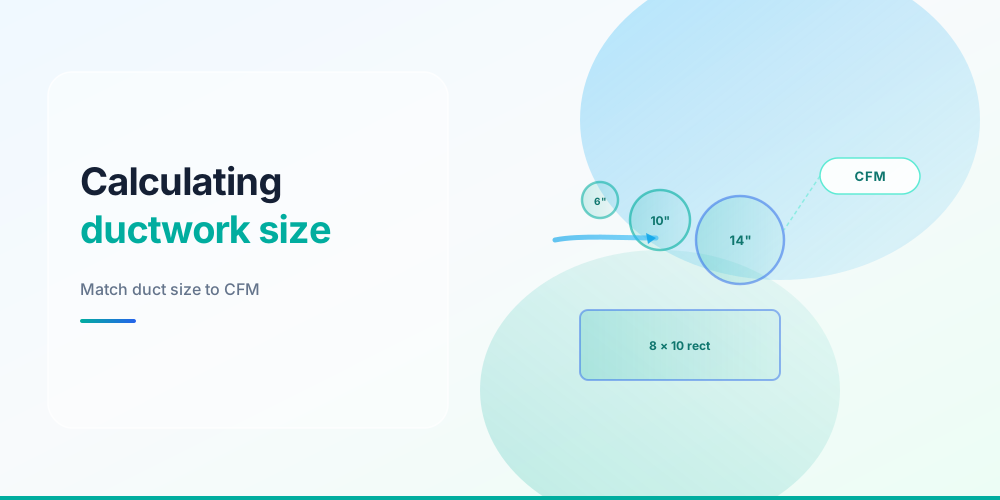
Calculating ductwork size means matching duct diameter or dimensions to the airflow (CFM) each run must carry - at a friction rate and velocity that keep the system quiet and within blower capacity. Searchers use different names - sizing ductwork, size of ductwork, duct calculator hvac, hvac duct design calculator, hvac duct sizer, hvac ductulator, ductwork calculator online, air duct calculator online, or air duct size calculator online - but every version answers: “What size duct carries this CFM without excessive noise or static pressure?”
The Two Rules Behind Every Duct Size
Friction rate: Static pressure consumed per 100 ft of duct. Residential branch runs target 0.08–0.10 in.wg/100 ft.
Velocity: Air speed in feet per minute. Keep branch runs under ~900 fpm to avoid register whistle. Returns run slower - size them larger for the same CFM.
A duct size cfm calculator or duct size to cfm calculator that ignores velocity will oversize trunks and undersize branches. Always check both.
The two rules behind every duct size
Round Duct Size Chart by CFM
Round metal duct at ~0.10 in.wg/100 ft friction rate:
| CFM | Round duct size |
|---|---|
| 100 | 6 in |
| 225 | 8 in |
| 350 | 9 in |
| 450 | 10 in |
| 700 | 12 in |
| 1,100 | 14 in |
| 1,700 | 16 in |
These numbers come from the same math behind any sizing ductwork for cfm tool. Flex duct needs one size larger due to ribbed-wall friction.
For the full chart with round-to-rect conversion, see Duct Size Chart. For Manual D workflow, see HVAC Duct Sizing Guide.
Round duct size by CFM
Supply vs Return When Sizing Ductwork
- Supply ducts carry conditioned air to rooms - sized from room CFM requirement
- Return ducts carry air back to the air handler - typically 100–125% of supply CFM split across returns
- Return drop near the air handler is often the largest single duct in the system
See Return Air Duct Sizing for return-specific rules and a return air duct sizing calculator walkthrough.
Rectangular Duct Equivalent
When ceiling space limits round duct, convert using equal cross-sectional area:
Area (sq in) = π × (diameter ÷ 2)²A 10 in round duct (78.5 sq in) ≈ 8 × 10 rectangular (80 sq in).
Round ↔ rectangular: match the area
Whole-System vs Single Run
A free hvac duct sizing calculator sizes one segment. Manual D (ACCA) sizes the entire system accounting for fitting losses, longest run, and total external static pressure. Hvac ductwork sizing at the whole-system level validates cumulative static against blower capacity - use segment calculators during design, then confirm with Manual D.
An hvac ductulator - the slide-rule wheel or digital equivalent - is the field tool behind every duct calculator hvac. Our Online Ductulator Guide explains how it works.
Duct Offset and Weight Estimates
A duct offset calculator sizes transition fittings when duct must jog around structure. A weight of ductwork calculator estimates material weight for hangers and structural support - typically 1–3 lb per linear foot for galvanized round duct depending on gauge and diameter.
Use the Free Calculators
HVAC Duct Size Calculator - hvac duct design calculator for round and rectangular duct from CFM.
Duct Friction Rate Calculator - verify friction on existing runs.
HVAC CFM Calculator - room and system airflow before calculating ductwork size.
For the broader duct calculator naming guide, see HVAC Duct Calculator Guide.
FAQ
How do I start calculating ductwork size from CFM?
Enter CFM and target friction rate (0.10 in.wg/100 ft default) into a duct calculator. Verify velocity stays under 900 fpm on branch runs. Upsize one increment if velocity is too high.
What is the difference between hvac duct sizer and ductwork calculator online?
Nothing meaningful - both size duct from airflow. “Ductwork calculator online” often implies whole-home scope; “hvac duct sizer” usually means a single run or segment.
When do I need Manual D instead of a duct size cfm calculator?
Any new whole-home duct system, major retrofit, or when total external static pressure exceeds blower rating. Segment calculators size individual runs; Manual D validates the complete system.
Why size returns larger than supplies?
Returns run at lower velocity to stay quiet. A return carrying the same CFM as a supply needs a larger duct cross-section.