
Common Plumbing Code Violations and Why Inspectors Catch Them
- 04 Sep, 2026
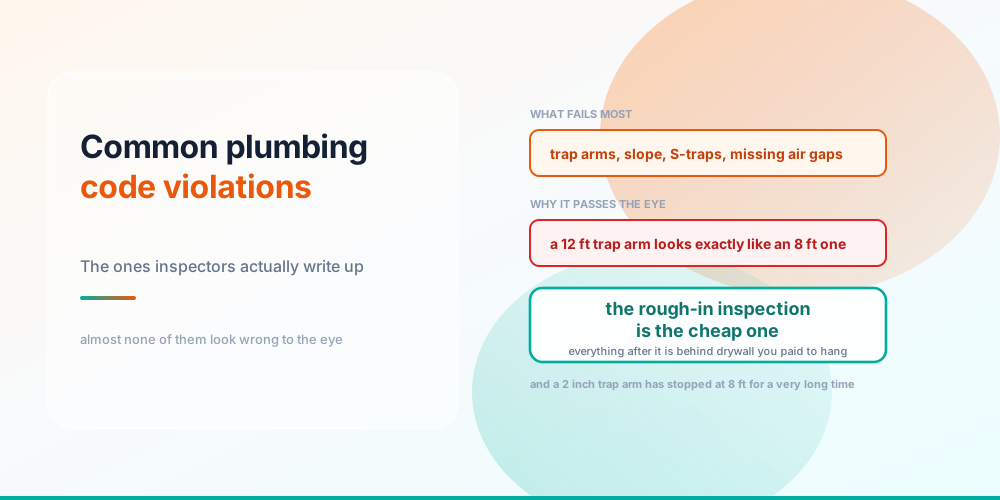
The plumbing defects that fail inspections are not exotic. They are a short, well-known list, and the reason they keep happening is not ignorance — it is that almost none of them look wrong.
A trap arm twelve feet long looks exactly like one eight feet long. A drain at 1/8 inch per foot looks exactly like one at 1/4. You cannot see any of it from the doorway, which is why it survives the work and surfaces at the inspection.
The list
Almost none of these look wrong
Trap arm too long. A 2 inch arm stops at 8 ft, a 1-1/2 inch at 6 ft, measured weir to vent fitting. Relocating a fixture during a remodel is how it happens, and it is the most common single failure. Why the limit exists is in why is my drain gurgling.
Drain slope wrong. 1/4 inch per foot at 2 inch and under — 2.08%. Too flat and solids sit; too steep and the water outruns them. Both directions fail.
An S-trap. Prohibited outright, and no length of arm makes it legal — it siphons its own seal by design. Still common in older work and in DIY vanity swaps.
Building drain undersized where a water closet discharges. Never under 3 inch, regardless of what the fixture unit table says. A floor that overrides the arithmetic entirely — see what size drain pipe do I need.
Vent undersized. Half the drain diameter, never under 1-1/4 inch, and upsized past 40 ft of developed length. The length is the part that gets missed.
No air gap on a discharge. 1.00 inch minimum on a 1/2 inch opening, 1.50 near a wall. Dishwasher and water softener discharges are the usual finds — the rule is in backflow prevention.
No PRV, or a PRV with no expansion tank. A PRV is required above 80 psi, and fitting one creates a closed system that then requires expansion control. The second requirement is the one that gets forgotten — do I need a PRV.
Why timing is the whole cost
The same defect, four prices
The same two-foot-too-long trap arm costs an hour during rough-in and a great deal more once there are finishes over it. The plumbing repair is identical in every row — what changes is what has to be destroyed to reach it, and by the time tile and fixtures are in, that dominates completely.
That is the entire argument for the rough-in inspection being the cheapest hour anyone spends on a job, and for nobody rushing it.
It is also the argument for building discovery risk into estimates honestly rather than optimistically — how to estimate plumbing jobs covers where that belongs in a price.
The walk-round
The walk-round before you call it in
Take a tape to every trap arm, the slope on every horizontal, the developed length of every vent, and every air gap.
Take a gauge to static pressure, the expansion tank pre-charge if the system is closed, the test pressure the AHJ wants held, and the delivered hot water temperature.
Just look for S-traps, cleanouts that exist but are not accessible, missing nail plates where pipe crosses framing, supports at the right spacing, and dielectric unions between dissimilar metals.
Two habits worth more than the list:
Ask the inspector what they check first. Every one of them has an order and most will tell you. It costs a phone call and it is the highest-return conversation available on the job.
Confirm which code and which edition. Everything above is IPC, and roughly fifteen states enforce the UPC or a derivative — with different trap arm measurement, different fixture unit values and a different position on air admittance valves. IPC vs UPC sets out exactly which of these numbers change.
The permit question
Unpermitted plumbing is a slower failure than a failed inspection and a worse one. It surfaces at resale, when a buyer’s inspector or an appraiser finds work with no record, and it can complicate an insurance claim on water damage.
The general position is that a permit is required for anything beyond minor repairs and like-for-like replacement of a fixture — but the actual threshold is local, and the range between jurisdictions is wide. Ask before assuming.
And the process around it
Everything above assumes an inspection is happening. What triggers one, what it costs, and why a permit fee adds more to a quote than the fee itself is in plumbing permits and inspections — along with why unpermitted work is the slower and worse failure.
Frequently asked questions
What are the most common plumbing code violations?
Trap arms exceeding their length limit, drain slope outside the required range, S-traps, building drains undersized where a water closet discharges, undersized or under-length-corrected vents, missing air gaps on appliance discharges, and a pressure reducing valve fitted without the expansion tank it requires.
Why do inspectors catch things that look fine?
Because almost every common failure is dimensional rather than visible. A 12 ft trap arm looks identical to an 8 ft one, and a drain at 1/8 inch per foot looks identical to one at 1/4. Five of the seven most common defects need a tape measure or a gauge to find at all.
How far can a trap be from its vent?
8 ft for a 2 inch arm, 6 ft for 1-1/2 inch, 5 ft for 1-1/4 inch, measured from the trap weir to the vent fitting under IPC Table 909.1. Those limits correspond to one pipe diameter of fall, past which the vent opening drops below the trap weir.
What slope does a drain need?
1/4 inch per foot — 2.08% — for 2-1/2 inch and under, 1/8 inch per foot for 3 to 6 inch, and 1/16 above that. Both directions fail: too flat and solids settle, too steep and the water runs away from them.
Why are S-traps not allowed?
Because they siphon their own seal. The vertical drop immediately after the trap creates the siphon that empties it, and no length of arm fixes it — which is why the prohibition is outright rather than dimensional. A P-trap with a properly located vent is the replacement.
What does it cost to fix a code violation after the fact?
Almost entirely a function of when it is found. The same trap arm correction is roughly an hour’s work during rough-in, and many times that after tile and fixtures — the plumbing repair is identical, and what changes is what has to be demolished and rebuilt to reach it.
Do I need a permit for plumbing work?
For most work beyond minor repairs and like-for-like fixture replacement, yes — but the threshold is set locally and varies widely. Unpermitted work surfaces at resale and can complicate a water damage insurance claim, which makes it a slower and worse failure than a failed inspection.
Are these rules the same everywhere?
No. Everything here is IPC, and roughly fifteen states enforce the UPC or a derivative, which measures trap arms differently, uses its own fixture unit values, and takes a different position on air admittance valves. Confirm the code, the edition and the local amendments your jurisdiction has actually adopted.
Sources & standards: IPC 2021 throughout — Table 909.1 for maximum trap arm developed length, Chapter 7 for minimum drain slope, Section 906.2 for vent sizing and the 40 ft upsizing threshold, Section 608 and Table 608.15.1 for air gaps, Section 604.8 for the pressure reducing valve threshold and 607.3 for thermal expansion control. Air gap figures are computed from the rule rather than transcribed. Roughly fifteen states enforce the UPC or a derivative, where several of these numbers differ — trap arm measurement, fixture unit values and air admittance valve acceptance in particular. The cost illustration uses this site’s estimate calculator basis at $110 an hour with 15% overhead; the hours and rebuild costs are realistic assumptions rather than measured figures and scale with your own rate. Permit thresholds are set locally, not by the model code. Confirm the code, edition and amendments your jurisdiction has adopted, and ask your inspector what they look at first.