
Tankless vs Tank: Simultaneity, Not Capacity, Is the Real Difference
- 03 Sep, 2026
The tankless pitch is “endless hot water” and the tank pitch is “it just works”. Both are true and neither is the useful comparison, because the two appliances do not fail in the same way.
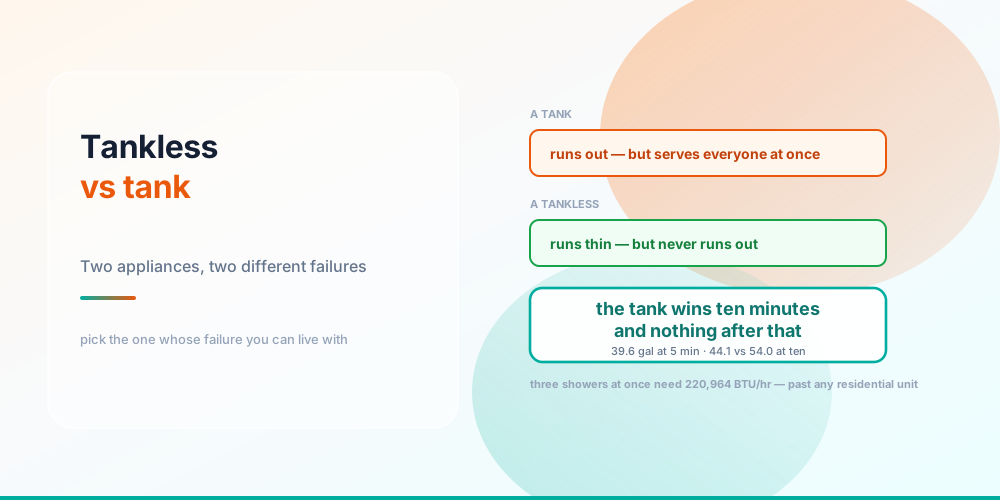
A tank runs out. A tankless runs thin. A tank hands you a fixed number of hot gallons as fast as you want them and then hands you cold water. A tankless hands you a fixed number of gallons per minute, forever, and if you ask for more than that at once everybody’s shower goes lukewarm. Which of those two failures you can tolerate is the actual decision.
The crossover is about ten minutes
The tank wins the first few minutes. Nothing after that.
At five minutes the tank has delivered 39.6 gallons and a 199k BTU tankless has delivered 27.0. The tank is comfortably ahead, because it started with 35 gallons already hot.
By ten minutes the tankless has caught it — 54.0 against 44.1 — and after that it is not close. At an hour the tank has managed 89.9 gallons, its full first-hour rating, and the tankless has produced 324.2.
That is the whole shape of the trade. Storage is a burst resource; a tankless is a rate. A house whose hot water use is short and clustered is well served by storage. A house that fills a large tub, runs long showers back to back, or has a soaking bath is where the tank runs out and the tankless does not.
What “endless” actually costs you
The endlessness is real, and it is capped by flow rather than by volume.
The same unit is a different appliance in a cold climate
A tankless heats water as it passes, so its output is entirely a function of how much heating that water needs. Rise is outlet temperature minus incoming groundwater temperature, and incoming water varies enormously by geography and season.
The same 199k BTU unit delivers:
- 12.61 gpm at a 30 °F rise — Florida in summer, water arriving at 75 °F
- 5.40 gpm at a 70 °F rise — a northern winter, water arriving at 50 °F
- 4.73 gpm at an 80 °F rise — a hard northern winter
That is the single most misleading thing about tankless marketing. A “9.8 gpm” unit is 9.8 gpm at some rise the datasheet chose, and in Minnesota in January it is not that unit. The Tankless Water Heater Calculator works it at your own rise, and tankless water heater sizing goes through the sizing method in full.
Simultaneity is the real question
Simultaneity is the dividing line, not capacity
Ask a tankless for two 2 gpm showers at a 70 °F rise and it needs 147,309 BTU/hr. Ask for three and it needs 220,964 — past the largest residential unit made. There is no cleverness available here; the energy has to arrive in the water in the second it passes through.
A tank meets the same demand completely differently. Three showers, two hand washes, a dishwasher and a clothes washer in one hour is 66 gallons of demand, and a 30 gallon tank on a 40k BTU burner covers it — first-hour rating 75.9 gallons, recovering 54.9 gallons an hour. One fifth of the burner, because it does not have to make it all at once.
This is what storage buys: it decouples the burner from the peak. And it is why a tankless retrofit so often needs a gas line upsize — the 199k BTU appliance replacing a 40k BTU one wants roughly five times the gas.
There is a related sizing subtlety. A tankless has a minimum activation flow, typically around half a gallon per minute. Below it the unit does not fire at all, which is why a trickling tap runs cold on a tankless and warm on a tank.
Cold water sandwich, and why recirculation changes the maths
Draw hot water, stop, then start again a minute later, and a tankless gives you a slug of cold between two slugs of hot. The unit shut down, the pipe held hot water that then cooled, and the burner takes a couple of seconds to come back. Modern units with small buffer tanks reduce it; they do not eliminate it.
A recirculation loop hides that problem and creates another. It keeps a supply of hot water at the fixture, which is good, and it means the heater fires repeatedly through the day to maintain a pipe rather than to serve a person, which erodes the efficiency case substantially. On a tankless it also means the unit is cycling constantly. The wait-time arithmetic — and why recirculation is often the wrong answer to it — is worked through in why hot water takes so long.
The honest ledger
A tankless is genuinely better at: endless duration, floor space, a 20-year service life against 10 to 12, no standby loss, and no 50 gallons of water waiting to end up on the floor.
A tank is genuinely better at: simultaneous demand, installed cost, retrofit simplicity, tolerance of hard water, low-flow draws, and being repairable by anyone.
The efficiency case is smaller than advertised. Standby loss on a modern insulated tank is real but modest, and a recirculation loop can wipe out the difference entirely. For a household that uses a lot of hot water in short bursts, the annual saving is often not what pays for a gas line upsize.
Hard water is the tankless’s weak point. Scale on a heat exchanger is a direct efficiency and reliability problem, and annual descaling is a maintenance obligation rather than a suggestion. A tank tolerates hard water badly too, but it fails slowly and cheaply.
The cost side of all this — including which upgrades a conversion drags in — is in what a water heater costs to replace.
Choosing, briefly
Choose a tank if the household has simultaneous demand, the budget is tight, the gas line is sized for what is already there, or the water is hard and nobody will descale anything.
Choose a tankless if the failure mode you actually experience is running out rather than running thin, space is genuinely constrained, you are in a warm climate where the rise is small, or the unit’s 20-year life against a tank’s 10 to 12 matters to you.
Choose two tankless units, or a tankless plus a small buffer, if you want endless duration and simultaneous demand. It is a real answer and it prices accordingly.
Frequently asked questions
Is a tankless water heater better than a tank?
Neither is better; they fail differently. A tank runs out of hot water but handles several fixtures at once. A tankless never runs out but caps how many fixtures it can serve simultaneously. Pick based on which failure your household actually hits.
How many showers can a tankless run at once?
At a 70 °F rise, a 199k BTU unit produces 5.40 gpm — two 2 gpm showers comfortably, three only if the fixtures are genuinely low-flow. Three 2 gpm showers need 220,964 BTU/hr, which is past the largest residential unit sold.
Why does my tankless water heater not keep up in winter?
Because incoming water is colder, so the rise is larger and the flow it can heat is smaller. The same 199k BTU unit does 12.61 gpm at a 30 °F rise and 5.40 gpm at 70 °F. Nothing has failed — the appliance is doing exactly what its physics allows.
Does a tankless water heater save money?
Less than the marketing suggests. It removes standby loss, which is real but modest on a modern insulated tank, and a recirculation loop can erase the saving entirely by firing the unit all day to keep a pipe warm. The stronger arguments for tankless are duration, space and service life.
What is the cold water sandwich?
A slug of cold water between two hot ones, when you stop and restart a draw. The unit shuts off, the pipe between it and the tap cools, and the burner takes a moment to relight. Units with small internal buffer tanks reduce it but do not remove it.
Do I need to upgrade my gas line for a tankless?
Usually. A 199k BTU tankless replacing a 40k BTU tank wants roughly five times the gas, and a 1/2 inch branch that fed the tank normally will not feed the tankless. The gas line upsize is one of the two or three things that make a conversion cost far more than a swap.
How long do tankless water heaters last?
Typically around 20 years against 10 to 12 for a storage tank, and the heat exchanger is usually replaceable rather than the whole unit. That longevity assumes annual descaling in hard water, which is a maintenance obligation rather than an option.
Which is better for a large family?
Usually a tank, or a tankless sized well past the obvious. Large households produce simultaneous demand, which is exactly what a tankless is worst at. A 66 gallon peak hour is comfortably served by a modest tank and burner; the same demand arriving all at once needs a very large tankless or two of them.
Sources & standards: Flow and recovery figures are derived from first principles — 8.33 lb per gallon and 1 BTU per pound per degree Fahrenheit, giving 499.8 BTU per gpm per °F — rather than transcribed from manufacturer literature, so the numbers here are what the physics allows rather than what any specific model claims. First-hour rating uses the US DOE method, with 70% of stored volume treated as usable to allow for cold water mixing in during the draw, plus one hour of recovery. Peak-hour demand uses the DOE first-hour-rating worksheet’s per-use gallon figures. Real appliances vary with burner modulation, minimum activation flow, and standby loss; check the model’s own submittal data before specifying. Gas line sizing, venting and combustion air for a conversion are separate calculations governed by the fuel gas code, and a licensed plumber and your AHJ should sign off any change of appliance type.