
How to Find a Water Leak: The Meter Test, Step by Step
- 06 Sep, 2026
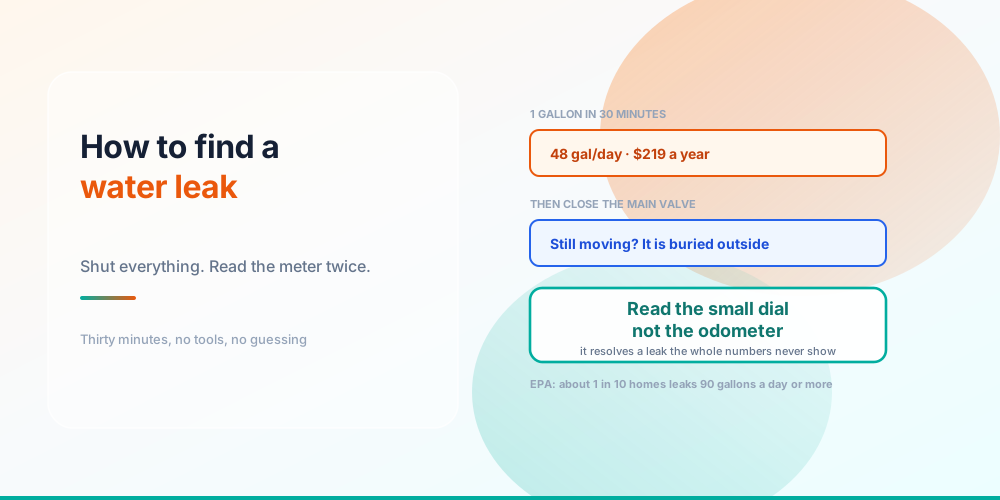
Most advice about finding a water leak stops at “check the meter”. That is the right first move and it is only half a method, because a moving dial tells you a leak exists without telling you how big it is or where it is. Both of those are answerable in about an hour with no tools.
The meter test, with the arithmetic finished
The meter test, turned into an answer
Shut every fixture in the building — taps, the ice maker, the irrigation timer, the washing machine — then read the meter, wait thirty minutes, and read it again.
Anything that moved is a leak, and it converts straight to money:
- 0.1 gallon in 30 minutes — 4.8 gallons a day — $22 a year
- 0.5 gallon — 24 gallons a day — $110 a year
- 1 gallon — 48 gallons a day — $219 a year
- 2 gallons — 96 gallons a day — $438 a year
- 5 gallons — 240 gallons a day — $1,095 a year
Two details matter more than the rest.
Read the small dial, not the odometer. Most residential meters have a sweep hand or a low-flow indicator that resolves hundredths of a gallon. The whole-number digits will not budge for a leak worth $200 a year. The small dial shows it in minutes.
Use the thirty minutes properly. Half an hour is long enough that a slow seep registers and short enough that nobody in the house forgets and flushes something. If you cannot get thirty undisturbed minutes, do it overnight and divide accordingly — the arithmetic is the same, just against a longer interval.
Three methods, three different questions
Three methods, three different questions
The three measurements are not alternatives — they answer different questions, and you will often use two of them on the same problem.
The meter test is the only one that proves whether a leak exists at all, because it measures the whole system including everything buried and concealed. It is also the only one that cannot tell you where the water is going.
The fill test measures anything you can put a container under: a weeping stop valve, a water heater relief valve discharging, a seep at a hose bibb. Catch it for a timed interval and convert. 8 fluid ounces in 30 seconds is 180 gallons a day — $821 a year. There are 128 fluid ounces in a gallon, which is all the arithmetic involved.
The drip count covers leaks too small to catch usefully in a jug. Count drips against a watch for a minute. 60 drips a minute is 5.71 gallons a day — $26 a year, and it takes 15,140 drips to make a gallon, which works out at a quarter of a millilitre a drop.
Then split the answer in two
Three steps, then a fork that decides everything
Once the meter says there is a leak, close the main shutoff valve where the supply enters the house and repeat the reading. This is the single most useful thing you can do, because it splits the problem in half.
The meter still moves — the leak is between the meter and the house, in the buried service line. Look for grass that is greener or growing faster in a line, a soft or sunken patch, water surfacing at a kerb, or in cold weather a spot that thaws before everything else. This is the expensive outcome and usually the homeowner’s responsibility from the meter onward, though where that boundary sits is a local rule.
The meter stops — the leak is inside. Work in order of probability:
- Toilets first, always. They are the largest and most common household leak, and they are silent when the flapper is the fault. Dye the tank and wait — the whole procedure is in toilet keeps running.
- The water heater — a temperature and pressure relief valve that is discharging, or an expansion tank that has lost its charge. A relief valve dribbling into a drain is invisible and continuous.
- Appliance connections — washing machine and dishwasher supply fittings, and the tail of an ice-maker line, which are the classic slow seeps behind a cabinet.
- Under-sink stops and supply lines, which weep at the packing rather than the joint.
EPA WaterSense reckons around a tenth of US homes are leaking 90 gallons a day or more — about $411 a year — which is enough to make this test worth running once even with no symptom at all.
Put your own numbers in
Rates vary hugely between utilities and the figures above use $5.50 per 1,000 gallons for water and $7.00 for sewer. Sewer usually matters more than people expect, because most US utilities bill it on metered water rather than measured discharge — so a leak is charged twice.
Convert your own meter reading, jug test or drip count into gallons and dollars at your own rates. If the leak turns out to be on the buried service line, how much does it cost to repipe a house covers what that class of work involves.
Frequently asked questions
How do I find a water leak with my water meter?
Turn off every water-using fixture and appliance, note the meter reading, wait thirty minutes without using any water, and read it again. Any movement is a leak. Read the small sweep dial or low-flow indicator rather than the whole-number digits — a leak worth $200 a year will not move the odometer but will move the small dial visibly.
How do I know if the leak is inside or outside the house?
Close the main shutoff valve where the supply enters the building, then repeat the meter test. If the meter still moves, the leak is in the buried service line between the meter and the house. If it stops, the leak is inside, and you should start with the toilets.
How much water does a small leak waste?
More than it looks. One gallon registered in thirty minutes is 48 gallons a day — 17,520 a year, about $219. Even a tenth of a gallon in thirty minutes, which is a dial you would call barely moving, runs to 4.8 gallons a day and $22 a year.
What is the most common hidden water leak?
A toilet, by a wide margin. A flapper that no longer seals passes water silently into the bowl at around 200 gallons a day — roughly $913 a year — with no sound and no visible movement. It is found with food colouring in the tank, not by looking.
Why is my water bill high with no visible leak?
Because the two largest household leaks are both invisible: a silent toilet flapper inside the house, and a service-line seep underground. Neither makes a noise or a puddle. The meter test finds both, and closing the main shutoff tells you which one you have.
Can I do a fill test instead of a meter test?
Only for a leak you can physically catch. A fill test measures what a container collects over a timed interval — 8 ounces in 30 seconds is 180 gallons a day — so it is ideal for a relief valve or a weeping stop, and useless for anything concealed. Use the meter test to prove a leak exists and a fill test to quantify one you have already found.
How many drips per minute is a real problem?
It is a real cost sooner than people expect, though it is never the biggest leak in a house. 60 drips a minute is 5.71 gallons a day and about $26 a year; 180 drips a minute is roughly $78. Worth fixing, but if your bill has jumped, the drip is not the explanation — check the toilets.
Does a leak get charged on the sewer bill as well?
At most US utilities, yes. Sewer is billed on metered water rather than on what reaches the plant, so leaked water is charged twice. On the rates used here sewer is the larger of the two lines. Some utilities will grant a one-off leak adjustment once a repair is documented — it is always worth asking.
Do I need a plumber to find a leak?
Not for the diagnosis. The meter test and the shutoff test are free, need no tools, and between them locate the leak to either “buried outside” or “inside the building”. You need a professional for the part that follows — acoustic or tracer-gas location of a buried line, or opening a slab — not for establishing that there is a leak and roughly where.
Sources & standards: The meter test, the fill test and the drip count are all straightforward volumetric conversions — 128 fluid ounces per gallon, and 15,140 drips per gallon, the latter being EPA WaterSense’s figure, which reconciles with a quarter-millilitre drop to within a fraction of a percent. The 90 gallons a day in roughly 10% of homes figure is EPA WaterSense’s own, as is the 10,000 gallons a year household estimate. Annual costs are computed at $5.50 per 1,000 gallons water and $7.00 sewer, the defaults on this site’s leak calculator; your rates will differ, and some utilities bill sewer on a winter average rather than metered volume. Typical leak rates for named fixtures are published estimates quoted for scale, not measurements — the entire point of the meter test is that a real leak is measured. Where responsibility for the service line changes from the utility to the property owner is a local rule, commonly at the meter but not universally; confirm with your utility before commissioning a repair.