
Toilet Keeps Running? What It Costs and How to Find the Cause
- 06 Sep, 2026
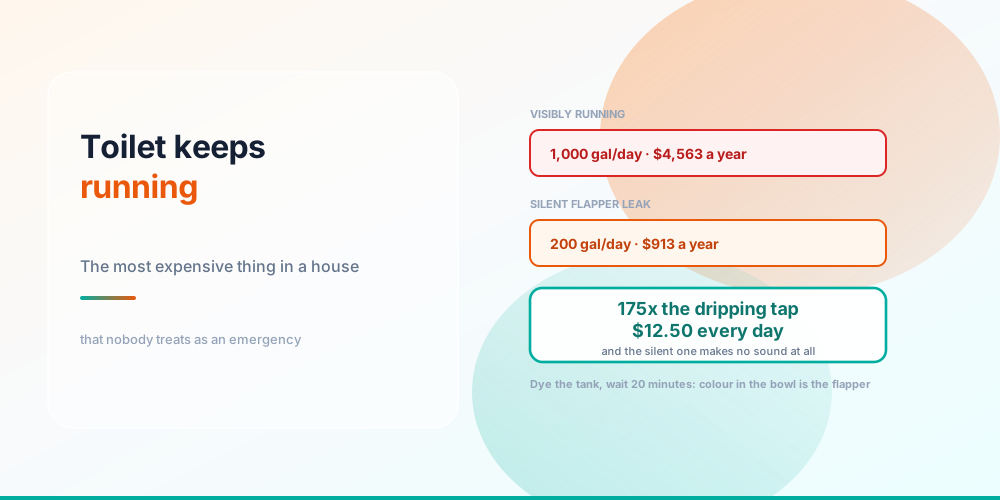
A running toilet is the most expensive thing in a house that nobody treats as an emergency. A dripping tap gets a bowl put under it the same evening. A toilet that refills itself every few minutes gets ignored for months, and it is roughly 175 times more expensive.
It is the top of the leak ladder, not the bottom
The two toilet failures own the top of the ladder
At $5.50 per 1,000 gallons for water and $7.00 for sewer — ordinary US rates, and the defaults on this site’s leak calculator — a visibly running toilet at 1,000 gallons a day costs $4,563 a year. That is $12.50 every day.
The dripping tap everybody photographs costs $26 a year.
The reason is not that toilets are special. It is that volume is volume, and a toilet failure passes water at a rate a tap physically cannot. A drip is measured in millilitres; a flush valve held open is a 3-inch opening with the full tank pressure behind it.
And the sewer charge is the part people miss. Most US utilities bill sewer on metered water, not on what actually reaches the treatment plant, so a leak is billed twice before anything else happens. On these rates sewer is the larger of the two lines.
The silent version is the one that gets you
There are two distinct failures and only one of them makes a noise.
A silent flapper leak passes about 200 gallons a day — $913 a year — with no sound at all. Nothing hisses, nothing runs, the bowl looks still. The only outward sign is a fill valve that clicks on every twenty minutes or so, which most people never notice, and a water bill that has quietly moved up a band.
A visibly running toilet is five times worse but announces itself, which is why it usually gets fixed.
Same fault, twenty times the bill
The framing that lands hardest: EPA WaterSense puts household leaks at around 10,000 gallons a year for a home that has them, and reckons about 10% of homes are leaking 90 gallons a day or more — itself $411 a year.
A visibly running toilet gets through that entire annual household figure in ten days. A silent flapper takes 50 days. The dripping tap takes 1,754 days, which is very nearly five years.
Three parts fail, and one test separates them
Three parts fail, and one test separates them
The dye test is the whole diagnostic. Put a few drops of food colouring in the tank, and do not flush for twenty minutes.
- Colour appears in the bowl — water is passing the flapper. That is the flush valve seal, and it is the most common failure by a wide margin.
- Bowl stays clear — the water is going down the overflow tube instead, which means the fill valve or the float, not the flapper.
That single test saves you from the standard mistake, which is replacing the whole fill valve assembly when a $5 flapper was the fault.
Once you know it is the flapper: they fail because the rubber hardens and the seat gets mineral scale. Both are consumables. In-tank cleaning tablets, particularly the chlorine ones, chew through flappers noticeably faster, which is a good reason not to use them.
If the bowl stayed clear, look at the water level. It should sit about an inch below the top of the overflow tube. Higher than that and the tank quietly decants down the overflow forever. Lowering the float fixes it, and costs nothing.
If it never stops filling at all, lift the float by hand. If the water stops, the float or its linkage is the fault; if it keeps running, the fill valve itself needs rebuilding or replacing.
Put a number on your own toilet
The rates above are defaults, and yours will differ — water and sewer charges vary enormously between utilities, and some places bill sewer on winter averages rather than metered volume, which changes the arithmetic.
Measure rather than guess. Work out what your own leak is costing with your own rates, and if you are not yet sure the toilet is the culprit, how to find a water leak covers the meter test that finds it without opening anything.
Frequently asked questions
How much water does a running toilet waste?
About 1,000 gallons a day when it is visibly running, and around 200 gallons a day for a silent flapper leak. On $5.50 water and $7.00 sewer per 1,000 gallons that is $4,563 and $913 a year respectively. The rate depends on how far the flapper is off its seat, so a weeping seal might be only 50 gallons a day — still $228 a year.
Why does my toilet run for a few seconds every so often?
Because water is escaping the tank slowly, the level falls, and the fill valve switches on to top it up. That intermittent refill is the classic signature of a flapper leak — the leak is silent and the refill is the only thing you hear. Confirm it with dye in the tank.
How do I know if it is the flapper or the fill valve?
Food colouring in the tank, then wait twenty minutes without flushing. Colour in the bowl means the flapper is passing water. A clear bowl means the water is leaving down the overflow tube, which points at the fill valve or a float set too high.
Is a running toilet an emergency?
Not in the sense of causing damage — the water goes down the drain rather than into the building. But it is the most expensive non-emergency in the house at $12.50 a day, so it is worth the twenty minutes it takes to diagnose rather than leaving it for a weekend that never comes.
Can a running toilet raise my water bill that much?
Yes, and it is the single most common explanation for a bill that suddenly doubles. A visibly running toilet adds roughly $380 a month. A silent flapper adds about $76 a month, which is small enough to be mistaken for a rate rise and large enough to matter over a year.
How much does it cost to fix a running toilet?
The parts are cheap: a flapper is a few dollars, a complete fill valve is usually under $25, and both are homeowner-serviceable with no tools beyond a sponge. If you call someone out, you are paying for the visit rather than the part — see plumber hourly rate for what that hour actually costs a contractor to supply.
Why do toilet flappers keep failing?
The rubber hardens with age and the flush-valve seat accumulates mineral scale, so the seal stops mating. Both are normal wear. In-tank chlorine cleaning tablets accelerate it considerably — they sit in the tank degrading the same rubber they share the water with, which is why many manufacturers void warranties when they are used.
Does sewer get charged on a leak too?
At most US utilities, yes. Sewer is billed on metered water rather than measured discharge, so every leaked gallon is charged twice. On the rates used here sewer is the bigger of the two charges — $7.00 against $5.50 per 1,000 gallons — which is why the totals surprise people who only counted water.
Will a running toilet stop on its own?
Sometimes, briefly. A flapper that is caught on a chain or debris may reseat itself, which is exactly why intermittent running gets dismissed. A hardened flapper or a scaled seat will not recover, and the leak will get worse as the seal degrades further.
Sources & standards: Leak flow rates are the ranges published by EPA WaterSense and utility conservation programmes — tier 3 figures quoted for scale, not measurements of your fixture, and every one is an editable input on this site’s leak calculator rather than an answer. The 10,000 gallons a year household figure and the 10% of homes leaking 90 gallons a day statistic are EPA WaterSense’s own. Annual costs are computed on $5.50 per 1,000 gallons water and $7.00 sewer, which are ordinary US rates and the calculator’s defaults; your rates will differ, and some utilities bill sewer on a winter average rather than metered volume, which changes the result materially. Nothing here is a code question — a leaking flapper is a maintenance item, not an IPC matter — but note that maximum flush volumes for new fixtures are set federally at 1.6 gallons per flush and locally in some jurisdictions. A real leak is measured, not looked up.