
How Much Does It Cost to Repipe a House? The Variable Nobody Quotes
- 01 Sep, 2026
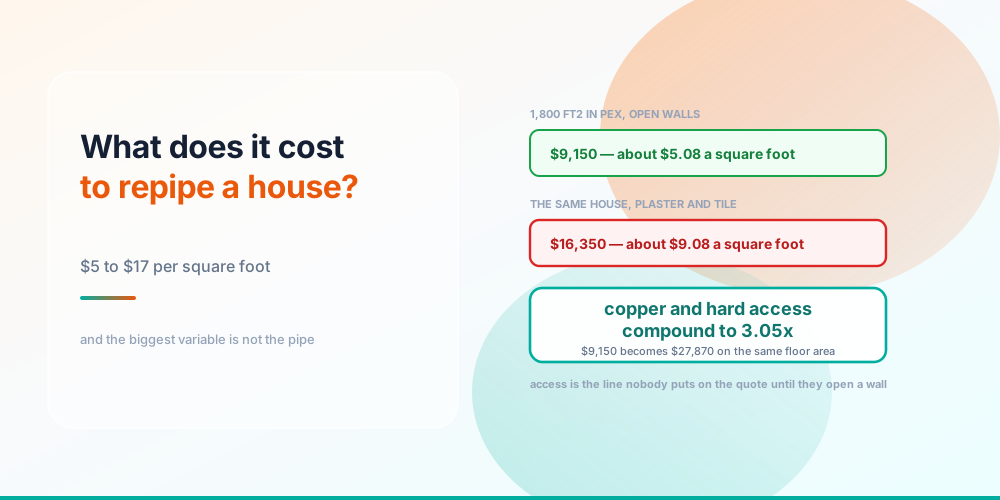
Roughly $5 to $17 per square foot, which on an 1,800 ft² house is about $9,000 to $30,000.
That is an unhelpfully wide band, and the width is the interesting part. Two houses of identical size, repiped to the same standard, can be three times apart — and the variable driving most of that spread is not the one people ask about.
The baseline
An 1,800 ft² single-storey house, two bathrooms, PEX, ordinary drywall access, $450 permit and $1,500 of drywall repair:
Base            1,800 ft2 x $5/ft2   =  $9,000
Access factor   average, x1.0        =  $9,000
Permit + repair                      = +$1,950
                                       -------
Total                                  $10,950   =  $6.08/ft2
Band: $9,308 to $12,592. That is the number a straightforward job lands on, and the Repipe Cost Calculator will move it for your own inputs.
The variable nobody quotes: access
Wall access on an 1,800 ft2 PEX repipe
- Open walls, crawlspace or basement — $9,150, about $5.08/ft²
- Ordinary drywall, some fishing — $10,950, about $6.08/ft²
- Plaster, tile, slab or finished ceilings — $16,350, about $9.08/ft²
A 79% swing with nothing changed but what is in front of the pipe.
This is the line that gets left off phone quotes, because you cannot assess it over the phone. Plaster and lath does not take a hole saw kindly and does not patch invisibly. Tiled bathroom walls mean either matching discontinued tile or re-tiling a room. Finished basement ceilings mean the drywall repair line doubles. A slab means the run goes overhead through the attic and back down, which is more pipe, more penetrations and more repair.
If a quote arrived without anyone walking the house, access was assumed. Ask which assumption.
Material moves less than you would think
Pipe material on the same 1,800 ft2 house
- PEX — $10,950 ($6.08/ft²)
- CPVC — $12,750 ($7.08/ft²)
- Copper Type L — $18,150 ($10.08/ft²)
Copper is a $7,200 premium — substantial, but the ratio is smaller than the material prices alone suggest, because labour, permit and drywall repair are the same in every case.
On the merits: PEX installs faster with far fewer joints, tolerates a freeze better, and is the default for good reasons. Copper is rigid, UV-stable, has a longer track record and is preferred by some buyers at resale. It is also more sensitive to water chemistry and to high velocity — see what size water line do I need for why erosion-corrosion sets a 5 ft/s limit on the hot side.
One design note that catches people substituting one for the other: PEX usually needs a size up on copper. A nominal 1 inch PEX tube bores 0.875 inches against copper Type L’s 1.025, and friction goes as diameter to the 4.87 power. Repiping a copper house in PEX at the same nominal sizes quietly downgrades it — PEX vs copper vs CPVC works through all three materials.
The levers compound
Material and access compound — they do not add
PEX in open walls: $9,150. Copper behind plaster and tile: $27,870. Same floor area, same fixture count, 3.05× apart.
Access is applied as a multiplier on the base cost, so it scales the material choice rather than adding to it. Choose the expensive pipe and the hard house and you pay the premium on the premium. Either one alone is a manageable increase; together they are a different project.
What else moves the number
Storeys. A second storey adds about 15% — more vertical runs, more drops, more repair on two levels.
Bathrooms. Beyond two, roughly $750 each. Bathrooms are where the fixture density is.
Region. Labour rates swing the total on a ladder from about 0.85 to 1.5 against national average. On the base job that is roughly $9,300 to $16,400 for identical work.
Floor area, non-linearly. Per-square-foot cost falls as the house grows, because permit and repair are largely fixed: 1,000 ft² runs about $6.95/ft², 1,800 ft² about $6.08, and 3,500 ft² about $5.56. Small houses look expensive per foot.
What it should include
Get these itemised, because their absence is how a low quote gets to be low:
- Every supply line replaced, main to fixture — not just the visible or the failing ones
- New angle stops and supply connectors at each fixture
- Permit and inspection
- Drywall repair to a defined standard — patched and ready for paint, or patched and painted, are different prices
- Water heater reconnection, and an expansion tank if the system is closed
- Pressure test and a written warranty
Two that are frequently excluded and worth confirming: painting beyond the patch, and tile replacement where a wall had to be opened.
When a repipe is actually warranted
Polybutylene. Grey or blue-grey flexible pipe with acetal fittings, installed roughly 1978 to 1996. It fails from the inside and the failure is not visible before it happens. This is the clearest case for replacement rather than repair.
Galvanised steel. Corrodes internally over decades, closing the bore. Because friction goes as diameter to the 4.87 power, the pressure loss climbs sharply once the bore starts closing — which is why a galvanised house feels fine for years and then feels bad quickly. Rusty water at first draw and poor flow with good static pressure are the signature; see normal water pressure for a house for the static-versus-flowing test that distinguishes it.
Repeated pinhole leaks in copper. Three in a year is a system-wide problem — water chemistry or velocity — not three unrelated events.
One thing to rule out before spending any of this, though: a water bill that has jumped is far more often a single leaking fixture than failing pipework. Prove it with the meter test in how to find a water leak — thirty minutes and no tools — and start with the toilets, because a silent flapper passes 200 gallons a day and a running toilet passes a thousand.
A major remodel with walls already open. Access is the multiplier. Repiping while the walls are open captures the cheapest version of the job that will ever be available on that house.
If you are the one quoting it
Everything above is the customer’s side of the number. The contractor’s side is a build-up: hours at a loaded rate, plus fixtures and materials, plus overhead, and then a margin applied by division rather than multiplication — how to estimate plumbing jobs covers why a 25% markup only delivers a 20% margin. The loaded rate itself is the other half, and it is mostly the hours nobody buys: plumber hourly rate shows how a $32 wage becomes a $117 bill rate.
And if you are the one pricing it, there is one operator worth checking before anything else: markup vs margin for plumbers shows why a 25% markup delivers a 20% margin, and what that difference comes to across a year of ordinary work.
Frequently asked questions
How much does it cost to repipe a house?
About $5 to $17 per square foot. An 1,800 ft² house in PEX with ordinary access runs about $10,950, or $6.08/ft². Open walls bring it to $9,150; copper behind plaster and tile takes it to $27,870. Run your own with the Repipe Cost Calculator.
Is PEX or copper better for a repipe?
PEX for most jobs — faster to install, fewer joints, better freeze tolerance, and about $7,200 cheaper on an 1,800 ft² house. Copper is rigid, UV-stable and preferred by some buyers at resale. If you substitute PEX for copper, go up a nominal size on mains and long branches, because PEX bores smaller at the same nominal size.
Why are repipe quotes so different?
Usually access, which is a multiplier and cannot be assessed over the phone. Open walls against plaster and tile is a 79% swing on the same house. The second cause is scope: whether drywall repair, painting, permit, angle stops and an expansion tank are in or out.
How long does a repipe take?
Typically two to five days of plumbing on an average single-family house, plus drywall repair and painting after. Hard access, multiple storeys and slab routing extend it. Water is usually off for part of each day rather than the whole period.
Do I need to repipe polybutylene?
Yes, in practice. Polybutylene — grey or blue-grey flexible pipe installed roughly 1978 to 1996 — degrades internally and fails without visible warning. Insurers and buyers both treat it as a defect, and it is the clearest case in the category for full replacement rather than repair.
Does a repipe include drywall repair?
It should, but confirm to what standard. “Patched and ready for paint” and “patched and painted” are different prices, and painting beyond the patch is commonly excluded. Tile replacement where a wall had to be opened is almost always separate.
Can I repipe just part of a house?
You can, and it is sometimes right — a single failing branch, or a bathroom already being remodelled. But if the cause is systemic (galvanised corrosion, polybutylene, aggressive water chemistry) partial work leaves the rest to fail later, and you pay the access multiplier twice.
Is a repipe worth doing during a remodel?
Almost always, if the walls are coming open anyway. Access is applied as a multiplier on the whole job, so repiping while walls are open captures the cheapest version of that work the house will ever offer — roughly $9,150 against $16,350 on the example here.
Sources & standards: cost figures are 2026 US national-average retail assumptions carried in the same model the Repipe Cost Calculator uses, with a ±15% band and regional multipliers on a 0.85 / 1.00 / 1.25 / 1.50 ladder. These are market assumptions, not code requirements, and are the figures here most likely to move. Material and sizing guidance follows IPC 2021 Chapter 6; pipe dimensions follow ASTM B88 (copper) and F876 (PEX). Permit requirements and inspection scope are set locally — confirm with your AHJ, and get itemised quotes from licensed plumbers before committing.