
Water Hammer: Why Pipes Bang, and What Actually Fixes It
- 06 Sep, 2026
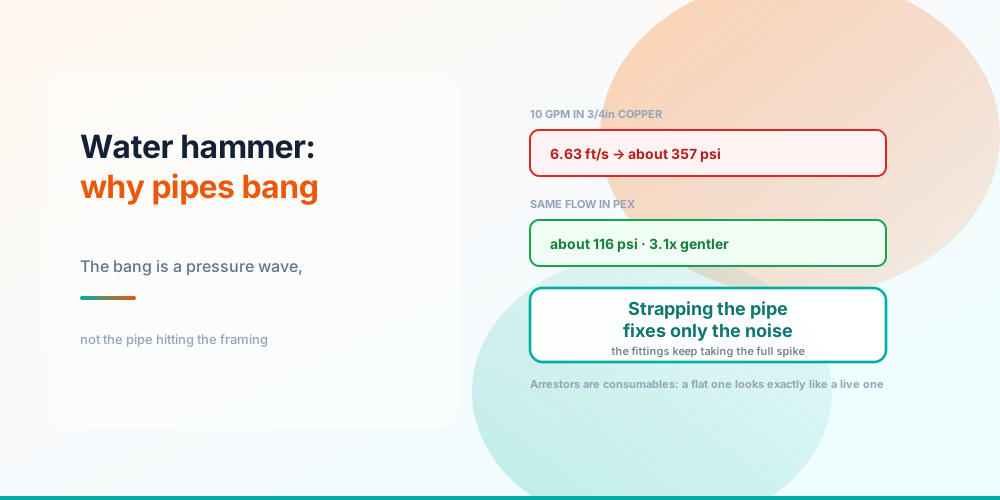
The bang when a washing machine shuts its inlet valve is not the pipe hitting the framing. That is the noise it makes afterwards. The bang is a pressure wave, and it is very much larger than most people assume.
The spike is the velocity, converted
The spike is the velocity, converted
When a valve closes instantly, the moving column of water has nowhere to go, and its momentum converts into pressure. The classical result is Joukowsky’s: the surge head is the pipe’s pressure-wave speed multiplied by the change in velocity, divided by gravity.
In 3/4-inch Type L copper — 0.785-inch bore — at 10 gpm the water is moving 6.63 ft/s, and slamming a valve on it produces a spike of about 357 psi.
That is not a rounding error on a 60 psi system. It is roughly six times the static pressure, arriving in milliseconds, and it is why hammer breaks things: pinholes at elbows, loosened solder joints, failed washing-machine hoses, and eventually a water heater relief valve that starts weeping because it has been lifted a few thousand times.
The material sets the conversion. The same 10 gpm gives:
- Copper, rigid — about 357 psi
- CPVC — about 196 psi
- PEX, flexible — about 116 psi
That last figure is 3.1 times gentler than copper, and it is the honest reason PEX systems rarely hammer. The pipe wall gives a little, the wave speed drops, and the spike drops with it. It is not that PEX is quieter — it is that the physics is different.
So it is a velocity problem
Hammer is a velocity problem, so the fix is a sizing table
Since the surge is proportional to velocity, the design limits the trade already uses for erosion are the same limits that keep hammer survivable: 8 ft/s cold, 5 ft/s hot.
At those limits, Type L copper carries:
- 1/2” — 5.82 gpm cold, 3.64 hot
- 3/4” — 12.07 gpm cold, 7.54 hot
- 1” — 20.58 gpm cold, 12.86 hot
- 1-1/4” — 31.34 gpm cold, 19.59 hot
- 1-1/2” — 44.36 gpm cold, 27.72 hot
The hot figure is 62.5% of the cold one at every size, because hot water erodes copper faster and the limit is tighter.
The practical consequence: a house that hammers is very often a house with an undersized branch. Push 10 gpm through a 1/2-inch line and the water is doing 13.75 ft/s — well over the limit — and the surge on a slam is around 741 psi. Going up one size to 3/4-inch drops it to 357, a 52% reduction from nothing but bore. Check your own numbers with the Pipe Velocity Calculator.
What actually fixes it
Three of these fix the surge. One only fixes the noise.
A water hammer arrestor is the real fix when the cause is a fast-closing valve you cannot slow down — a washing machine or dishwasher solenoid, or an irrigation zone valve. It is a sealed piston-and-gas chamber listed to ASSE 1010, and it needs to be within a few feet of the offending valve, because it can only absorb a wave it actually meets. One fitted at the water heater does nothing for a solenoid two floors up.
Note that arrestors are consumables. The gas charge escapes slowly over years, and a dead arrestor looks exactly like a live one from the outside. A system that stopped hammering and then started again years later usually has a flat arrestor, not a new fault.
The old air chambers — a capped vertical stub of pipe above a fixture — worked on the same principle and fail for a worse reason: the air dissolves into the water and the chamber fills. Then it is just a dead leg holding stagnant water, which is a water-quality problem rather than a cushion. If you find them, they are not maintainable; replace with proper arrestors.
A pressure-reducing valve is not a hammer fix, but it helps, because the surge adds to whatever the system already sits at. Over 80 psi static the code wants a PRV anyway, and lower static pressure also means lower velocity through the same fixture opening. Whether you need one is covered in do I need a pressure reducing valve.
Strapping the pipe deserves its own warning. Securing a loose run absolutely stops the banging, and it changes the pressure wave not at all. You have silenced the symptom while the fittings keep taking the full 357 psi. Do it — just do not stop there.
The one that is not hammer
If the noise is a sustained shudder or squeal rather than a single bang, that is not water hammer. It is usually a failing fill valve or a worn tap washer chattering, or a PRV hunting. Hammer is a discrete percussive event at the moment a valve closes. If the noise lasts as long as the water runs, look for a vibrating component instead — and if the noise arrives with a toilet refilling, toilet keeps running is the more likely explanation.
Frequently asked questions
What causes water hammer?
A valve closing faster than the water column can decelerate. The momentum of the moving water converts into a pressure wave — in 3/4-inch copper at 10 gpm, a spike of around 357 psi. Appliance solenoid valves are the usual culprits because they close in milliseconds, far faster than any hand-operated tap.
Is water hammer dangerous?
It is damaging rather than immediately dangerous. Repeated spikes of several hundred psi loosen joints, work-harden copper at elbows until pinholes form, fail flexible appliance hoses, and lift water heater relief valves until they weep. Nothing fails on the first bang; things fail after a few thousand.
Why does PEX not hammer like copper?
Because the surge depends on the pipe’s pressure-wave speed, and a flexible wall gives slightly under the wave. At the same 10 gpm, copper produces about 357 psi and PEX about 116 psi — roughly a third. PEX systems do still hammer if the velocity is high enough, just far less violently.
Do water hammer arrestors work?
Yes, when fitted close to the valve causing the problem — within a few feet. An arrestor gives the decelerating column somewhere to go. One installed at the water heater or the main does nothing for a washing machine solenoid on another floor, which is the most common installation mistake.
Do water hammer arrestors need replacing?
Yes. They hold a gas charge behind a piston and that charge escapes slowly over years, after which the arrestor is inert. A dead arrestor is visually identical to a working one, so a system that stopped hammering and later started again should be assumed to have a flat arrestor before anything else is investigated.
Will strapping my pipes fix water hammer?
It will fix the noise. Securing a loose run stops it striking the framing, which is what you actually hear. The pressure wave is unchanged, so the fittings keep taking the load. Strapping is worth doing and is never a complete fix on its own.
Can high water pressure cause banging pipes?
It contributes, because the surge adds to the static pressure the system already sits at, and higher static pressure drives higher velocity through the same opening. Over 80 psi static a pressure-reducing valve is required in most jurisdictions regardless, so if you are hammering and reading 90 psi, fit the PRV first.
What velocity is too fast for a water pipe?
8 ft/s for cold water and 5 ft/s for hot are the usual design limits — the hot limit is tighter because hot water erodes copper faster. In 3/4-inch Type L copper those correspond to 12.07 gpm cold and 7.54 gpm hot. These are ASPE and manufacturer practice rather than an IPC number, but they are what the trade designs to.
Are the old air chambers above fixtures the same as an arrestor?
Same principle, worse execution. A capped vertical stub cushions the wave until the trapped air dissolves into the water, which it does within months to a couple of years. After that it is a dead leg full of stagnant water — a water-quality issue with no cushioning benefit. They cannot be recharged in service and should be replaced with listed arrestors.
Sources & standards: The surge calculation is the Joukowsky equation — surge head equals the pipe’s pressure-wave speed times the change in velocity, divided by gravity — computed here on the pipe dimensions this site uses throughout (ASTM B88 for copper). Wave speeds of 4,000 ft/s for rigid copper, 2,200 for CPVC and 1,300 for PEX are published values quoted for scale, not measurements; the real figure depends on wall thickness, restraint and dissolved air, and instantaneous closure is a worst case that a real valve only approaches. Treat the psi figures as the order of magnitude, which is the point. Velocity limits of 8 ft/s cold and 5 ft/s hot are ASPE and manufacturer design practice, not an IPC requirement — the code does not publish a velocity limit. Arrestors are listed to ASSE 1010. The 80 psi threshold above which a pressure-reducing valve is required is IPC 604.8, and the IPC is a model code — confirm the edition your jurisdiction adopts.