
Water Velocity in Pipes: The 8 and 5 ft/s Limits Nobody Can Cite
- 04 Sep, 2026
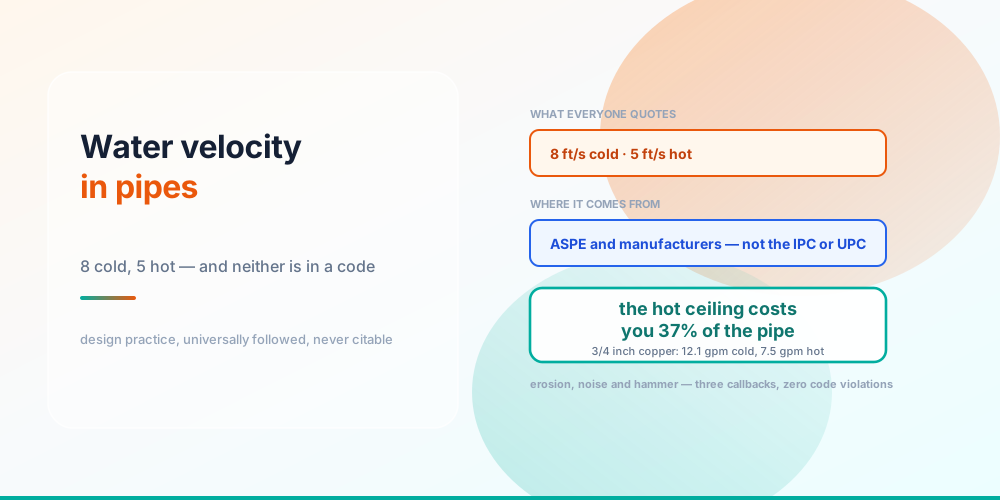
Ask any plumber the maximum velocity for water in a pipe and you will get “eight feet per second, five on the hot” without hesitation. Ask which code section says so and the conversation stops.
It is not in the IPC. It is not in the UPC. Neither model code publishes a velocity limit for water distribution. The figures are ASPE and manufacturer design practice — sound engineering, universally followed, and not a citation.
That is not a gotcha. It changes how you use them: as a design constraint you apply because you understand the failure mode, rather than a rule you point at.
Where the numbers do come from
Nobody can cite the velocity limit, because it is not in a code
The limits exist to prevent three specific things.
Erosion-corrosion. Fast water strips the protective oxide film off copper and then keeps stripping the metal underneath, usually at elbows and just downstream of them where the flow is turbulent. It shows up as pinholes with a characteristic scalloped, horseshoe-shaped pit pointing downstream. This is the reason the limit is material-specific and the reason hot water gets a lower one — heat accelerates it.
Noise. Velocity is what you hear. A line running at 10 ft/s in a stud bay is audible in the room, and it is the single most common cause of “my new bathroom is loud”.
Water hammer. The pressure surge when a quick-closing valve slams is proportional to the velocity you just stopped. Halve the velocity and you halve the surge. Dishwashers and washing machines with solenoid valves are the usual culprits, and a fast line makes them much worse.
None of those is a code violation. All of them are callbacks.
What the limits cost you
The hot ceiling costs you 37% of the pipe
At the cold ceiling, type L copper carries:
- 1/2 inch — 5.8 gpm
- 3/4 inch — 12.1 gpm
- 1 inch — 20.6 gpm
- 1-1/4 inch — 31.3 gpm
- 2 inch — 77.2 gpm
The hot column is 62.5% of the cold one at every size — exactly five eighths, because both are the same linear relationship between flow and area with a different constant. So a 3/4 inch hot line tops out at 7.5 gpm where the same pipe carries 12.1 cold.
That ratio is worth carrying around. It means a hot line effectively runs a notch smaller than the cold line beside it, which is one reason recirculation returns and long hot runs get upsized in practice.
Why the last two ft/s are the expensive ones
Speed is not free — friction climbs faster than flow does
In a 3/4 inch copper line:
- 5 ft/s — 7.54 gpm, 6.57 psi per 100 ft
- 8 ft/s — 12.07 gpm, 15.69 psi per 100 ft
- 10 ft/s — 15.09 gpm, 23.72 psi per 100 ft
Going from the hot cap to the cold cap buys 1.6 times the flow for 2.4 times the friction. That is the real argument against running pipe hard: even where erosion is not a concern, you are spending pressure you may not have. The budget arithmetic is in low water pressure in a house.
Velocity also carries a small energy term of its own — velocity head, V² over 2g. At 8 ft/s that is 0.995 ft of head and at 5 ft/s it is 0.389 ft. Small, but it is the term people leave out of pump calculations; see total dynamic head.
There is a much less small consequence of velocity, though. Stop a fast-moving column suddenly and its momentum converts into pressure — a spike of several hundred psi on a 60 psi system. That is water hammer, and it is the loudest reason to respect a velocity limit even where erosion never would have mattered.
Material changes the answer
The 8 and 5 figures are a copper convention that got generalised. Manufacturers publish their own:
Copper is the one the numbers were written for, and the one erosion-corrosion actually threatens. Some authorities go further and recommend lower limits for continuously recirculating hot lines, because those run at temperature all day.
PEX is not subject to erosion-corrosion in the same way and manufacturers generally permit higher velocities. Its problem is different: a much smaller bore for the same nominal size, so it hits any velocity limit at a lower flow. The bore comparison is in PEX vs copper vs CPVC.
CPVC and PVC are also not erosion-limited in the copper sense, but they are noisier and more brittle, and solvent-welded joints do not appreciate repeated hammer.
Check the manufacturer’s own published limit for the material you are installing — that document is at least a citation, which is more than the generic figure has.
Using it properly
Velocity is one of two constraints on a supply pipe, and they bind in different places. Velocity governs short, high-flow runs; friction governs long ones. A size that satisfies one can fail the other, which is why the Pipe Velocity Calculator and the pipe size calculator answer different questions — and why what size water line do I need works both together.
Two practical habits:
Check velocity on the branches, not just the main. A 1/2 inch branch feeding two fixtures is where the limit gets exceeded, because that is where the flow is concentrated in the smallest pipe.
Check the hot side separately. It has the lower ceiling and it usually has the longer run.
Frequently asked questions
What is the maximum water velocity in a pipe?
8 ft/s for cold water and 5 ft/s for hot is the design practice figure used almost universally. It is not published in the IPC or the UPC — it comes from ASPE guidance and manufacturer literature, and it exists to limit erosion-corrosion, noise and water hammer.
Is the 8 ft/s velocity limit in the plumbing code?
No. Neither the IPC nor the UPC publishes a velocity limit for water distribution; they address velocity indirectly through sizing methods. The figure is design practice. That does not make it optional in any meaningful sense, but it does mean there is no section number to cite.
Why is the hot water velocity limit lower?
Because heat accelerates erosion-corrosion in copper. The convention is 5 ft/s hot against 8 cold — exactly 62.5% of the cold figure, so a 3/4 inch line carries 12.1 gpm cold and only 7.5 gpm hot. Continuously recirculating hot lines are sometimes held lower still, since they run at temperature all day.
What happens if water velocity is too high?
Three things, none of them a code violation and all of them a callback. Erosion-corrosion strips copper at elbows and produces pinhole leaks. Noise — a fast line is audible through a wall. Water hammer — the surge from a quick-closing valve is proportional to the velocity it stopped.
How do I calculate water velocity in a pipe?
Flow divided by area, in consistent units: v = 0.4085 × gpm ÷ d², with d the inside diameter in inches. The inside diameter is the part people get wrong — nominal size is not bore, and PEX in particular is far smaller than its nominal size suggests.
How many gpm can a 3/4 inch pipe carry?
At the 8 ft/s cold ceiling, 12.1 gpm in type L copper — and only 7.5 gpm on the hot side at 5 ft/s. PEX of the same nominal size carries less, because its bore is smaller. Velocity is only one of the two limits, though: over a long run, friction will stop you first.
Does velocity limit apply to PEX the same way?
Not identically. PEX is not subject to copper’s erosion-corrosion mechanism and manufacturers generally allow higher velocities. Its constraint is bore — a PEX line of the same nominal size has substantially less cross-section, so it reaches any given velocity at a lower flow.
Should I size for velocity or for pressure loss?
Both, and take whichever gives the larger pipe. Velocity usually governs short high-flow runs; friction usually governs long ones. A pipe that satisfies velocity can still fail on pressure over a long developed length, which is why the two are checked separately and the answer is the larger of the two.
Sources & standards: The 8 ft/s cold and 5 ft/s hot velocity ceilings are ASPE and manufacturer design practice, not requirements of the IPC or the UPC — neither model code publishes a velocity limit for water distribution, and this page is deliberate about saying so. Erosion-corrosion thresholds are material-specific and come from manufacturer and copper-industry guidance; check the published limit for the material you are installing. Velocities and flows here are computed as v = 0.4085 × gpm ÷ d² over the ASTM B88 bore dimensions for type L copper, and friction losses use Hazen-Williams at C = 140. The code numbers shown for contrast — IPC 604.8 for the pressure reducing valve threshold, 906.2 for minimum vent size, Table 909.1 for trap arm length — are genuine IPC citations. The IPC is a model code; confirm the edition your jurisdiction adopts.