
Normal Water Pressure for a House: 40 to 60 psi, and Why Height Costs 4.33
- 01 Sep, 2026
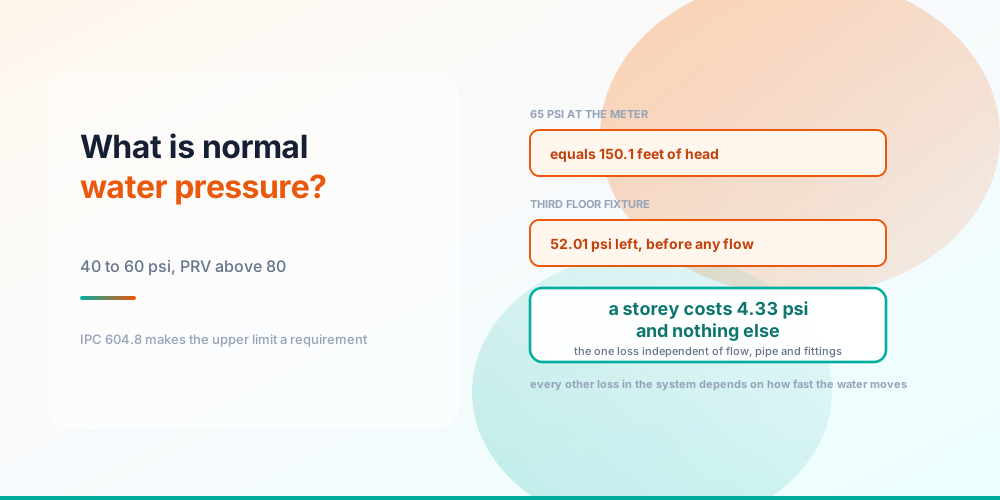
Normal is 40 to 60 psi. Below about 40 fixtures start to feel wrong; above 80 the code requires you to do something about it.
That is the short answer, and it is fine as far as it goes. The more useful thing to understand is that pressure and height are the same quantity in different clothes, and once you see that, most pressure complaints in a house explain themselves.
Pressure is height
1 foot of water  =  0.4331 psi
1 psi            =  2.309 feet of water
Sixty-five psi at your meter is a column of water 150.1 feet tall. That is the number the utility is holding up for you.
Pressure, head, and where the code draws its line
The Water Pressure Calculator converts either way and flags the PRV threshold.
Every storey costs 4.33 psi
Ten feet of building height is 4.33 psi, gone, before a drop of water moves.
What each storey costs, starting from 65 psi
Here is what makes this loss special, and it is worth stating plainly:
Elevation is the only loss in a plumbing system that is completely independent of flow.
Friction depends on how fast water is moving, which pipe material it is moving through, what diameter, how many fittings. Meter loss depends on flow. Every one of those goes away when nothing is running. Elevation does not. It is charged at full rate whether the house is asleep or every fixture is open.
That is why third-floor pressure complaints are real even when the gauge at the hose bibb reads fine. The gauge is at ground level. The fixture is 26 feet up, and 11.26 psi of the reading never gets there.
Where 60 psi actually goes
Static pressure is not what the pipe gets to spend. Several claims come off it first.
Where 60 psi goes before the pipe gets any
On an ordinary house — 60 psi at the street, the highest fixture 20 feet up, 15 psi needed at that fixture, 8 psi lost crossing the meter:
- 8 psi to the meter
- 8.66 psi to elevation
- 15 psi reserved for the fixture
28.34 psi left for friction. Spread over a 120 ft developed run, the pipe is allowed to lose 23.62 psi per 100 ft, and that is the number that sets the size. The reasoning is worked through in what size water line do I need.
Notice how little of the original 60 psi is actually available to spend on pipe. Take away another storey of height and a slightly worse meter, and the budget halves.
Too much pressure is a problem too
IPC 604.8 requires a pressure-reducing valve where static pressure exceeds 80 psi. That is a requirement, not a recommendation, and it exists because high pressure quietly destroys things:
Fixtures and appliances. Washing machine and dishwasher inlet valves, supply connectors and toilet fill valves are all rated for a pressure they can be handed more of.
Water hammer. The shock when a fast-closing valve shuts scales with velocity, and higher pressure means higher velocity through the same pipe.
Erosion-corrosion. Faster water scours the protective oxide layer off copper tube, especially at elbows and especially on the hot side. Pinhole leaks in a house with 90 psi are not a coincidence.
Waste. Every fixture flows more than it needs to. It is invisible on the meter reading until you compare it to a neighbour on a PRV.
Fitting a PRV usually also means fitting a thermal expansion tank, because a PRV contains a check valve and that makes the system closed. Heated water in a closed system has nowhere to go, and IPC 607.3 requires somewhere for it to expand into. This is the classic sequence: pressure complaint → PRV fitted → T&P relief valve starts weeping → expansion tank was the missing piece. Size it with the Thermal Expansion Tank Calculator, and note that the pre-charge matters more than the tank size — the same job needs 2.02 gallons at a 40 psi pre-charge and 8.10 at 70 psi.
Diagnosing low pressure
Test at an outside hose bibb with a $10 gauge, twice.
Static — everything off. This is the utility’s pressure minus nothing but the height of the gauge.
Flowing — with a fixture or two open. The difference between the two readings is your system’s friction and meter loss under load.
Then:
Static low, flowing low. The problem is upstream — the utility, the service line, a partly-closed main shutoff, or a clogged PRV. Check the meter valve and the main first; they are free.
Static fine, flowing collapses. The problem is inside — undersized pipe, scaled galvanised, or a partly-closed valve somewhere in the run. Old galvanised steel is the classic: the bore closes with corrosion product over decades and the loss goes as diameter to the 4.87 power, so it gets bad quickly at the end. That is usually the point at which a whole-house repipe enters the conversation.
One fixture only. Aerator, cartridge or angle stop. Not a pressure problem at all.
Only when something else runs. Undersized shared branch. The main may be fine while the branch serving both fixtures is not.
Pressure versus flow
These get conflated constantly, and the distinction is the key to most complaints.
Pressure is potential — force per unit area, measured with everything shut.
Flow is how much actually arrives, in gallons per minute.
A house can have excellent static pressure and poor flow, and that combination points squarely at pipe: too small, too long, too corroded, too many fittings. It cannot be fixed by anything that adjusts pressure, because pressure was never the constraint. Conversely a house with genuinely low static pressure will have poor flow no matter how generously it is piped.
If the gauge reads 65 static and 30 flowing, you have a pipe problem. If it reads 35 static, you have a supply problem. The full diagnostic walk-through, with the friction numbers behind each branch of it, is in low water pressure in a house.
If the supply is a well
Everything above assumes a municipal main holding a steady pressure. On a well the pressure switch and the tank set it instead, and the two ends of the band — cut-in and cut-out — are what you are actually adjusting when you chase pressure. Raising them has a cost most people are not told about: it reduces how much water the tank delivers per pump cycle, because drawdown is a ratio of absolute pressures rather than a difference. That arithmetic, and why an over-charged tank looks exactly like a dead one, is in what size well pressure tank you need — and if the pump is already starting and stopping constantly, well pump short cycling puts a number on what it is costing and names the free thing to check first.
Adding a backflow preventer or a PRV to any service — well or municipal — also turns the house into a closed system, which brings its own requirement with it: see backflow prevention explained for which assembly a given connection needs, and why installing one obliges you to deal with thermal expansion.
If the pressure is too high rather than too low
Above 80 psi the code stops leaving it to you, and fitting the valve it requires brings a second requirement along with it. Do I need a PRV works through the threshold, why the pressure above it buys you nothing at the fixtures, and why the setting you choose then triples or thirds the expansion tank.
And where pressure has to be created rather than reduced — a booster, a transfer pump, a sump — the quantity that matters is head rather than psi, and they are the same thing in different units: total dynamic head.
Frequently asked questions
What is normal water pressure for a house?
40 to 60 psi is the comfortable range. Below 40 showers and simultaneous fixture use start to feel weak; above 80 psi IPC 604.8 requires a pressure-reducing valve. Sixty-five psi — a common municipal figure — is equivalent to 150.1 feet of head.
Is 80 psi too high for water pressure?
Eighty is the code threshold: above 80 psi static, a PRV is required. At exactly 80 you are at the limit rather than over it, but most plumbers would fit one anyway, because high pressure shortens the life of supply connectors, fill valves and appliance inlets and accelerates erosion-corrosion in copper.
How much pressure do I lose per floor?
4.33 psi per 10 feet of height, at 0.4331 psi per foot. A second-floor fixture starts about 4.33 psi down on the ground floor, a third-floor fixture about 8.66 psi down. It is the one loss in the system that does not depend on flow at all.
Why is my water pressure low upstairs?
Height, plus whatever friction the run adds on top. A third-floor fixture is already 8 to 13 psi down before water moves. If the main is also undersized, the upstairs fixtures are where it shows first, because they have the least margin left.
How do I test my water pressure?
A screw-on gauge at an outside hose bibb, read twice: static with everything off, and flowing with a couple of fixtures open. Static tells you what the utility delivers; the gap between the two tells you what your own pipe and meter are costing under load.
Do I need a pressure reducing valve?
If static pressure exceeds 80 psi, yes — IPC 604.8 requires one. Expect to fit a thermal expansion tank at the same time, because a PRV contains a check valve and that makes the system closed, which triggers IPC 607.3.
Why does my relief valve keep dripping after fitting a PRV?
Because the PRV closed the system and there is no expansion tank. Water expands about 1.71% heating from 40 °F to 140 °F, and in a closed system that expansion has nowhere to go except out through the T&P valve. Fit a correctly pre-charged expansion tank and the weeping stops.
What is the difference between water pressure and water flow?
Pressure is potential force, measured static. Flow is gallons per minute actually delivered. Good pressure with poor flow means the pipe is the constraint — undersized, corroded, or too long — and no pressure adjustment will fix it.
Sources & standards: IPC 2021 Section 604.8 (maximum water pressure and pressure-reducing valves), Section 604.6, and Section 607.3 (thermal expansion control on closed systems). The 0.4331 psi per foot conversion derives from water density at 60 °F; the fixture pressure requirements used in the budget example follow common IPC minimums. Figures here are computed from the same model the calculators use. The IPC is a model code — roughly fifteen states enforce the UPC or a derivative such as California’s CPC. Confirm the edition your jurisdiction adopts, and have a licensed plumber sign off anything installed.