
Perc Tests and Leach Field Sizing: A 5x Swing From the Ground Alone
- 05 Sep, 2026
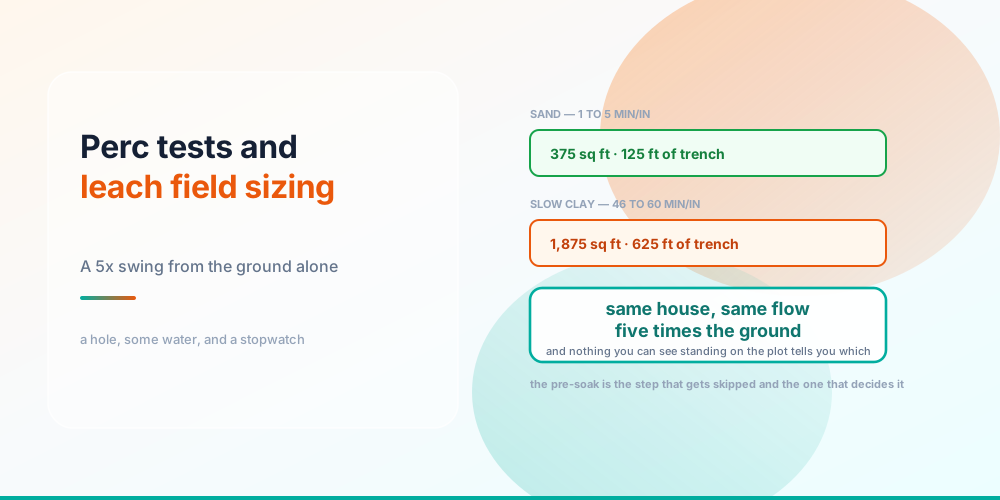
A percolation test is a hole in the ground, some water, and a stopwatch. It is also the single most consequential measurement on a rural building plot, because it can make a piece of land buildable or not — and nothing you can see standing on it tells you the answer.
The same three-bedroom house needs 375 square feet of leach field on sand and 1,875 on slow clay. Same house, same flow, same everything except what is under it.
What the ground does to the number
The ground decides, and it decides by a factor of five
- Sand or sandy loam, 1 to 5 min/in — absorbs 1.2 gal/sq ft/day — 375 sq ft, 125 ft of trench
- Loam, 6 to 15 — 0.8 — 563 sq ft, 188 ft
- Silt loam, 16 to 30 — 0.45 — 1,000 sq ft, 333 ft
- Clay loam, 31 to 45 — 0.36 — 1,250 sq ft, 417 ft
- Slow clay, 46 to 60 — 0.24 — 1,875 sq ft, 625 ft of trench
125 feet of trench against 625. That is the difference between a corner of a garden and a serious earthworks contract, and it is decided entirely by what a soil scientist finds in a hole.
Note what the test does not affect: the tank. That is sized from bedroom count and retention time, and the two calculations never meet — what size septic tank do I need covers both paths, and the Septic Tank Calculator runs them.
What the test actually is
Five steps, and one of them decides the answer
Dig several holes, spread across the proposed field area, at roughly the depth the trenches will sit. One hole is not a test — soil varies over tens of feet, which is the whole reason for doing this rather than asking the neighbour.
Scratch the sides. Digging smears and seals the bore, especially in clay. An unscratched hole reads slower than the soil actually is.
Pre-soak. Keep the holes full for hours, sometimes overnight. This is the step that gets skipped and the step that decides the answer — dry soil drinks fast, and a test on dry ground flatters the result badly. A field sized on a flattered number fails.
Measure the drop. Refill to a set depth and time how long the level falls one inch.
Convert. Minutes per inch becomes gallons per square foot per day via the jurisdiction’s own table.
Two honest caveats. The procedure is not uniform — hole diameter, pre-soak duration, number of readings and the conversion table all vary by health department. And many jurisdictions have moved away from perc testing entirely toward soil morphology: a licensed evaluator digs a pit, reads the horizons, texture and mottling, and assigns a loading rate from what the soil is rather than from how fast water leaves a hole. Where that applies, the perc test is not the test.
Turning area into trench
Area is the requirement. Trench length is just how you deliver it.
The soil result gives you an area. How you deliver it is a layout question:
- 2 ft wide trenches — 281 ft of run
- 3 ft wide — 188 ft
- 4 ft wide — 141 ft
Same 563 square feet in every case. Wider trenches mean a shorter run, which matters when the available ground is long and thin, or short and wide.
And the area itself scales with the house: 2 bedrooms is 375 sq ft on loam, 5 bedrooms is 938.
Then double it. Most jurisdictions require a reserve area — a second, equally sized, undisturbed piece of ground held for the replacement field the system will eventually need. On slow clay that means finding room for 1,875 square feet twice, before setbacks to the well, the property line, surface water and the foundation come off.
That combination — a poor perc result and a reserve requirement — is what makes plots unbuildable far more often than the primary field alone.
When the ground fails
A slow result is not automatically the end, but it moves you into a different budget.
Mound systems build the absorption area above grade in imported sand fill, used where the water table is high or bedrock is shallow.
Sand filters treat effluent before it reaches a smaller field.
Aerobic treatment units produce a cleaner effluent that some jurisdictions allow onto a reduced field.
Drip dispersal distributes at low rate over a wide area, which suits difficult ground and needs a pump and maintenance.
All of them cost multiples of conventional trenches, and all of them carry a maintenance obligation that a gravity trench field does not.
Very fast is also a failure. Soil that percs in under a minute per inch does not filter — effluent reaches groundwater essentially untreated. Most jurisdictions set a lower limit as well as an upper one, and pure sand or fractured rock can fail for being too permeable.
If you are buying land
Make the offer contingent on a passing perc test, and do the test before closing rather than after. It is the one plumbing measurement that can determine whether a plot is worth anything.
Test in the wet season. A test run in August on ground that sits over a winter water table produces a permit and then a failure.
Ask how long the result is valid. Many jurisdictions expire perc results after a period, so an old report attached to a listing may be worth nothing.
Check for a reserve area on the plan, not just a primary field. A design that exactly fits the buildable ground usually cannot be permitted.
Frequently asked questions
What is a perc test?
A percolation test: holes are dug in the proposed leach field area, pre-soaked, then refilled and timed as the water level drops. The result is expressed in minutes per inch, which converts to a soil loading rate in gallons per square foot per day — the number that sizes the field.
How big does a leach field need to be?
Daily flow divided by the soil loading rate. For a three-bedroom house at 450 gallons per day, that is 375 square feet on sand and 1,875 on slow clay — a five-fold range decided by the ground alone. Then most jurisdictions require an equally sized reserve area on top.
What is a good perc rate?
Broadly, 1 to 60 minutes per inch is the workable band, with the middle of it the easiest to design for. Faster than about a minute per inch can fail for not filtering the effluent at all; slower than roughly 60 usually means conventional trenches are not permitted and an engineered system is needed.
Why does the pre-soak matter so much?
Because dry soil drinks. A test run on unsaturated ground reads far faster than the soil actually performs under continuous loading, which produces an undersized field that fails later. It is the step most often skipped and the one that most changes the answer.
Can a perc test fail?
Yes, in both directions. Too slow and the soil cannot accept the effluent, so conventional trenches are not permitted. Too fast and it does not filter, so effluent reaches groundwater essentially untreated. Most jurisdictions set limits at both ends.
What happens if my land does not perc?
You move to an engineered system — a mound, a sand filter, an aerobic treatment unit or drip dispersal — each costing multiples of conventional trenches and each carrying an ongoing maintenance obligation. Or the plot is not buildable, which is why this test belongs before closing.
Does the perc test affect the septic tank size?
No. The tank comes from bedroom count and retention time; the field comes from the soil. They are independent calculations and neither constrains the other — a bigger tank does not compensate for poor soil, and good soil does not let you shrink the tank.
How long is a perc test valid?
It depends on the jurisdiction, and many do expire them. An old report attached to a land listing may carry no weight at all, and conditions can genuinely change if the site has been graded or the water table has moved. Confirm the validity period with the health department before relying on one.
Sources & standards: Percolation testing and onsite sewage disposal are governed by state and county health departments and by the International Private Sewage Disposal Code where adopted — not by the IPC, which explicitly hands private disposal off. The soil loading rates shown are indicative values commonly used, and they are among the most jurisdiction-specific numbers in the trade, which is why the calculator makes both the loading rate and the per-bedroom allowance editable. Test procedure varies substantially — hole size, pre-soak duration, number of readings and the conversion table are all local — and many jurisdictions have replaced perc testing with soil morphology evaluation by a licensed soil scientist, where these figures do not apply in the same way. The 150 gallon per bedroom per day design flow is a widely used allowance rather than a universal rule. Reserve area, setback distances, seasonal testing requirements and result validity periods are all set locally. Have the site evaluated by whoever your jurisdiction licenses, and get the result before you buy.