
What Size Septic Tank Do I Need? Bedrooms, Soil, and Why Both Matter
- 03 Sep, 2026
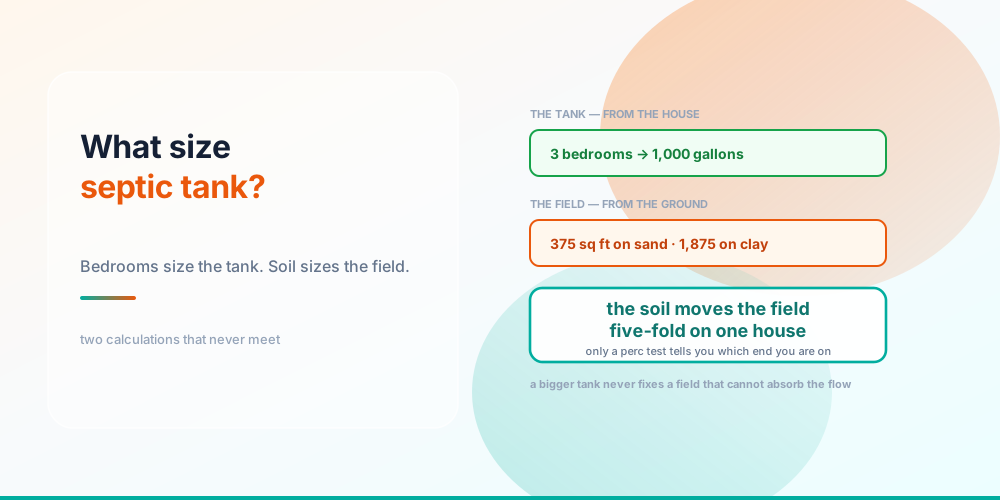
Ask what size septic tank a house needs and you will be told a number of gallons. That answer is half a system, and it is the half that almost never turns out to be the expensive one.
A septic system is two sizing problems, and only one of them has anything to do with the house. The tank is set by how many bedrooms you have. The leach field is set by what the soil will absorb — and the soil can move the field area by a factor of five on a house that has not changed at all.
The two paths
One flow figure, two calculations that never meet
Everything starts from a design flow, and the design flow starts from bedrooms rather than people. That looks arbitrary until you notice why: occupancy changes, bedrooms do not. A house sold to a couple is sized for the family that buys it next.
150 gallons per bedroom per day is the allowance most jurisdictions use. A three-bedroom house is therefore designed for 450 gallons a day whether one person lives there or six.
Sizing the tank
The tank holds sewage long enough for solids to settle and grease to rise. Two days is the retention period most rules ask for, so the arithmetic is simply the daily flow doubled — and then compared against a floor.
Two candidates, and the larger one wins
Look at what that table actually says. A three-bedroom house produces 900 gallons of retention volume and a 1,000 gallon minimum, so the minimum governs. A four-bedroom house produces 1,200 against a 1,250 minimum — the minimum again. The calculation does not take over until five bedrooms, where 1,500 gallons of retention meets a 1,500 gallon floor exactly, and at six bedrooms retention finally pulls ahead at 1,800.
This is why almost every ordinary house gets a 1,000 or 1,250 gallon tank and why the answer feels like a lookup rather than a calculation. For the houses most people are asking about, it is one. Work your own numbers with the Septic Tank Size Calculator, which keeps both the per-bedroom allowance and the minimum editable because both vary by state.
Two things push a tank above the table. A garbage disposal adds solids the tank has to hold, and many health departments add capacity or require a second compartment for one. A whirlpool tub dumps 60 to 80 gallons in a few minutes, which is a hydraulic surge rather than a volume problem, but several jurisdictions treat it as both.
Sizing the field — where the money is
The leach field is where the effluent leaves the system and enters the ground. Its area is the daily flow divided by how much the soil will accept per square foot per day, and that rate is the single most variable number in residential plumbing.
One house, five soils, a five-fold swing
375 square feet on sand. 1,875 square feet on slow clay. A 5.0x swing, same house. In trench terms that is 125 feet of trench against 625 feet — the difference between a corner of the garden and a substantial earthworks job, and it is decided entirely by what a soil scientist finds in a hole.
That is what a percolation test measures: how many minutes the water level takes to drop one inch in a pre-soaked hole. Fast soil, small field. Slow soil, big field. Slow enough and conventional trenches stop being permitted at all, and the site moves to a mound, a sand filter, or a drip dispersal system — a different budget entirely.
Do not buy land for a house without knowing the perc result. It is the one plumbing number that can make a plot unbuildable.
What the tank does not do
A common misreading is that a bigger tank compensates for a poor field. It does not. The tank separates solids; the field disposes of liquid. Every gallon that enters the tank leaves it the same day, so doubling the tank buys settling time, not disposal capacity. A field that cannot absorb 450 gallons a day will fail behind a 2,000 gallon tank exactly as it fails behind a 1,000 gallon one — it will just take slightly longer to show.
The reverse is also true. An oversized field does not let you shrink the tank, because the tank’s job is retention time and retention time is set by flow.
Reserve area, setbacks, and the things that shrink a lot
Sizing the field is not the same as fitting it. Most jurisdictions require a reserve area — a second, equally sized, undisturbed piece of ground held for the replacement field the system will eventually need. On slow clay that means finding room for 1,875 square feet twice.
Then the setbacks come off: distance to the well, to property lines, to surface water, to the foundation, to any cut bank. A generous-looking acre can lose most of its usable ground to them.
Where sizing goes wrong
Counting people instead of bedrooms. The code counts bedrooms because it is sizing the house, not the household. A den with a closet and a window is a bedroom to an inspector.
Skipping the perc test because the neighbour’s system is fine. Soil changes over tens of feet. The house next door tells you the region, not the site.
Sizing the field on the tank. They are independent. Nothing about a 1,000 gallon tank implies a field area.
Forgetting the reserve area. Designing a field that exactly fits the available ground usually means the permit is refused, because there is nowhere for the replacement.
Adding a bedroom later. A finished basement bedroom raises the design flow by 150 gallons a day and can put the existing system out of compliance. Some jurisdictions will not approve the remodel without a system upgrade.
Going deeper on the ground
The soil side is the half that decides whether a plot is buildable, and it is worth understanding on its own — what the test actually involves, which step decides the answer, and what happens when the ground fails. Perc tests and leach field sizing covers it, including the alternatives once conventional trenches stop being permitted.
Frequently asked questions
What size septic tank do I need for a 3 bedroom house?
1,000 gallons in most jurisdictions. Three bedrooms at 150 gallons per bedroom per day is a 450 gallon design flow, which needs 900 gallons of two-day retention — less than the 1,000 gallon minimum, so the minimum governs. A garbage disposal or a whirlpool tub can push it to the next size.
How is septic tank size calculated?
Daily design flow multiplied by the required retention period, usually two days, then compared against the jurisdictional minimum for the bedroom count. The larger of the two is the tank. On houses up to four bedrooms the minimum is almost always the larger, which is why the answer looks like a table.
Why is septic size based on bedrooms and not people?
Because occupancy changes and bedrooms do not. A system sized for the two people living there today would be undersized the moment the house sells to a family of five. Sizing on bedrooms sizes for the house across its whole life.
How big does a leach field need to be?
Daily flow divided by the soil application rate from a perc test. For a three-bedroom house at 450 gallons a day, that is 375 square feet on sand and 1,875 square feet on slow clay — a five-fold range decided purely by the ground. There is no way to know which end you are on without the test.
What is a perc test and do I really need one?
A percolation test measures how fast water drains from a hole in the ground, in minutes per inch. It is what sets the leach field area, and it is required nearly everywhere for a new system. Skipping it is not an option a permitting authority offers.
Does a bigger septic tank fix a failing leach field?
No. The tank settles solids; the field disposes of liquid. Every gallon in leaves the same day, so extra tank volume buys settling time and nothing else. A field that cannot absorb the daily flow will fail regardless of the tank in front of it.
Do I need a bigger tank if I have a garbage disposal?
Usually. A disposal adds suspended solids that consume settling capacity and shorten the interval between pump-outs. Many health departments respond by requiring the next tank size up, a two-compartment tank, or an effluent filter. Check the local rule — this is one of the requirements that varies most.
What happens if my septic tank is too small?
Retention time falls, solids leave with the effluent instead of settling out, and they reach the leach field. Solids clog the soil interface, the field stops absorbing, and effluent surfaces or backs up. The tank can be pumped; a field clogged with solids usually has to be replaced.
Is septic tank sizing in the plumbing code?
Not the IPC. The International Plumbing Code explicitly hands private sewage disposal off to other documents — the International Private Sewage Disposal Code where adopted, and state and county health departments everywhere else. Septic requirements vary more between jurisdictions than anything else in plumbing, so treat every figure here as a common default rather than a rule.
Sources & standards: Design flow at 150 gallons per bedroom per day, a two-day retention period, and the minimum tank capacities by bedroom count are widely used values from state onsite-wastewater rules and the International Private Sewage Disposal Code where it is adopted — they are not IPC requirements. The IPC deliberately excludes private sewage disposal. Soil application rates against percolation rate are indicative only and are among the most jurisdiction-specific numbers in the trade, which is why the calculator leaves both the per-bedroom allowance and the application rate editable. Your county health department, not this page and not the IPC, sets the numbers your permit will be judged against. Have the site perc-tested and the design stamped by whoever your jurisdiction requires.