
PEX vs Copper vs CPVC: Bore, Cost, and Why PEX Needs a Size Up
- 02 Sep, 2026
Most comparisons of these three argue about cost and installation speed. Those matter. But there is a hydraulic difference underneath that decides the size you buy, and it is routinely missed.
Nominal size is a label, not a dimension. Three pipes all called “3/4 inch” bore three different holes.
The bores
Same nominal size, four different holes
At nominal 1 inch: copper Type L bores 1.025 in, CPVC Schedule 40 bores 1.049, and PEX bores 0.875.
PEX is outside-diameter controlled — its OD matches copper tube so the fittings interchange — but its wall is much thicker to handle the pressure at that material’s strength. Thicker wall, same outside, smaller hole.
And the gap widens with size. PEX holds 79.6% of copper’s flow area at 1/2 inch and only 69.3% at 2 inch. Upsizing does not close it.
The result that decides the argument
Here is where intuition fails. PEX has a better friction coefficient than copper — Hazen-Williams C of 150 against 140. Smoother wall, less drag. So it should perform at least as well.
10 gpm through nominal 3/4 inch — the best C factor loses
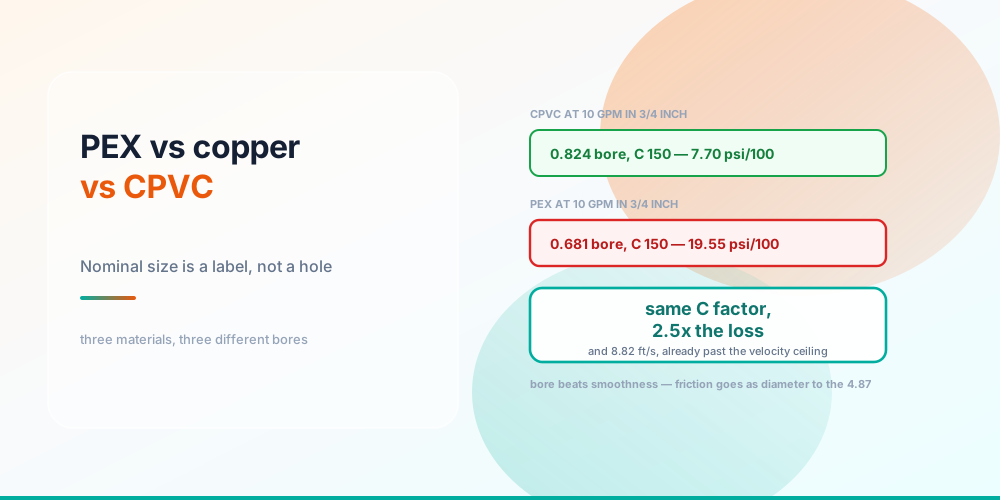
At 10 gpm through nominal 3/4 inch:
- CPVC — 7.70 psi per 100 ft, 6.02 ft/s
- Copper Type M — 9.45 psi per 100 ft, 6.21 ft/s
- Copper Type L — 11.08 psi per 100 ft, 6.63 ft/s
- PEX — 19.55 psi per 100 ft, 8.82 ft/s
PEX loses 2.5 times what CPVC does at the identical C factor. And at 8.82 ft/s it is already past the 8 ft/s cold ceiling — that pipe is not just lossy, it is noisy.
The reason is the exponent. In Hazen-Williams, friction loss goes as diameter to the power of 4.87. Shrink the bore 13% and loss rises about 90%. No plausible improvement in wall smoothness competes with that.
Bore beats smoothness. The practical rule: when you substitute PEX for copper on a sized drawing, go up a nominal size on mains and long branches. Short fixture drops are usually fine as they are. Check any specific case with the Water Pipe Size Calculator or the Pipe Velocity Calculator.
But bore is only one axis
If hydraulics were the whole story, nobody would use PEX. They use it for good reasons that have nothing to do with flow.
Choosing between them — bore is only one axis
PEX installs fastest, with far fewer joints — a run can go home-run from a manifold with no fittings in the wall at all, and a joint you never made is a joint that never leaks. It expands rather than splits when water in it freezes, which in a cold climate is worth more than any friction number. It is cheapest. Against that: it needs a size up, it degrades in sunlight (never run it exposed outdoors), and rodents will chew it.
Copper bores the most flow per nominal size, tolerates UV and heat, and has a track record measured in decades. It is rigid, which some installers prefer for support and appearance. Against that: it is the most expensive, the slowest to install, it splits when frozen, and it is sensitive to water chemistry and to velocity — which is exactly why the hot-side limit is 5 ft/s rather than 8. Aggressive water plus high velocity produces pinhole leaks, and they cluster at elbows on the hot side.
CPVC has the best bore of the three and the same C factor as PEX, so hydraulically it is the strongest performer here. It is cheaper than copper and handles hot water. Against that: it is rigid, needs solvent-welded joints at every direction change, becomes brittle with age and UV, and is intolerant of some fire-stop and thread sealants that will crack it.
What this means for a repipe
Material choice moves the total less than people expect, because labour and drywall repair are shared across all three. On an 1,800 ft² house, PEX runs about $10,950 and copper about $18,150 — a $7,200 premium. Wall access moves the number further than material does. The full breakdown is in how much does it cost to repipe a house, and the Repipe Cost Calculator takes your own inputs.
The one thing to get right at the design stage: repiping a copper house in PEX at the same nominal sizes quietly downgrades it. Same labels on the pipe, 25 to 30% less flow area throughout. If the original system was marginal, the new one will be worse, and it will be blamed on the fixtures.
One place PEX’s small bore is an advantage
There is exactly one, and it is worth knowing.
The wait for hot water at a tap is the volume of water already sitting in the line. A 50 ft run at 2 gpm clears in 38 seconds in 3/4 inch copper and 28 seconds in 3/4 inch PEX, because PEX holds less. Over a year at four draws a day, that is 1,835 gallons poured down the drain in copper against 1,379 in PEX.
Same property, opposite sign. Full treatment in why hot water takes so long.
Frequently asked questions
Is PEX better than copper?
For most residential repipes, PEX wins on installed cost, speed, joint count and freeze tolerance. Copper wins on flow per nominal size, UV and heat tolerance, and track record. The decision usually comes down to climate and budget rather than performance — but size the PEX a step up.
Does PEX need to be a bigger size than copper?
Usually yes, by one nominal size on mains and long branches. A nominal 1 inch PEX tube bores 0.875 in against copper Type L’s 1.025 — about 27% less flow area — and friction goes as diameter to the 4.87 power, so PEX’s better C factor of 150 cannot make up the difference.
Why does PEX have more friction loss than copper if it is smoother?
Because bore beats smoothness. PEX’s Hazen-Williams C of 150 is better than copper’s 140, but at 10 gpm in nominal 3/4 inch, PEX loses 19.55 psi per 100 ft against copper’s 11.08 — its bore is 0.681 in against 0.785. Loss scales with diameter to the 4.87 power, which overwhelms any C-factor advantage.
Is CPVC better than PEX?
Hydraulically, yes — CPVC bores 0.824 in at nominal 3/4 against PEX’s 0.681, at the same C factor, so it loses 7.70 psi per 100 ft against PEX’s 19.55. But CPVC is rigid, needs a solvent-welded joint at every turn, and becomes brittle with age and UV. PEX is faster to install and survives freezing better.
Can PEX be used outside?
Not exposed. PEX degrades in sunlight, and manufacturers publish limited UV exposure allowances measured in months. It can be buried or run in conduit, but a run of PEX in daylight is a run with a clock on it.
Which pipe is best for hot water?
All three handle domestic hot water. Copper tolerates the highest temperatures and UV; CPVC is rated for hot but embrittles with age; PEX handles hot well and holds less water, so the wait at the tap is shorter. Keep hot-side velocity under 5 ft/s in copper — erosion-corrosion accelerates with temperature.
Does copper last longer than PEX?
Copper has the longer track record, measured in decades, and that is a genuine advantage. But copper in aggressive water at high velocity develops pinhole leaks, sometimes within fifteen years, while PEX has no comparable failure mode. Longevity depends more on water chemistry and design velocity than on material alone.
What is the cheapest pipe for a whole-house repipe?
PEX, by a wide margin. On an 1,800 ft² house PEX runs about $10,950 against copper’s $18,150 — a $7,200 difference. But wall access moves the total more than material does: the same house behind plaster and tile runs $16,350 in PEX alone.
Sources & standards: pipe inside diameters are computed from published outside diameter and wall thickness per ASTM B88 (copper tube), F876 (PEX, which reproduces the SDR-9 relationship exactly) and D1785 (Schedule 40), not transcribed. Friction figures use Hazen-Williams with C factors of 140 for copper and 150 for PEX, CPVC and PVC. Velocity limits of 8 ft/s cold and 5 ft/s hot are ASPE and manufacturer design practice, not IPC numbers. Cost figures are 2026 US national-average assumptions carried in the repipe cost model. The IPC is a model code — confirm the edition your jurisdiction adopts, and have a licensed plumber sign off anything installed.