
Why Hot Water Takes So Long — and Why a Bigger Pipe Makes It Worse
- 02 Sep, 2026
Nothing is wrong with your water heater.
The water heater made hot water minutes ago and it is sitting there, hot, waiting. What is standing between it and the tap is a pipe full of water that went cold since the last time anyone used it. You have to push all of that out before a single drop of hot water arrives.
The wait  =  the volume of water in the hot line
             divided by the flow rate at the tap

Nothing about the heater appears in that equation.
The arithmetic
Gallons per foot is a clean formula:
gal per ft = 0.0408 x d² (d = actual bore, inches)That derives from π/4 × d² × 12 ÷ 231 — the 231 being cubic inches in a US gallon. Nothing approximate about it.
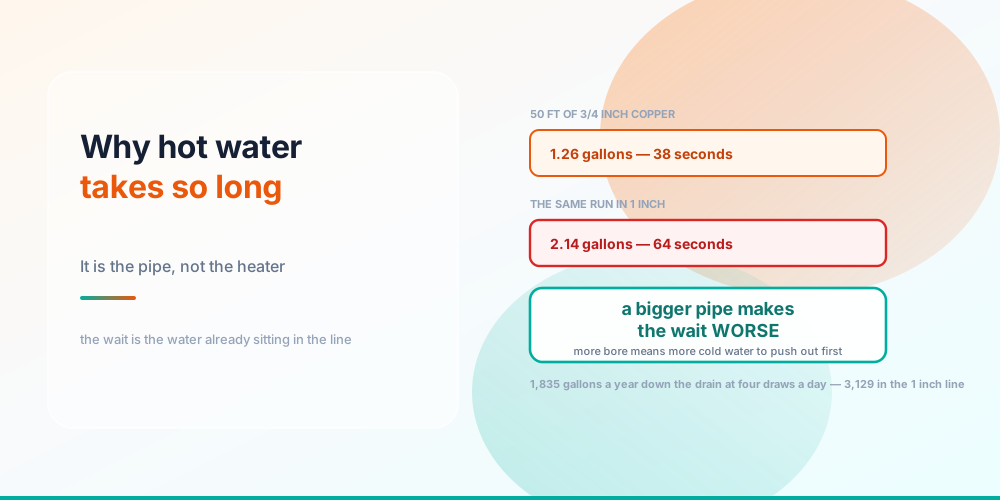
A 50 ft run of 3/4 inch copper (bore 0.785) holds 1.26 gallons. At 2 gpm that is 38 seconds. The Pipe Volume Calculator does it for any run.
The part that surprises people
50 ft of hot line at 2 gpm — how long before it runs hot
Look at the copper rows. 1/2 inch: 18 seconds. 3/4 inch: 38 seconds. 1 inch: 64 seconds.
Upsizing the hot line makes the wait worse. Substantially worse — going from 3/4 to 1 inch nearly doubles it.
This runs against every instinct. Bigger pipe means more flow, more flow means it arrives faster, surely? No. Bigger pipe means more stored volume, and the stored volume is precisely what you have to evacuate first. The flow rate at the tap is set by the fixture, not the pipe, so a fatter pipe just means more cold water queued ahead of the hot.
Which means the single most common instinct here — “we’ll run a bigger hot line to the far bathroom” — is exactly backwards. It is also the one situation in the whole plumbing system where PEX’s small bore is an advantage: 3/4 inch PEX holds 0.94 gallons against copper’s 1.26, so the same run clears in 28 seconds instead of 38. Everywhere else that small bore is a liability — see PEX vs copper vs CPVC.
Distance is the dominant term
Distance decides it — 3/4 inch copper at 2 gpm
Ten feet is an 8 second wait. A hundred feet is 75 seconds and two and a half gallons, every single time.
The relationship is linear in length and inverse in flow rate, so a low-flow fixture makes it worse: at 50 ft in 3/4 inch copper, a 2.5 gpm shower waits 30 seconds while a 1 gpm bathroom faucet waits 75. Aerators that save water at the tap lengthen the wait at the tap, and a good deal of the saving goes down the drain during it.
What it costs over a year
What the wait costs over a year
Four draws a day through 50 ft of 3/4 inch copper is 1,835 gallons a year. The same run in 1 inch copper is 3,129 gallons. In 3/4 inch PEX it is 1,379.
A swing of more than 1,700 gallons a year on the same house, with the same heater and the same habits, decided entirely by what is in the wall. And you paid to heat every gallon of it.
What actually fixes it
Shorten the run. By far the most effective and the only one that is free — at the design stage. Put the heater near the fixtures that get used most, or accept a longer run to the guest bathroom rather than the primary one. Retrofitting this is expensive; getting it right on a new build costs nothing.
Smaller bore on the hot side. Size the hot line for the fixtures it serves, not for the main. A dedicated 1/2 inch run to a distant bathroom beats a 3/4 inch branch off a trunk, and holds less than half the water.
A recirculation loop. A pump keeps hot water moving so it is always at the fixture. It genuinely solves the wait. The honest caveat: a continuously running loop wastes standby heat all day, which can cost more energy than the water it saves. Use a timer, a demand button, or a thermostatic control — a loop running 24/7 to save 38 seconds is a poor trade.
A point-of-use heater. A small unit under the far sink. Effective for one fixture, and it needs power and space.
Structured or manifold plumbing. Home-run 3/8 or 1/2 inch lines from a central manifold to each fixture. Minimises volume per run and is a natural fit for PEX. Best done at build time.
What does not fix it
A bigger water heater. The heater is not the constraint. A 75 gallon tank sits exactly as far away as a 40 gallon one.
A tankless heater. Slightly worse, if anything — the unit has to sense flow and fire before it starts producing, adding a moment on top of the pipe volume. If the complaint is wait time, a tankless conversion will not address it. See tankless water heater sizing.
Turning up the thermostat. Hotter water still travels at the same speed through the same pipe. It makes the tap hotter when it arrives, not sooner.
A bigger hot line. Covered above, and worth repeating because it is the most common suggestion: it makes the wait longer.
The number underneath all of this
Everything on this page is one figure divided by a flow rate, and that figure is pure geometry: how many gallons are in a pipe derives it from the area of a circle and shows why the bore, not the nominal size, is the input that matters.
There is also a setting on the heater that changes the arithmetic. Storing at 140 and mixing down to 120 means a smaller share of every draw comes from the tank — safer at the tap, and it makes a 50 gallon tank behave like 64: water heater temperature.
Frequently asked questions
Why does it take so long for hot water to reach my tap?
Because the pipe between the heater and the tap is full of water that has gone cold, and all of it has to be pushed out first. A 50 ft run of 3/4 inch copper holds 1.26 gallons, which at 2 gpm takes 38 seconds. The heater plays no part in that number.
Does a bigger pipe get hot water faster?
No — it makes it slower. A bigger pipe stores more water, and the stored water is exactly what you have to evacuate. 50 ft of 1/2 inch copper clears in 18 seconds; the same run in 1 inch takes 64. Flow at the tap is set by the fixture, not the pipe.
How much water is wasted waiting for hot water?
The full contents of the hot line, every time. At four draws a day through 50 ft of 3/4 inch copper that is 1,835 gallons a year — and 3,129 gallons if that line is 1 inch. All of it heated and none of it used.
Will a recirculation pump fix the wait?
Yes, that is what it is for. The caveat is standby loss: a loop running continuously bleeds heat from the pipe all day and can cost more energy than the water it saves. Run it on a timer, a demand button or a thermostatic control rather than constantly.
Will a tankless water heater give me hot water faster?
No, slightly slower. The pipe volume is unchanged, and a tankless unit adds a moment to sense flow and fire before it produces anything. Wait time is a distribution problem; changing the heater does not touch it.
How do I calculate the wait time?
Volume divided by flow. Gallons per foot is 0.0408 × bore², so multiply by the run length and divide by the fixture’s gpm. Fifty feet of 3/4 inch copper at 2 gpm is 1.26 ÷ 2 × 60 = 38 seconds. The Pipe Volume Calculator does it directly.
Does PEX get hot water faster than copper?
Yes, and it is the one place PEX’s small bore helps. Nominal 3/4 inch PEX bores 0.681 in against copper’s 0.785, so a 50 ft run holds 0.94 gallons instead of 1.26 — 28 seconds instead of 38. Everywhere else that small bore costs you a pipe size.
Do low-flow fixtures make the wait longer?
Yes. The wait is volume divided by flow, so halving the flow doubles the wait. At 50 ft in 3/4 inch copper, a 2.5 gpm shower waits 30 seconds and a 1 gpm faucet waits 75 — and much of the water a low-flow aerator saves goes down the drain during the longer wait.
Sources & standards: the volume relationship gal per ft = 0.0408 × d² derives from π/4 × d² × 12 ÷ 231, where 231 cubic inches is one US gallon — validated in the library against published gallons-per-foot figures. Pipe inside diameters are computed from ASTM B88 (copper) and F876 (PEX) dimensions rather than transcribed. Waste figures assume four hot draws per day and a 2 gpm fixture; your own usage will differ. Recirculation standby losses vary widely with pipe insulation, loop length and control strategy. The IPC is a model code — confirm the edition your jurisdiction adopts, and have a licensed plumber sign off anything installed.