
Markup vs Margin for Plumbers: 25% Markup Is a 20% Margin
- 04 Sep, 2026
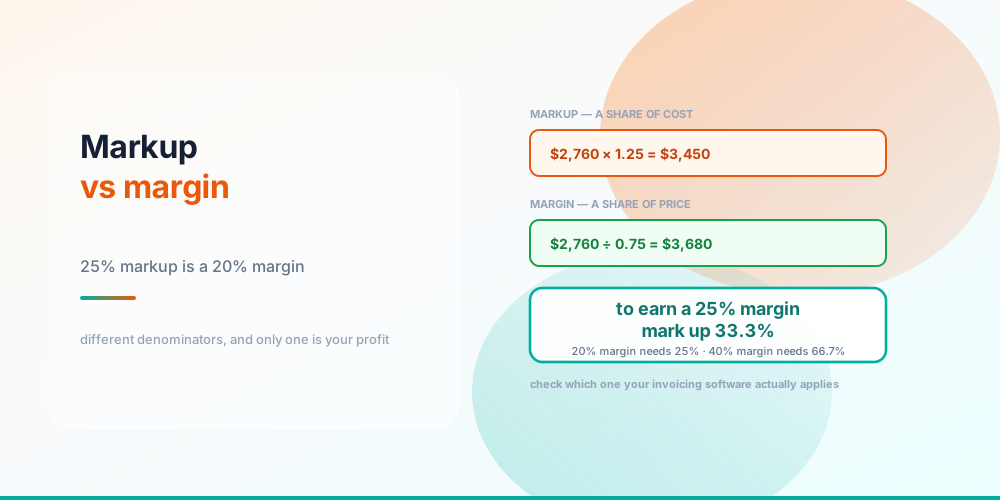
Markup and margin are the same profit expressed two ways, and mixing them up is the most expensive typo in the trades. A 25% markup delivers a 20% margin. Not approximately — exactly, every time, on every job of every size.
Why they differ at all
One profit, two denominators
Take a job that costs $2,760 and sells for $3,450. Profit is $690 either way.
Markup divides by cost. $690 ÷ $2,760 = 25%.
Margin divides by price. $690 ÷ $3,450 = 20%.
Same profit, same job, two different percentages — because price is always larger than cost. That is the whole thing, and it means markup and margin can never be equal. Margin is always the smaller number.
The conversion, both directions
The conversion, both ways
markup = margin ÷ (1 − margin) margin = markup ÷ (1 + markup)
To hit a target margin, mark up by:
- 10% margin → 11.1% markup
- 20% margin → 25.0% markup
- 25% margin → 33.3% markup
- 30% margin → 42.9%
- 40% margin → 66.7%
- 50% margin → 100% markup — you double the cost
And if you use the margin figure as a markup instead, here is what you actually get:
- 20% used as markup → 16.7% margin
- 25% → 20.0%
- 30% → 23.1%
- 40% → 28.6%
Read that column downward and notice the shortfall growing: 3.3 points at 20%, 5.0 at 25%, 6.9 at 30%, 11.4 at 40%. The more ambitious your target, the more the confusion costs you. The shops working hardest to be profitable lose the most to it.
The relationship is scale-free — it holds identically on a $200 service call and a $40,000 repipe, which is why it is worth memorising rather than recalculating.
What it costs across a year
Per job it is a shrug. Per year it is a van.
At a 25% target on a $2,760 job, the gap is $230. Easy to shrug at.
Across 192 jobs a year it is $44,160.
And nothing else about the business changed. No job was priced differently on site, no material was bought worse, nobody worked slower. That is a full technician’s cost, lost to one operator on a keyboard.
At a 40% target the same arithmetic gives $141,312.
Three places it hides
Your software. Ask which one your invoicing or estimating system applies when you enter a percentage. Many apply markup and label the field “margin”, or use the terms interchangeably in different screens. This is worth ten minutes and a test invoice.
Supplier conversations. A supplier talking about “margin on materials” and a contractor hearing “markup” are having two different conversations about the same number.
Flat-rate books. A book built by applying markup where margin was intended bakes the error into every task, permanently, and it is invisible afterwards because the prices look deliberate.
Getting it right
Decide in margin. Margin is a share of revenue, which is what your accounts are built from and what you compare against benchmarks. Markup is an operator, not a goal.
Convert once, then use the markup. If your process is easier with markup, convert your target margin to a markup and write it down. For a 25% margin the number is 33.3%, not 25%.
Check that the cost you mark up is the real cost. Markup on direct cost alone, with overhead forgotten, is a second and independent error — and the two compound. The full build-up is in how to estimate plumbing jobs, and the Plumbing Job Estimate Calculator shows both prices side by side so the difference is visible rather than assumed.
Check your labour rate too. If the loaded rate is wrong, every margin on top of it is wrong — plumber hourly rate.
Electricians hit the identical trap, worked through in markup vs margin for electricians.
Frequently asked questions
What is the difference between markup and margin?
Both express the same profit; they differ in the denominator. Markup is profit as a share of cost. Margin is profit as a share of price. On a job costing $2,760 sold for $3,450, the $690 profit is a 25% markup and a 20% margin — same money, two numbers.
What markup do I need for a 25% margin?
33.3%. The formula is markup = margin ÷ (1 − margin). For 20% margin use 25% markup, for 30% use 42.9%, and for a 50% margin you have to double the cost — a 100% markup.
Is a 25% markup the same as a 25% margin?
No, and it never can be. A 25% markup delivers exactly a 20% margin. Because price is always larger than cost, margin is always the smaller percentage of the two, and the two are equal only at zero.
How much does confusing markup and margin cost?
On a $2,760 job at a 25% target it is $230. Across 192 jobs a year that is $44,160 — a full technician’s cost — with nothing else about the business changed. At a 40% target the annual figure is over $141,000.
Which should I use for pricing?
Set your target in margin, because that is what your accounts and any industry benchmark are expressed in. Then convert it once to a markup if your process is easier that way, and write the converted number down so nobody re-enters the margin figure by mistake.
Does my estimating software use markup or margin?
Worth checking rather than assuming — many apply markup and label the field “margin”, and some use the terms differently on different screens. Enter a known cost and a known percentage on a test invoice and check the output against both formulas.
Why does the error get worse at higher percentages?
Because the gap between the two denominators grows with the profit. At a 10% target the shortfall is under a point; at 25% it is 5.0 points; at 40% it is 11.4. The shops aiming for the highest returns lose the most to the confusion.
Does this apply to materials as well as labour?
To everything you price. Any cost you add a percentage to is subject to it — fixtures, materials, subcontractors, the whole job. The formula is scale-free, so it behaves identically on a $200 part and a $40,000 repipe.
Sources & standards: This is business arithmetic rather than code, and the conversion identities — markup = margin ÷ (1 − margin) and margin = markup ÷ (1 + markup) — are exact and scale-free. The dollar figures use the same illustrative job as this site’s plumbing estimate calculator (10 hours at $110, an $850 fixture, $450 of materials, 15% overhead) so the post and the calculator cannot disagree; substitute your own. The 192 jobs a year used for the annual figures is an illustration, not a benchmark — use your own job count and average job size, since the annual number scales directly with both. Nothing here substitutes for your own accounts or your accountant.